


Image refresh rate can be a critical parameter
After reviewing the main milestones of the development of thermal cameras from the initial exploratory tools to today's matrix thermal cameras in the introductory chapter of our series, we will focus on the image refresh rate of thermal cameras and then on detector readout methods.
When is it a critical parameter?
Based on the above, the image refresh rate of a thermal camera is critical for any task where temperature changes need to be examined. If the change to be recorded has a period of 1/10 second, then a minimum of 20 Hz (preferably 25 Hz) image refresh rate is required. In the case of power electronics devices, often heatings with frequencies of up to 300 Hz occur, requiring an image refresh rate above 600 Hz for recording (which can only be achieved with photon detector thermal cameras). Further examples include the need for exceptionally fast photon detector thermal cameras in detecting tool and workpiece heating in machining technologies, observing the surface temperatures of vehicle airbags, researching the temperatures of pyrotechnic processes, or examining impacts of mechanical shocks.
The list could go on, but do not be led to the mistaken conclusion that in the case of slow (or even steady-state) thermal processes, the image refresh rate of the thermal camera may not be a critical parameter for the feasibility of the measurement. For moving measurement objects or a moving thermal camera, it is equally important that the thermal camera is fast enough.
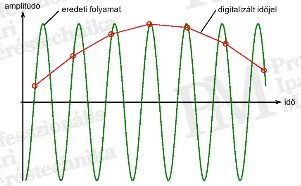 |
| Figure 1: Undersampling error due to violation of Shannon's law [source: PIM] |
For microbolometer thermal cameras, the integration time that determines their image refresh frequency limits how fast moving objects can still be correctly detected. The maximum speed is the value at which during the integration time, the object surface detected by an individual detector elongates so much in the direction of motion that this sensing surface "runs off" the object surface during the integration time.
Numerical example: If we want to detect a 15 mm wide object with a 30 Hz refresh rate (typically with a 25 ms integration time) and a 2 mrad geometric resolution thermal camera from a distance of 1 m, then the maximum speed between the thermal camera and the object (parallel to the object surface) can be calculated as follows: 2 mm + 25 ms * x m/s < 15 mm, where x is the maximum speed. Therefore, based on the above equation, the maximum speed is 0.52 m/s, which is only 1.87 km/h.
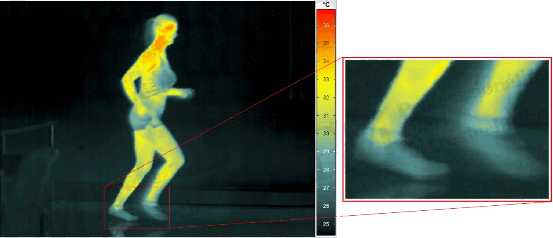 |
| Figure 2: Blurring of thermal image due to fast object motion - enlarged view of running legs [source: PIM] (slowly moving body + left leg on the ground --> sharp, hands and right leg in fast motion --> blurred) |
There are serious problems even when trying to take detailed thermal images or measurements from a distance with a handheld thermal camera. It is a known fact in photography that a skilled - steady-handed - photographer can take motionless photos even at 1/60 shutter speed (without a tripod), while an amateur with shaky hands can sometimes result in blurred images at 1/125 shutter speed. These shutter speeds represent 17 ms and 8 ms integration times, respectively. What skill is required to capture motionless thermal images holding a 30 Hz, or even just 15 or 9 Hz thermal camera by hand? To achieve this, one would need to hold the device motionless for 30-40 ms, which is practically impossible. In other words, for handheld operation, only thermal cameras with integration times shorter than 15 ms can safely capture motionless thermal images. This is generally provided only by 50 Hz and faster thermal cameras; slower thermal cameras are unsuitable for handheld shots.
 |
| Figure 3: Blurring of thermal image due to camera movement (e.g., hand tremor) [source: PIM] |
Detector Readout Methods
For moving or rotating objects, or a thermal camera in motion relative to the object, the metrological applicability of thermal cameras depends not only on the previously discussed image refresh frequency but also on the method of reading out pixel data. Two main methods are commonly implemented: line-by-line readout (applicable for both thermal and photon detectors) and the so-called snap-shot readout. The latter is exclusive to certain photon detectors, as the slowness of thermal detectors, such as microbolometers (with integration times of 6-20 ms), renders this technology completely impractical.
Serial Readout
If we consider an average 320×240 pixel matrix sensor, this represents 78,600 individual detectors. It is obvious that for the digitization of the analog electrical output signals per pixel, it is not practical to use the same number of samplers and analog-to-digital (AD) converters due to their large space and energy requirements, as well as costs. Therefore, only a single circuit with 240 samplers-AD converters equivalent to one row is used to read out the sensor's 320 rows one after another (incrementally). We zero the signals of the detectors in the first row, start their measurement (integration) time, and then do the same slightly later with the second, third, and subsequent rows.
Meanwhile, the integration time of the sensors in the first row has elapsed, so we can now read out their measurement data. Moving on individually, we will do the same with the remaining rows until we reach the last one. During this process, the integration time of the first rows has already been restarted for the next readout cycle. In practice, the process can be described as if the sensors were continuously integrating, and by stepping through row by row, we interrupt this with a readout and reset.
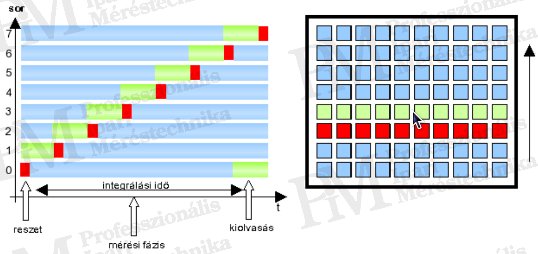 |
| Figure 4: Timing diagram for serial readout [source: PIM] |
The consequence of serial readout is that the representation of moving objects becomes distorted, as illustrated in Figure 5 (the faster the motion, the greater the distortion.) The reason for this is that the measurement data line by line were not generated at the same time, but one after the other - similar to a multiplexed multi-channel measurement system.
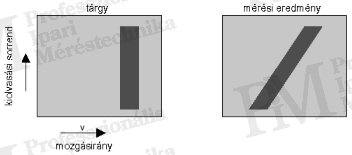 |
| Figure 5: Distortion of moving objects representation due to serial readout [source: PIM] |
Snap-shot technology
The issue related to the detection of moving or rotating objects can be solved with snap-shot technology. However, its application only makes sense with sufficiently fast (even just 10 µs integration time) photon detectors. Compared to them, with thermal detectors (e.g., microbolometers) that are slower by several orders of magnitude, the representation of moving objects would be blurred anyway due to the long integration time. (To be continued in the next issue.)
Rahne Eric (PIM Ltd.) pim-ltd.com, gepszakerto.com
The content of the publication is protected by copyright, and its (even partial) use, electronic or printed republishing is only allowed with the indication of the source and the author's name, as well as with the author's prior written permission. Infringement of copyright will have legal consequences.
Copyright © PIM Professzionális Ipari Méréstechnika Kft.
2026 | Minden jog fenntartva
Impresszum | Adatkezelés