


Thermographic devices suitable for contactless temperature measurement (infrared cameras with thermographic capabilities) have undergone rapid development in recent years. Considering that these devices appeared just 50 years ago, they have now grown into one of the most well-known and versatile inspection tools, so it's no surprise that the market offers a wide variety of options (manufacturers, types). For a customer planning to purchase a thermal camera, the issue is no longer the lack of suitable types but rather the overwhelming variety of choices. Therefore, it is time to review the development and types of these instruments from a professional perspective and organize the current offerings based on some important technical parameters. The measurement technology implemented in the cameras and the available accessories determine the device's application area, as well as the expected measurement accuracy and the achievable thermal image quality.
Scanning thermal cameras - the "disappeared" peak technology of the early days
The very first commercially available thermal cameras designed for temperature measurement were primarily produced in scanning (point-scanning) format. These cameras use only a single-element ("point") detector to convert the infrared radiation and mechanically scan the object with a mechanical (mirror or lens) system. Since this imaging principle requires a high-speed (photon) detector and high-precision mechanics, it is quite expensive to manufacture, requires cooling, and due to the mechanical components, has a limited lifespan. However, it has a significant advantage over all other methods: each signal corresponding to a single image point is captured by the same detector. Thus, data from every point in the thermal image are created under perfectly identical conditions, resulting in excellent image homogeneity (and even a thermal image resolution of up to 10mK). The slowness of image acquisition (typically only one image per second) and the other disadvantages mentioned earlier have led to the fact that this thermal camera technology is now only available as used equipment at best.
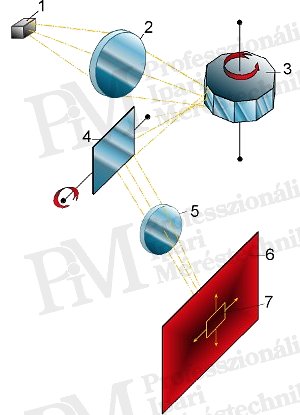
Figure: Conceptual structure of scanning thermal cameras [source: Infratec]
(1 detector, 2+5 lenses, 3 horizontal deflecting mirror, 4 vertical deflecting mirror, 6 object, 7 measurement surface)
Matrix detector thermal cameras - the "common" design of modern thermal cameras
In matrix detector thermal cameras, thousands of individual sensors are arranged in a matrix-like manner to simultaneously detect the thermal radiation of the object to be measured, eliminating the need for a mechanical deflecting unit. As a result, the camera is mechanically simpler, smaller, lighter (and cheaper). Although the optical path seems surprisingly simple, the devil is in the details: a major issue is that each individual sensor converts the thermal image of each pixel, and while their characteristics may be very similar to their neighbors, they are still measurably different. Compensating for this lack of uniformity requires a significant amount of real-time image processing, yet the image homogeneity achieved is still not comparable to scanning systems. However, with modern matrix detector thermal cameras - depending on the sensor technology used - achieving a thermal resolution of 30mK (or even 20mK) is now possible, which is sufficient for most applications, leading to the discontinuation of scanning thermal camera production.
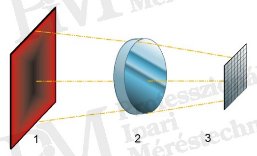
Figure: Conceptual structure of matrix detector thermal cameras
[source: Infratec] (1 detector, 2 lens, 3 object)
Sensors of modern matrix detector thermal cameras Fundamentally, two basic types are distinguished - thermal sensors and photon detectors. Thermal types are based on the principle that they heat up due to the infrared radiation (energy of electromagnetic waves), causing a change in one of their physical (electrical) parameters from which the necessary electrical signal can be extracted. In contrast, photon detectors provide an electrical signal proportional to the number of photons, but they require deep cooling (-150°C ... - 200°C) to operate. (Without cooling, disordered electron movement would hinder the occurrence of the exploitable physical effect.) Basic sensor technologies
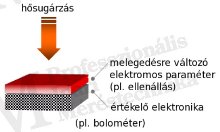
Figure: Operation of thermal detectors [source: PIM]
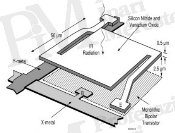
Figure: Schematic structure of a microbolometer [source: Infratec]
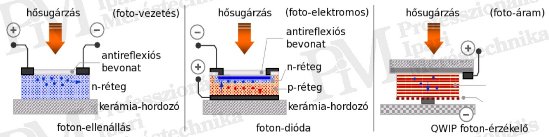
Figure: Structure and operation of photon detectors [source: PIM]
Various sensors exist for different wavelength ranges, depending on the material used. However, due to their weak thermal sensitivity, bolometers/microbolometers can only be used for the long-wave wavelength range. (Sufficiently high radiation intensity can only be expected in this range.) The following figure provides an overview of the technical possibilities.
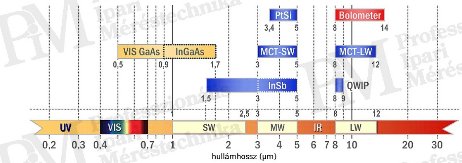
Figure: Infrared sensor wavelength ranges according to sensor materials
However, it is important to know that the sensor's wavelength range (spectral sensitivity) significantly influences the application areas of thermal cameras. (As a reminder: different - limited - wavelength ranges of thermal cameras are necessary due to the transmission properties of the atmosphere. Short, medium, and long-wave thermal cameras are made for this reason. While low-temperature objects (e.g., -80°C) cannot be measured with medium-wave 3 ... 5 µm thermal cameras, it is impossible to detect the thermal radiation of objects behind glass with long-wave 7.5 ... 14 µm thermal cameras. There are further application-related limitations regarding large (several hundred meters) measurement distances: these can only be achieved with long-wave thermal cameras. On the other hand, the detection of flame temperatures is mostly possible with medium-wave thermal cameras, but the reverse task - detecting object temperatures through flames without sensing flame temperature - can be achieved with long-wave thermal cameras. For many applications (detecting the temperature of thin foils, detecting gas leaks, measurements through special measurement windows such as vacuum chamber windows or furnace measurement windows), the appropriate wavelength range thermal camera and suitable infrared filters must be selected based on the material. This task requires special knowledge and experience, and to avoid costly mistakes, it is advisable to entrust it to a professional.
Thermal Camera Frame Rate (Frame Rate)
Thermal cameras with microbolometer-based matrix sensors exist with frame rates of 9, 15, 30, 50, 60, 120 Hz, or even 240 Hz - whether they are installed or portable (mobile) thermal cameras. Significantly higher frame rates - 850, and even 6000 or 9000 Hz - can be achieved with photon detector thermal cameras. The required frame rate depends on the time constant of the temperature change of the object, the speed of movement, or even the movement speed of our thermal camera. The time constant of the temperature change of the object (change "speed") - or more scientifically expressed: the frequency of the temperature process - is a serious requirement due to the operating principle of thermal cameras: thermal cameras (like all digital signal processing measuring systems) must also comply with the basic sampling rule - the Shannon theorem. The Shannon theorem requires that the sampling of the highest frequency component of the measured process should be at least twice the frequency required for digitization. If this law is not followed, undersampling occurs, which would lead, for example, in the case of periodic temperature fluctuations, to the apparent slower (lower frequency) temporal change of the recorded temperature process than the actual process (see the diagram below). This would lead to completely erroneous conclusions in many cases!
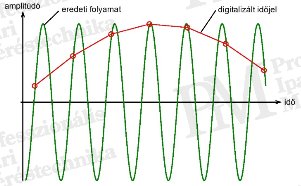
Figure: Undersampling error resulting from violating the Shannon theorem [source: PIM]
Based on the above, the frame rate of a thermal camera is critical for any task where temperature changes need to be examined. If the recorded change has a 1/10-second period), then a minimum of 20 Hz (preferably 25 Hz) frame rate is required. In the case of power electronics devices, heating with frequencies as high as 300 Hz is not uncommon, requiring a frame rate frequency above 600 Hz for recording (which can only be achieved with photon detector thermal cameras)! Further examples of the need for exceptionally fast photon detector thermal cameras include detecting tool and workpiece heating in machining technologies, observing the surface temperatures of car airbags, researching the temperatures of pyrotechnic processes, or examining impact-induced mechanical effects... The previous list could go on for a long time, but this should not lead to the mistaken conclusion that in the case of slow (or even steady-state) thermal processes, the frame rate of the thermal camera cannot be a critical parameter for the feasibility of the measurement. Because in the case of moving measurement objects or a moving thermal camera, it is equally important for the thermal camera to be fast enough. In the case of microbolometer thermal cameras, the integration time that determines their frame rate limits how fast moving objects can still be correctly detected. The maximum speed of movement is when during the integration time, the surface of an individual detector that is being sensed by the object extends so much in the direction of movement that this sensing surface runs off the object surface during the integration time.
Example: If we want to detect a 15 mm wide object with a thermal camera with a 30 Hz frame rate (typically with a 25 ms integration time) and a 2 mrad geometric resolution from a distance of 1 m, then the maximum speed between the thermal camera and the object (parallel to the object surface) can be calculated as follows: 2 mm + 25 ms * x m/s < 15 mm, where x is the maximum speed. Therefore, based on the above equation, the maximum speed is 0.52 m/s, which is only 1.87 km/h.
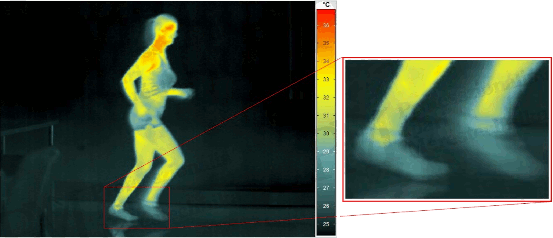
Figure: Blurring of thermal image due to fast object motion - enlarged view of running legs [source: PIM]
(slowly moving body + left foot on the ground --> sharp, hands and right foot in fast motion --> blurred)
Even when using a handheld thermal camera, there are serious problems if you want to create detailed thermal images or even measurements over longer distances. It is a well-known fact in photography that a practiced - steady-handed - photographer can take motionless photos even at a 1/60 shutter speed (without a tripod), while an "amateur" with shaky hands may result in blurred images even at a 1/125 shutter speed. These shutter speeds represent 17 ms and 8 ms of exposure time. What skill is required to capture motionless thermal images while holding a 30 Hz or even just a 15 or 9 Hz thermal camera by hand! To achieve this, you would need to hold the thermal camera motionless for up to 30 ... 40 ms, which is practically impossible. In other words, when handheld, only thermal cameras with integration times shorter than 15 ms can safely capture motionless thermal images. This is generally provided only by 50 Hz and even faster thermal cameras; slower thermal cameras are unsuitable for handheld recordings.
Figure: Blurring of thermal image due to camera movement (e.g., hand tremor) [source: PIM]
Detector Readout Methods In the case of moving or rotating objects or a thermal camera in motion relative to the object, the metrological applicability of thermal cameras depends not only on the discussed thermal image refresh rate but also on the method of pixel data readout. Two main methods are commonly implemented: line-by-line readout (applicable for both thermal and photon detectors) and the so-called "Snap-Shot" readout. The latter is exclusively a feature of certain photon detectors, as the slowness of thermal detectors (e.g., microbolometers with integration times of 6 ... 20 ms) renders this technology completely meaningless. Line-by-line readout: Taking an average 320x240 pixel matrix sensor as a basis, this represents 78,600 individual detectors. It is obvious that to digitize the analog electrical output signal of each pixel, it is not practical to use an equal number of samplers and AD converters (due to space and energy requirements and costs). Therefore, only a single circuit with 240 samplers - AD converters corresponding to a single row is used to sequentially "read out" the 320 rows of the sensor. First, we zero the "signals" of the detectors in the first row and start their measurement (integration) time, then shortly after, we do the same with the second, third, and subsequent rows. Meanwhile, the integration time of the detectors in the first row elapses, allowing us to read out their measurement data. Then, we proceed individually with the other rows until we reach the last one. In the meantime, the restart of the integration time of the first rows for the next "readout" cycle has already taken place. This process can practically be described as if the detectors were continuously integrating, and we interrupt this with a readout and zeroing out on a line-by-line basis.
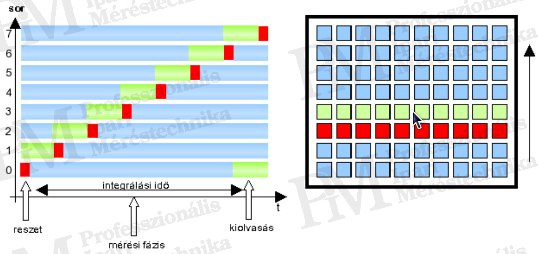
Figure: Timing diagram in case of line-by-line readout [source: PIM]
As a consequence of line-by-line readout, the representation of moving objects is distorted, as illustrated in the following figure. (The faster the motion, the greater the degree of distortion.) The reason for this is that the measurement data line by line did not "occur" at the same time but only successively - similar to a multiplexed multi-channel metrological system.
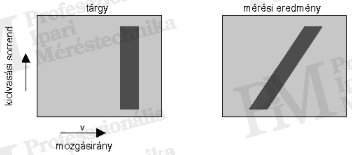
Figure: Distortion of moving objects representation due to line-by-line readout [source: PIM]
The problem related to the detection of moving or rotating objects can be solved with the "Snap-Shot" technology. However, this method is only meaningful with sufficiently fast (even down to 10 µs integration time) photon detectors. In contrast, thermal detectors (e.g., microbolometers) that are orders of magnitude slower would blur the representation of moving objects anyway (due to the long integration time). Photon detectors with "Snap-Shot" capability perform measurements (signal integration) simultaneously on each pixel, and then the measured values on the pixels are "frozen" at the same time. Subsequently, as with line-by-line readout, the values are read out and A/D-converted line by line. Therefore, instead of using thousands of readout-digitalization circuits, only as many as needed for reading out each row are used. Nevertheless, the representation of moving objects is not distorted because all individual detector signals originate from the same time (moment). Metrologically, this is a system of simultaneous sampling.
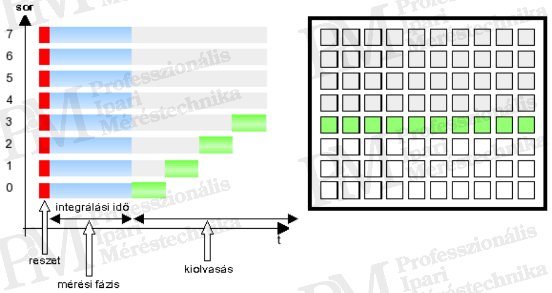
Figure: Timing diagram in case of "Snap-Shot" technology (gray = frozen value) [source: PIM]
With the most advanced thermal cameras equipped with "Snap-Shot" technology, currently up to 450 320x256 pixel thermal images can be captured per second. However, the time requirement for the advancing readout line by line seen in the timing diagram can be compared to the integration time of the photon detectors and may even exceed it. The maximum image readout frequency is therefore mainly limited by the readout process. To counteract this and achieve even faster image capture, the processing of SubFrame sub-images can be applied, which unfortunately results in displaying fewer details due to fewer pixels. Special thermal cameras equipped with this image processing technology can capture up to 4500 images per second at a resolution of 160x128 pixels. Note: the detector still performs signal integration and value freezing simultaneously on all pixels.
Simply, we limited the readout and digitization to the selected area. 
Figure: Examples of SubFrame solutions in "Snap-Shot" technology [source: PIM]

Figure: Fan thermal image - left: with microbolometer serial readout, right: with photodetector "Snap-Shot" procedure [source: InfraTec]
Cooling Technologies for Photodetectors
Today, there are many long-wave thermal cameras based on uncooled thermal detectors (e.g., microbolometers) available. However, the most accurate and fastest measurement capabilities, as well as short- and mid-wave thermal cameras, can only be made with photon detectors - which exclusively require cooling. Instead of liquid nitrogen solutions, highly reliable miniature cooling compressors (Stirling coolers) have become more common for ensuring their cooling. For some detector types, the additional option of using thermoelectric (Peltier) cooling is available, although this does not achieve such low temperatures (resulting in a narrower range of detector designs and materials.) Stirling Cooling Stirling cooling is based on the CARNOT thermal cycle, where a gas (helium) is compressed (causing the gas to heat up), then it cools by releasing heat to the environment. During the subsequent expansion (in another cylinder), the gas cools to a very low temperature and thus is able to absorb heat energy from the environment (in our case, from the detector). This entire process occurs as a closed cycle. The two-piston micro-compressor used for this purpose in thermal cameras allows them to be used in any position, ensuring measurement reliability and accuracy over a wide operating temperature range (with good efficiency). However, a disadvantage is that these cooling compressors have a significant size and weight, making it impossible to create lightweight and compact thermal cameras with this technology. An even bigger problem (especially for continuous applications) is that Stirling coolers are a mechanical system with a limited lifespan. For the most modern devices, this limit can approach 8000 - recently 12000 - operating hours (maintenance-free!).


Figure: Stirling cooler principle and an actual Stirling cooler [source: InfraTec]
Peltier Cooling Peltier cooling (also known as thermoelectric cooling) is generally implemented in the form of a 3-stage Peltier element cascade to achieve the deep temperatures required. Its advantage over Stirling cooling is that it has no mechanical (moving and thus wearing) parts, practically resulting in no lifespan limit. However, in exchange for higher energy consumption, it can only achieve less low temperatures (about -150 °C), which may not be sufficient for the operation of all types of photodetectors.


Figure: 3-stage Peltier cooling principle / MCT-Sprite photodetector with Peltier cooling [source: InfraTec]
Copyright © PIM Professzionális Ipari Méréstechnika Kft.
2026 | Minden jog fenntartva
Impresszum | Adatkezelés