


"A universal measurement procedure"
The primary goal of building thermography is the objective and comprehensive assessment of building insulation. When it comes to buildings, we fundamentally distinguish between quantitative and qualitative thermographic procedures. It is important to know that thermographic measurement serves to capture the momentary temperature of surfaces, which is influenced by various measurement conditions.
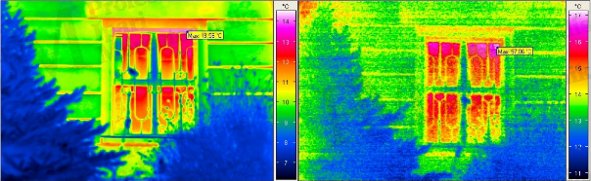
Considering what was discussed in the theoretical introduction in our previous issues, it becomes clear that due to the low temperatures to be measured, for building thermography we need to choose a long-wave thermal camera. With medium-wave cameras, cold objects cannot be measured because their medium-wave radiation emission is minimal or nonexistent. The long-wave range is advantageous for us because due to its favorable transmission properties through the atmospheric window, we can detect heat radiation almost losslessly from distances of up to a hundred meters.
The effect of the wavelength range of thermal cameras. Left: thermal image taken with a long-wave camera: very good temperature resolution, low noise, the warmest place is the upper edge of the window frame (13.56 °C, as the measurement does not penetrate through the glass). Right: thermal image taken with a medium-wave camera: worse temperature resolution, noisier image, the warmest point is the lamp in the room (57.06 °C, as the camera sees the lamp through the glass)
Another positive aspect that arises during measurements is that commonly used building materials (except window glass and shiny or polished surfaces) have relatively high emissivity, and since the temperatures of the objects to be measured typically differ only slightly from the ambient temperature, we only need to consider the reflection effect to a small extent. The situation is quite different, for example, with glass surfaces or brand-new aluminum-clad insulations, unfortunately, these are generally not measurable.
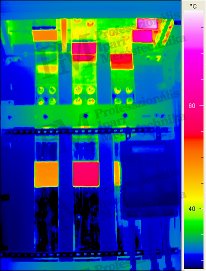
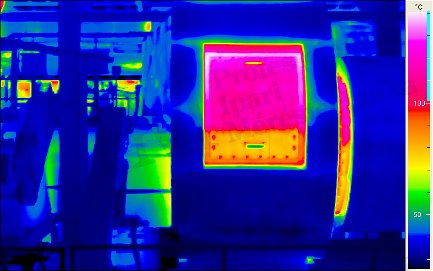
The effect of reflection (thermal radiation reflection). Left: thermal image of railway tracks: the polished surface of the tracks has a very low emissivity, the actual temperature of the tracks is only detectable on the painted parts (phase color markings), the rest reflects the ambient temperature. Right: thermal image of a hot air fan: the polished aluminum cladding of the insulation has a very low emissivity value, the actual temperature of the hot air fan is visible at the rusty access opening (>160 °C), the rest reflects the ambient temperature, the temperature of the insulated surfaces can be inferred based on the upper (contaminated) areas (around 90 °C), as the emissivity factor is better due to contamination.
Special features of building thermography
The primary goal of building thermography is the objective and comprehensive assessment of building insulation. But never forget that thermographic measurement serves to capture the momentary temperature of surfaces, which is influenced by various measurement conditions. When it comes to buildings, we fundamentally distinguish between two types of thermographic procedures. Quantitative thermographic examinations The purpose of quantitative building thermography is to evaluate the complete surface temperature distribution of the building and determine the heat transfer coefficient (e.g., when calculating heat loss or heating energy requirements). Since the coefficient can only be calculated based on very accurate (absolute accuracy) temperature data, very strict conditions must be met regarding the data collection with the thermal camera. The procedure is characterized by
Qualitative thermographic examinations The purpose of qualitative thermal camera building inspections is to search for and document the building's thermal bridges and insulation "defects" (quality deviations). Most problems can be identified based on heat differences that can be displayed with a thermal camera with sufficiently high temperature resolution; in such cases, absolute (numerically exact) temperature data play a minor role.
The characteristics of the procedure
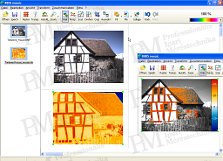
Both quantitative and qualitative building thermographic inspections should include both indoor and outdoor measurements. In the case of quantitative examinations, indoor inspections are practically mandatory, as this is the only way to calculate the heat flow properties of individual surfaces. Our table provides an overview of the measurement conditions to consider during indoor and outdoor measurements, as well as the differences (challenges) between the execution of the measurements.
Differences between indoor and outdoor thermographic inspections
| Outdoor thermography | Indoor thermography |
|
|
General measurement conditions and requirements
In order to create thermal images with a thermal camera that are not only "colorful" but can also be evaluated by architects, energy experts, structural engineers, and operators - allowing for correct conclusions - the following minimum conditions must be met:
It follows from the above that building thermography can only be carried out during the heating season, in appropriately cold (below 5 °C) weather conditions.
Requirements for the thermal camera system
When creating high-quality, evaluable thermal images, there are also very serious expectations for the thermal camera itself, without meeting which we will only get unrecognizable thermal images that cannot detect faults. The thermal camera must minimally meet the first six points of the following list:
The effect of sunlight
Left: building capture during the day (unfinished construction): - the sun's radiation reflects off the building walls, making the walls appear warm, even though there is no heating. Right: building capture three hours after sunset: - the warming effect of the daytime sunlight is barely noticeable, so now we can measure.
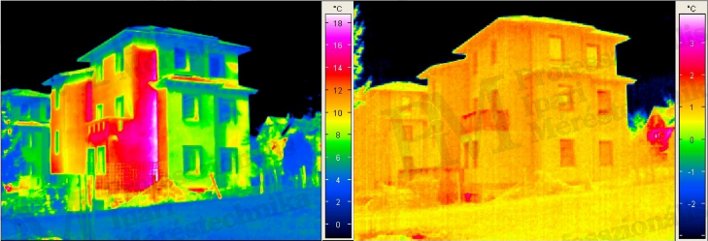
In our series, we will present further thermal image examples to illustrate the importance of complying with the listed rules.
Rahne Eric (PIM Ltd.) pim-kft.hu, termokamera.hu
The content of the publication is protected by copyright, and its (even partial) use, electronic or printed re-publication is only permitted with the indication of the source and the author's name, as well as with the prior written permission of the author. Violation of copyright (Copyright) will have legal consequences.
Copyright © PIM Professzionális Ipari Méréstechnika Kft.
2026 | Minden jog fenntartva
Impresszum | Adatkezelés