


For industrial producers, as the utilization of manufacturing capacities increases, it becomes increasingly important to implement a maintenance system capable of preventing unexpected failures causing production downtime. Significant successes can be achieved by applying Planned Preventive Maintenance (commonly known as PPM) and modern lubricants, but the risk factor remains too high. The additional disadvantage of PPM - the unnecessary replacement of still good or even completely faultless components resulting in additional costs (losses) - justifies the need for other methods.
Currently, the theoretical and practical development of vibration diagnostics (vibration monitoring, machine diagnostics, vibration analysis) enables more efficient maintenance methods than before. Many domestic and foreign companies successfully apply maintenance organized based on regular vibration diagnostic evaluations, known as condition-based or reliability-centered maintenance. The foundation of such methods is to provide operators/maintainers with timely information about the technical condition of machine components, as well as potential issues and failures based on measuring the vibration characteristics of machines, suitable for preventing unexpected failure events. The advantage of preventing machine and component failures is understandable when considering the potential daily, weekly losses caused by unexpected failures. In the heightened competitive environment in the industry, there is an increasing need to maintain the good condition of existing equipment. Not to mention that production is carried out with increasingly specialized machines, making it more difficult to quickly source their specific components. Storing spare parts also requires space and capital. It seems advisable to prevent larger and more costly machine damages by promptly addressing minor faults.
The physical principle of vibration diagnostic tests
Every solid body is capable of vibrating in multiple directions at different frequencies. The largest displacements can be observed at the body-specific natural frequency, as the body "resonates" at this frequency in the given direction (hence the concept of resonance frequency). Naturally, no body starts vibrating on its own; it requires excitation - an external force - to do so. The greater this force, and in the case of alternating forces, the more closely its rate of change matches the body's natural frequency, the greater the vibrations the solid body performs in the direction determined by the force. In the case of rotating machines, the sources of vibrations are the inevitable alternating forces occurring during machine operation. These forces can never be completely eliminated, as they arise from, among other things, the regular alternating operation of the machine (e.g., reciprocating machines), the residual unbalance of rotating components, and the periodic forces originating from the drive (e.g., network harmonics). The effect of the forces present during operation on individual machine components should be imagined as each machine component being part of a spring-mass oscillating system. A rotating machine consists of numerous such oscillating systems, almost all of which are interrelated and excite each other. Due to the resonance properties of solid bodies, each machine element tends to follow the effect of the alternating force at its own frequency. This applies not only to the moving components of the machine but also to all supporting elements. The frequency of vibrations measurable on the machine and the associated amplitude depend on the stiffness and mass of the mechanical elements. The smaller the machine element, the higher the frequency but the lower the amplitude of the vibration it performs. The intensity of vibration changes during the lifespan of the machine or machine component(s) due to variations in clearances, surfaces, and elastic factors - wear and aging of the machine - over time. The trend of change is illustrated on the life cycle curve below. As shown in the diagram, the vibration level is higher during the running-in period of the machine element. For a worn-in machine element, the vibration intensity remains approximately the same for a long time, and in the final stage of wear of the machine element, the vibration intensity increases (almost exponentially).
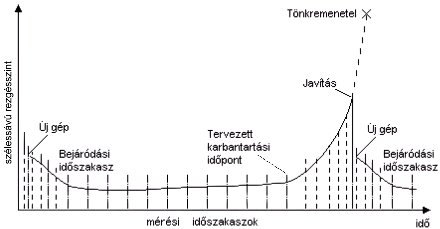 |
| Figure 1: Relationship between life cycle and vibration level for rotating machines [source: PIM] |
The goal of introducing condition-based maintenance
The long-term goal of introducing and maintaining condition-based maintenance in every company is economic savings, which consist of two factors: Cost savings:
Revenue growth:
Additional benefits of condition-based maintenance
Vibration measurement and analysis-based machinery condition assessment methods
1. Broadband vibration measurement or vibration level measurement If a measurement procedure providing a specifically easy-to-use, easily interpretable rotating machine condition characteristic is needed, then broadband vibration measurement or vibration level measurement is the appropriate method. Handheld instruments designed for this purpose measure the effective value of vibration velocity (RMS, i.e., the square root of the sum of the squares of the vibration components). The usual frequency range of the measurement extends from 10 to 1000 Hz (according to ISO 2372) or from 10 to 3200 Hz (according to the new ISO 10816-3). These ranges cover the most common frequencies characteristic of mechanical problems in rotating machinery. Imbalances, mechanical looseness, resonance, as well as misalignments of shafts and couplings are clearly noticeable. However, it does not provide information on which one dominates. The application of handheld broadband vibration meters is recommended for measurements on the bearings (or their housings) of rotating machinery, following the recommendations of various vibration assessment standards. Users without experience may be advised to base the evaluation of measurement results on the ISO 10816-3 standard (which replaced the old ISO 2372 and ISO 3945). However, there are technologies requiring stricter requirements than the standard, as well as cases allowing for higher vibration levels than the standard.
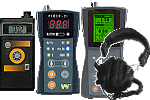
Figure 2. Typical digital handheld vibration level meters [source: PIM]
Standards are generally based on vibration velocity measurements expressed in mm/s effective value (RMS). The readability of the measurement result is enhanced by interpreting the read value as the average speed of the back-and-forth motion. The effective value of vibration velocity best reflects the extent of undesired phenomena, adverse energy (forces) present. These always cause wear and material fatigue in the machine structure. The ISO 10816-3 standard classifies machines and distinguishes between flexibly and rigidly mounted machines. (The latter corresponds to the classification based on the resonance frequencies and the fundamental speed of the machines. For example, a machine mounted with rubber pads or springs - thus flexibly - often exhibits resonances at low speeds, performing large oscillations even at very low speeds. If the speed exceeds the critical resonance frequencies, the vibration level decreases. In the case of rigidly mounted machines, such phenomena do not occur.) Modern machines operate at high speeds and have relatively flexible bearings, peripherals, and foundations. Therefore, these can be treated as flexibly mounted even without being fixed with rubber pads or springs. In these cases, the ISO 10816-3 standard allows slightly higher vibration levels compared to rigid mounting.
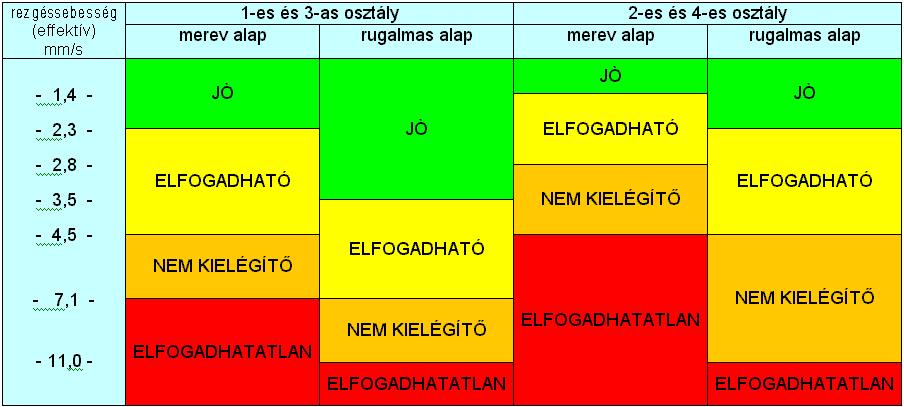
Figure 3: Recommended vibration level limit values by ISO 10816-3 (excerpt)
By using standards, it can be easily determined whether certain machines can be operated further or not. As a basic rule, if a machine shows vibrations greater than 3 mm/s effective value (including the most common machine types such as electric motors, pumps, fans, generators), the cause of the vibration must be identified. Do not continue to operate a machine vibrating more than 7 mm/s unless you are sure that the machine's endurance allows long-term operation under such conditions without unexpected breakdowns.
2. Machinery condition monitoring with trend analysis
The rate of deterioration of machinery condition is the most valuable information for organizing condition-based machine maintenance, as it helps estimate when and what intervention needs to be performed to ensure the machine operates without unexpected shutdowns (and unnecessary repairs) but also avoids suffering greater damage due to existing minor faults. To achieve this, the trend of machine vibrations needs to be created, where the rate of increase provides information on expected durations. The method of trend analysis is very simple: at regular intervals, machine vibrations need to be measured again (at the same locations, in the same direction, and preferably with the same measuring instrument), and data for each measuring point should be evaluated graphically over time. Considering the current machine-specific limit values, it can be estimated when the vibrations of our machine will reach the limit(s) under unchanged loads and other conditions, indicating when intervention is necessary at the latest. For many small and medium-sized companies with a large number of machines, it is no longer advisable to simply go through the equipment with "paper and pencil," record individually which machine's vibrations are at what level, then create separate graphs for each, or transfer the data individually to a computer. It is much more worthwhile to invest in a measuring instrument capable of measuring the effective value of vibration velocity and storing data for multiple machines, as well as transmitting them to a computer. The necessary instruments can be obtained at a relatively favorable price, resulting in significant benefits from their use, as maintenance planning becomes timely. Knowing when adjustments, balancing, or bearing replacements need to be done, unnecessary repairs and unexpected machine downtimes can be avoided.
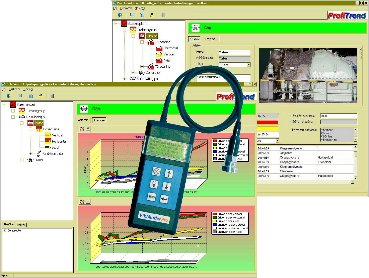 |
| Figure 4. Data collector handheld instrument, as well as machine condition monitoring and maintenance support PC software [source: PIM] |
3. Precise detection of machine component faults through spectrum analysis of vibrations
Vibration spectrum and frequency analysis is not only a trend but also the most effective machine condition monitoring tool currently available, provided that the information it contains is "read" with expertise. While the machine condition monitoring and surveillance technologies presented so far do not require specially trained experts to be "deployed," spectrum analysis can only be applied effectively with appropriate training and experience. The basis of spectrum analysis is the following train of thought: Every machine or machine component (shaft, casing, support element, bearing, disc, etc.) as a "rigid" body has the fundamental mechanical (physical) property that it is most capable of performing vibrations in certain directions at one or more specific "natural" frequencies (thus resonating at this frequency due to external excitation, in our case, for example, due to alternating forces originating from the machine's rotation). With spectrum analysis of the recorded vibration signal, it becomes "visible" what frequencies of vibrations are present. The vibration frequencies can be assigned to certain machine components and typical machine faults, taking into account the current machine speed. Through vibration spectrum analysis, the faults of individual machine elements can be precisely identified, and it can be determined whether there is a misalignment or unbalance error. For example, in the case of bearing faults, this method is capable of separately detecting damage to the inner, outer ring, or the cage. By measuring the electrical parameters of electric motors, electrical faults (including breakage of asynchronous motor rotor bars) can be identified. Through vibration spectrum analysis of machine vibrations, it is already possible to know exactly what needs to be done before repairs. Significant savings can be achieved in terms of components and working time, and moreover, it is not possible to forget to correct less noticeable but still present faults during repairs. Furthermore, the success of the repairs can be checked very quickly and accurately by comparing the spectra of measurements taken before repairs and after recommissioning. The reliability of machines repaired and checked in this way greatly increases while maintenance costs decrease.
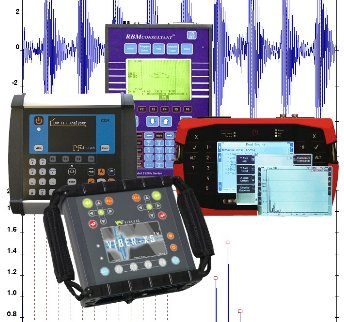 |
| Figure 5: Modern vibration analysis data collectors, typical vibration spectrum and time signal in the background [source: PIM] |
Rahne Eric (PIM Ltd.) pim-ltd.com, machineryexpert.com
The content of the publication is protected by copyright, and its (even partial) use, electronic or printed republication, is only permitted with the indication of the source and the author's name, and with the author's prior written permission. Violation of copyright (Copyright) has legal consequences.
Copyright © PIM Professzionális Ipari Méréstechnika Kft.
2026 | Minden jog fenntartva
Impresszum | Adatkezelés