


The temperature resolution is crucial for image quality
In this section, we list the most common lenses and their roles (sometimes their "side effects"), then we move on to the thermal resolution of thermal cameras and the temperature measurement range that partially influences the measurement capability.
Standard lens
Depending on the pixel resolution of the camera's detector, with these lenses, a geometric resolution of approximately 2.4 - 0.6 mrad can be achieved alongside viewing angles of 20×15°–30×25°.
Telephoto lens
Compared to standard lenses, typically with halving the viewing angle in both dimensions, a geometric resolution that is twice as good (numerically halved) can be achieved. There are also "larger" telephoto lenses that offer a quarter or even a tenth of the viewing angle dimensions and geometric resolution, thus significantly improving the geometric resolution.
Wide-angle lens
Compared to standard lenses, typically doubling the dimensions of both viewing angles is possible, but at the same time, the geometric resolution is halved (numerically doubled). There are so-called super wide-angle lenses as well, with which the dimensions of the viewing angles and the geometric resolution can be quadrupled (while degrading the geometric resolution to a quarter).
Close-up lenses, macro lenses
The primary role of these lenses is to reduce the minimum measurement distance of standard lenses or telephoto lenses (minimal focal distance), allowing very small objects to be measured from distances that meet the requirements of geometric resolution.
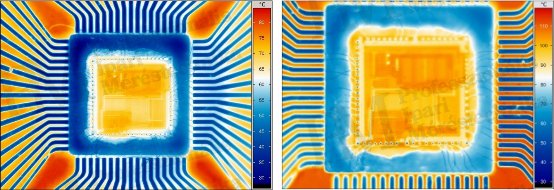 |
| Figure 1: Thermal image resolution achievable with macro lens or microscope lens [source: InfraTec] |
Microscope lenses
Microscope lenses are used for measuring special small objects. They are usually custom-made, their imaging capabilities are similar to optical microscopes (of course, in the wavelength range of thermal radiation). Their practical disadvantages include their large size, weight, and cost, as well as their minimal depth of field in compliance with optical laws.
Thoughtful application is necessary
Special attention must be drawn to the often completely erroneous use of wide-angle lenses. For example, if our concern was that, while adhering to the limitation of geometric resolution, only a part of the object to be measured (e.g., a switchgear cabinet) could be captured in a single thermal image from a specified maximum measurement distance, then the use of a wide-angle lens acquired to increase the field of view not only does not solve our problem but worsens our situation. This is because due to the halved geometric resolution resulting from the wide-angle lens providing a field of view twice as large in both directions, our measurement can now only be performed from a distance of at most half of the previous distance.
Thus, the field of view of our measurement has not actually increased (it remains exactly the same), but in addition to image distortion, the viewing angle of the object surface - especially towards the edges - can be quite skewed. This further negatively affects the accuracy and evaluability of our measurement. (Note: wide-angle lenses are mainly justified in indoor thermography of buildings. Before using them in other professions, careful consideration is needed to ensure that the achieved larger field of view does not result in other, potentially much more serious optical or metrological disadvantages.)
Thermal resolution of thermal cameras
Especially when the temperatures to be measured are close to the lower limit of the camera's current measurement range, the image quality is decisively determined by the temperature resolution. NETD (noise equivalent temperature difference) is the effective value of the camera's own noise, expressed in the temperature difference of the object that results in the same electrical signal. This parameter, which qualifies the camera's temperature resolution capability, is usually determined at 30 °C. However, it is important to note that the value almost exponentially increases as the object's temperature decreases.
Example:
A lower-quality thermal camera with a ±120 mK (±0.12°C) temperature resolution at 30°C will already have a noise of ±0.25°C at 0°C in practice. Since this value is per pixel, the total thermal resolution of the thermal image is only 0.5°C (since the pixels can deviate from their placement and each other in opposite directions up to the maximum value). However, for a surface on the thermal image that is visually recognizable as coherent, the temperature must differ by at least twice the above value from the surrounding thermal image pixels - thus, in this example, the minimal temperature difference that defines recognizability is close to 1°C!
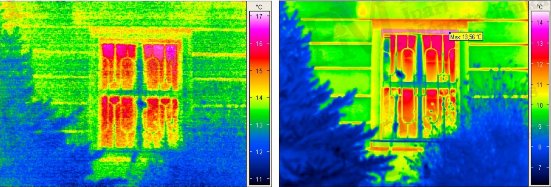 |
| Figure 2: left image with inadequate thermal resolution, right image with good thermal resolution [source: PIM] |
Based on the above, it is easy to recognize that there are areas of thermal camera applications where the thermal resolution of the camera is one of the most essential quality (metrological) factors, while in others, it is of significant importance. The thermal resolution is considered a critical parameter in the following applications:
Temperature Measurement Range(s)
There is often a need for thermal cameras to be able to measure "higher" temperatures. As if this were some difficult task! But it's not. Most (even the cheapest) thermal cameras measure up to a minimum of 120 °C, but there are also quite a number of low-cost and standard thermal cameras with extended measurement ranges up to 200, 250, or 350 °C. A more interesting question is at what Celsius temperature their measurement capability starts, at what resolution (with how many bits of digitization), and how many selectable measurement ranges they cover to fully utilize their measurement capability. Because only with all the listed data will it become clear what capability and measurement accuracy (quality) the given thermal camera has.
The first quality parameter to mention relates to the digitalization of temperature values. There are devices with 12, 14, or even 16 bits that cover temperatures of 160, 200, 240, or even 360 °C within their critical lowest (or only) measurement range. The expected accuracy is quite extreme: a 12-bit low-cost thermal camera with a single measurement range between –10 °C and +350 °C has a digitalization resolution of just 360 K/4096 = ±87.9 mK, whereas for a professional thermal camera (with multiple selectable measurement ranges) this value is 160 K/65536 = ±2.4 mK. That's a significant difference! The second essential technical characteristic is the lower limit of the thermal camera's measurement range, as measuring low temperatures is the most challenging according to Planck's radiation law (at these temperatures, bodies emit only minimal amounts of radiation). This task is therefore the most challenging in terms of measurement technology and can be attributed to the thermal camera's own noise, described by the already mentioned NETD factor. Accordingly, most low-cost thermal cameras are only capable of calibrated measurements starting from 0 °C, some models boast a lower limit of –10 °C, and a –20 °C lower limit is very rare. In contrast, long-wave professional instruments are capable of precise (and calibrated) measurements starting from –40 °C according to their specifications. In many tasks (such as building thermography outdoor measurements, biological, or environmental measurements), this is a crucial parameter determining the applicability of the thermal camera, as there are guaranteed to be measuring points with temperatures even far below 0 °C.
Rahne Eric (PIM Ltd.) pim-kft.hu, termokamera.hu
The content of this publication is protected by copyright, and its (even partial) use, electronic or printed re-publication, is only permitted with the indication of the source and the author's name, as well as with the author's prior written permission. Violation of copyright (Copyright) will have legal consequences.
Copyright © PIM Professzionális Ipari Méréstechnika Kft.
2026 | Minden jog fenntartva
Impresszum | Adatkezelés