


3-point dynamic balancing Three-point - with free radius
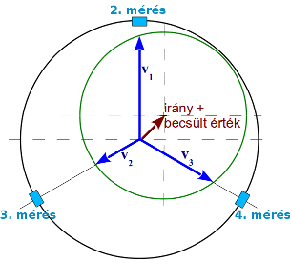
The basis of the procedure (summing up the test measurement vectors) can be derived from geometrical / physical relationships. This calculation is special in that the three test measurements can be performed at arbitrary angular positions, making it applicable even for structures not divisible by 120°. It is completely indifferent for the calculation whether angular coordinates matching the clockwise or counterclockwise rotation direction are used. The calculation result is displayed in the same coordinate system as the one in which the data was entered. I have solved the mathematical problem of dividing by "0" in estimating the balancing mass, however, I recommend performing an accurate determination in step 2 (based on my 25 years of practical experience). If the position for mounting the balancing weight falls in a place where installation is impossible, then with the "weight distribution" function, the weight in question can be distributed to the two neighboring - installable angular positions. We cannot be held responsible for any direct or indirect damages suffered due to the correctness of the procedure or the application of the above calculations. The development and expansion of the procedure's capabilities are my intellectual creation, thus falling under the protection of copyright. Rahne Eric (author)
The basic relationships (frequency determinations) can be derived from geometric/physical relationships. Some additional frequencies and relationships are the result of my 25 years of practical experience. The use of calculations is permitted only with the indication of the source and author's name, and with the author's prior written permission. Republishing of materials in print or electronic form is strictly prohibited without specific (occasional!) permission! Eric Rahne (author)
Copyright © PIM Professzionális Ipari Méréstechnika Kft.
2026 | Minden jog fenntartva
Impresszum | Adatkezelés