


"Instead of firefighting and major repairs"
Condition-based maintenance with vibration diagnostics (V.)
Following the guide helping the correct application of vibration sensors in our technical diagnostic series, we continue with the interpretation and analysis of measured vibration data. The effective measurement of vibration velocity and the detection of machine faults determinable by determining the effective value, followed by determining the condition of rolling bearings with vibration acceleration measurement. To the discussion started in the previous part about the correct application of vibration sensors, we add that it is not surprising that even when using a magnetic base, we can only measure in a very limited frequency range, as ultimately only the magnetic force ensures the transmission of vibrations. It is disadvantageous that in order to achieve greater adhesion, a larger magnet should be used, but the magnet and the sensor act as one body, which, due to its increasing weight, becomes less willing to follow high-frequency vibrations. In general, we can say that with the use of a proportional-sized magnet and ensuring a proper measurement surface (flat, clean, unpainted), we can measure up to 8-10 kHz. If we want to measure vibrations beyond this frequency limit, we are forced to use completely different mounting technologies. If we glue a washer to the surface to be measured and fix the sensor with screws, with the right adhesive we can measure up to 20 kHz. The measurable frequency range expands to about 30 kHz if we opt for direct attachment of the sensor. (Of course, appropriate high-frequency sensors should be used up to these frequencies.) And if we want to measure up to 40 kHz, only one solution is possible: the sensor must be mounted directly on the surface to be measured (flat, clean, unpainted). To assist in the transmission of vibrations, wax should be placed between the sensor and the measuring surface..gif "Vibration Level Meters")
It should be noted that in some cases, we may face additional problems. On the one hand, the weight of the sensor (and the probe or magnetic base) can affect the measured value. A good rule of thumb is to accept measurement results with caution if they are measured on machine elements lighter than ten times the total weight of the sensor (including the magnet or probe). On the other hand, at the upper frequency limit of any installation technology, a so-called coupling resonance occurs. This is why, in the case of measurements with a probe, resonances at around 3 kHz may occur, and in the case of magnetic mounting, resonances at around 10 kHz may occur. The consequence of this is reflected in completely unrealistic measurement results. Overall, we can say that the success of our measurement depends much more on the careful coupling of the sensor than on the capabilities of the sensor or the instrument.
Interpretation and Analysis of Vibration Data When a measurement procedure providing a machine condition characteristic that is easy to handle and easy to interpret is needed, the appropriate method is to measure the effective value of vibration velocity (otherwise known as broad-band vibration measurement or vibration level measurement). Handheld instruments used for broad-band vibration measurement measure the effective value of vibration velocity (RMS, the square root of the sum of the squares of the vibration components). For example, if the vibration originates from unbalance (4 mm/s), misalignment (2 mm/s), and gear meshing (5 mm/s) simultaneously, the resultant vibration – i.e., the effective value measured by the device – will be 3.9 mm/s. Vibration effective value = √(42 + 22 + 52)/3¬ = 3.9 mm/s (corrected - ed.) The usual frequency range generally extends from 10 to 1000 Hz. These ranges encompass the most common frequencies characteristic of mechanical problems in rotating machinery. For example, unbalance, mechanical looseness, resonance, and misalignment of shafts and gears are clearly noticeable. However, there is no information available on which one is present or dominant. The application of the aforementioned types of handheld instruments is recommended for measurements on machine bearings (or their housings) in accordance with various vibration evaluation standards. For users without experience, the evaluation of measurement results is recommended to be based on the ISO 10816-3 standard, of course, not "without thinking." There are technologies that require stricter requirements than the standard and cases that allow higher vibration levels than the standard. Classification according to standards Standards are generally based on the measurement of vibration velocity expressed in mm/s effective value (RMS). The readability of the measurement result is aided by interpreting the read value as average speeds of reciprocating motion. The effective value of vibration velocity best reflects the extent of unwanted phenomena, "disturbing energies." These cause wear and material fatigue in the machine structure wherever they can be measured. The ISO 10816-3 standard classifies machines and distinguishes between machines mounted flexibly and rigidly. The latter corresponds to the classification based on the relationship between the resonance frequencies of the machines and their running speeds. For example, a machine mounted with rubber pads or springs – thus flexibly – often exhibits resonances at low speeds, and the machine undergoes large oscillations even at very low speeds. If the speed exceeds the critical resonance frequencies, the vibration level decreases. In the case of rigidly mounted machines, such a phenomenon does not occur. Modern machines operate at high speeds and have relatively flexible bearings, peripherals, and foundations. Therefore, these can be treated as flexibly mounted even without rubber pads or springs. In these cases, the ISO 10816-3 standard allows slightly higher vibration levels compared to rigid mounting. Vibration level limit values recommended by ISO 10816-3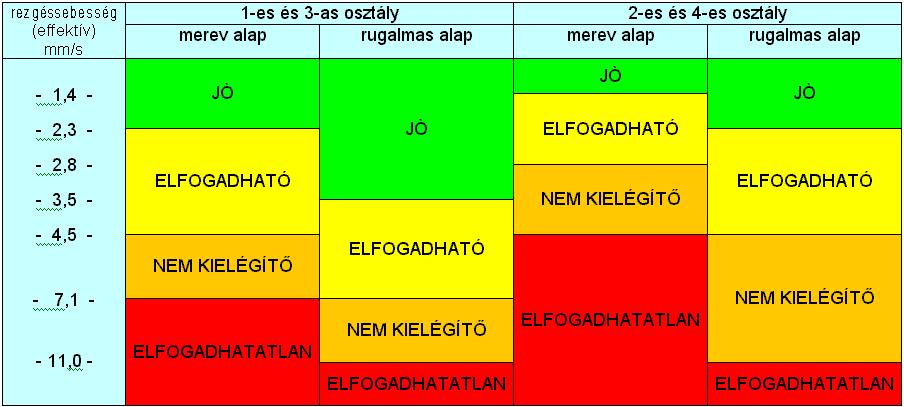
By using standards, it can be very easily determined whether certain machines can be operated further or not. As a basic rule, it is acceptable that for machines showing vibration greater than 3 mm/s effective value (including the most common types of machines such as electric motors, pumps, fans, generators), the cause of the vibration must be identified. Do not continue to operate a machine vibrating more than 7 mm/s if you are not sure that the machine's endurance allows long-term operation under such conditions!
Rahne Eric (PIM Ltd.) pim-ltd.com, machineryexpert.com
Copyright © PIM Professzionális Ipari Méréstechnika Kft.
2026 | Minden jog fenntartva
Impresszum | Adatkezelés