


While spectral analysis of machine vibrations during operation is proven to be one of the most effective methods for detecting and proving most machine faults - such as imbalance, misalignment, bent shaft, bearing fault - the inspection of the machine's structural components requires other tools. The solution is provided by finite element modeling or motion animation. Due to lower measurement and computation requirements, motion animation is the simplest to apply.
Let's assume that during operation, every structural element of the machine (foundation, platform, frame, support, beam, bearing housing, etc.) moves or deforms due to the periodic forces acting on the machine - mainly at frequencies of 25 or 50 Hz, or their multiples, as most machines operate at speeds of 1500-3000 revolutions per minute. These movements are not visible to the naked eye for two reasons: firstly, our eyes cannot follow changes at 50 Hz and above frequencies, and secondly, these movements are often only in the range of micrometers (thousandths of a millimeter).
Visualization of movements
How can we make the movements of machine elements visible? The simplest way is by using a stroboscope: illuminate every other (or every third, fourth) movement! Since our eyes can only recognize objects at the moment of a strong flash, it appears as if the process is happening at 25 Hz instead of 50 Hz or even at 12.5 Hz. This way, the adequately large amplitude - but otherwise invisible due to speed - movements become visible. (Of course, only if we tune our stroboscope to a frequency different from the one being examined, as otherwise we see a still image.) The method has several disadvantages: * unfortunately, we still cannot see small, a few tens of micrometer movements * only a limited area can be illuminated and analyzed * the evaluation of what is seen is quite subjective, and data is stored only in memory. Better results than with the stroboscope method can be achieved by utilizing the capabilities of modern vibration measuring instruments and computer technology, as we also aim to observe vibrations here. Our first task is to create a model of the machine structure to be examined, which includes every structural node. When creating the model, keep in mind to include only as many measurement points as absolutely necessary to detect the examined or assumed problem - as measurements need to be taken at these points. The model shows a machine element mounted on a plate (such as a base plate and bearing housing). Next comes the data collection tailored to our model: the spatial (x, y, and z directions) vibrations (movements) must be measured at each node. Since we want to compare (or display together) the movements of multiple points, it is obvious that not only the amplitude of the movements, but also their relative timing (phase) is important information. Below, we review the possible measurement methods.
Measurement methods
Amplitude-phase measurement with triggering Since we are mainly interested in displacements related to machine rotation, we can take the rotation frequency of the machine's main shaft as the basis for time comparison. For this, all measurements must be started with the rotation speed sensor signal (one pulse per revolution), in other words, triggered (synchronized with the rotation speed), and then process the detected vibration signal: determine the amplitude and phase angle of the rotation frequency, or some multiple component. As a result of our measurements, we have three (for each spatial direction) vibration amplitude values and phase data per structural node. Together, these data describe the spatial movement performed by the examined measurement point (at a given frequency). If we are interested in movements at a different frequency (rotation frequency multiple), the measurements must be repeated at each point at the respective frequency. The advantage of the method is that it does not require a complex instrument for measurements and can be carried out relatively quickly. However, the downside is that we obtain data only at one (rotation frequency-dependent) or, depending on the instrument's capabilities, two to three distinguished (rotation frequency multiples) frequencies, and it is essential that a triggerable signal is present on the rotating part. Reference signal (two-sensor) method We work with two vibration sensors, one of which is considered a reference and is not moved from its position during the measurement. The other sensor is successively placed in the specified directions of the individual measurement points. During the measurement, we record the phase and amplitude spectrum of the vibrations. Thus, the temporal comparison of the signals is not based on the rotation axis trigger signal but on the vibrations measured by the reference sensor. The advantage of the reference signal method over the trigger pulse measurement is:
As a disadvantage of the method, the increased equipment requirement can be mentioned.
It is common practice to conduct our measurements while the machine under examination is in operation, as we are usually interested in the root causes of significant machine and structural vibrations. Therefore, regardless of the measurement method used, we must consider the physical limitations of the procedure. Perhaps the most important is the time due to the number of channels (measurement points) that can be measured simultaneously. In most cases, we conduct measurements with one or two sensors (on one or two channels), which means that we only obtain comparable data if there are constant vibrations present over time - at least during the measurement period. This is a significant limitation because with hundreds of measurement points, the required time can be hours, so long-term stability (consistent operating conditions) is essential. If this cannot be ensured, it is easy to imagine that variable amplitude and phase relationships may lead to incorrect results.If there is an opportunity or need, the operational vibrations of the machine structure under examination can be replaced by an exciter machine, which generates vibrations continuously with the force and frequency determined by us - usually within certain adjustable limits. In this case, of course, we do not have to worry that the amplitude and phase of the vibrations are not constant.
Modeling, evaluation
Evaluation follows the collection of measurement data. By persistently analyzing the results (comparisons, coherence checks, etc.), any potential faults in the examined structure can be identified, but the possibility of error - especially with large datasets - is quite high, as the fault may not necessarily be prominently displayed. To speed up the analysis and minimize errors, computer-based motion animation based on graphical representation is used. During the animation, the machine structure's motion at a particular frequency is depicted with exaggerated amplitudes - but phase-correctly - and greatly slowed down. A well-designed 3D (three-dimensional, spatial) model - and of course flawlessly executed measurements - can reveal a multitude of machine and machine structural faults. The looseness between individual machine elements is the easiest to detect. The lack of coordinated movement can lead to serious vibrations and other consequences if the machine elements should rigidly connect to each other. The most frequently checked connections are the mounting points of the bearing-bearing housing-base plate-base system, as well as the entire interconnected support and building structures. Looseness is very easily detected in the animation diagram, as there is a significant amplitude and phase difference in the motion of adjacent (connected) machine elements. The phases of the motion of a machine element incorrectly fixed to the base plate are visible in the diagram.
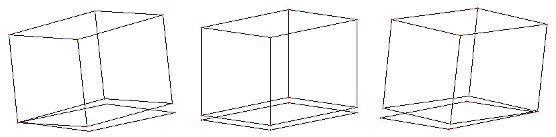
In the examined structure, cracks or fractures appear in a similar way to looseness, but their detection is much more cumbersome. While in searching for looseness, when creating our model and thus recording measurement points, we clearly know where to look for any potential faults (connection of machine elements), for the less visible cracks and fractures, measurements within a specific machine element are necessary for detection. In this case, the success of the examination depends on modeling, as improper conclusions can be drawn from measurements taken too sparsely or in inappropriate planes. Therefore, it is worth noting that if even the slightest suspicion arises during the analysis and animation of the measurement regarding any fault, it is advisable to carry out further - more detailed - examinations in the vicinity of the specific points.
Furthermore, the animation method can clearly demonstrate the resonant behavior of individual structural elements. The examination has a single - but very serious - condition, that is, we must excite the structure with a force at a frequency corresponding to its natural frequencies (if this would not occur under machine operation due to some construction or assembly error). The phases of the motion of a supported beam at one end can be seen during bending or twisting at one of its resonance frequencies. (source of the diagram: Energopenta)

In addition to the simple models mentioned, much more complex ones can be created - the detail (and complexity) of the model primarily depends on the task. However, the number of points in the model sets a limit on the increasing measurement work and the graphical comprehensibility of the results. A model of a pulsating tank under pressure can be seen in the diagram, created with the VMI AB product, the VibShape hardware- (instrument-) independent motion animation PC software. Collecting data from many measuring points is no small task, but the visual is stunning. It is important to note here that the method is not omnipotent; we should not attempt to examine rapidly occurring, difficult to reproduce, or time-varying (non-stationary) processes with it.

Rahne Eric (PIM Kft.) pim-kft.hu, gepszakerto.hu
The content of the publication is protected by copyright, and its (even partial) use, electronic or printed republication is only permitted with the indication of the source and the author's name, as well as with the author's prior written permission. Violation of copyright (Copyright) entails legal consequences.
Copyright © PIM Professzionális Ipari Méréstechnika Kft.
2026 | Minden jog fenntartva
Impresszum | Adatkezelés