


"Instead of firefighting and major repairs"
Condition-based maintenance with vibration diagnostics (VII.)
The most valuable information for condition-based machine maintenance is provided by the rate of deterioration of machine condition. To obtain this information, it is necessary to create a trend of machine vibrations, where the rate of increase provides information about expected durations. Through spectrum analysis of vibrations, faults in individual machine components can be precisely identified, and it can be determined whether there is a misalignment or imbalance error present. Organizing condition-based machine maintenance requires fundamental information about the rate of deterioration of machine condition, based on which it can be estimated when and what intervention needs to be performed to ensure that the machine operates without unexpected downtime (and, equally importantly, unnecessary repairs) and does not suffer greater damage from existing minor faults until the next maintenance. To achieve this, the trend of machine vibrations (the broadband vibration velocity effective value and the high-frequency vibration acceleration value) must be created, from which expected durations can be inferred.
Machine condition monitoring with trend analysis
The practical method described in theory is very simple: the vibrations of machines must be re-measured at regular intervals (in the same locations, in the same directions, and preferably with the same measuring equipment), and data for each measuring point must be graphically evaluated over time. By considering interpretable limit values for each machine (for each measuring point and direction, as well as for both mentioned vibration parameters), it can be estimated when the machine vibrations under unchanged load and other conditions will reach the limit(s), indicating the latest time for intervention.
In many small and medium-sized companies with a large number of machines, it is no longer advisable to "walk through the equipment with paper and pencil" and record individually at which level each machine's vibrations are, then create separate graphs for each, or enter the data individually into a computer. It is much more worthwhile to invest in a measuring device capable of measuring the effective vibration velocity and storing the data for multiple machines, as well as transferring them to a computer. While the necessary instruments can be relatively easily obtained, the benefits derived from their use increase manifold: maintenance becomes predictable. Knowing how long adjustment corrections, balancing, or bearing replacements need to be performed, both unnecessary repairs and unexpected machine downtime can be avoided.
Correct recording of vibration trends
In order for trends indicating the urgency of maintenance to be truly useful for estimating the timing of interventions, in addition to the aforementioned points, the following measurement rules must also be followed:
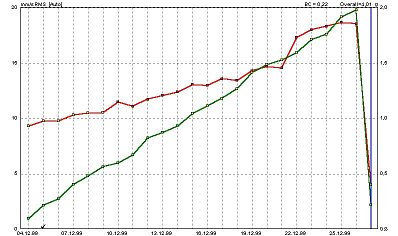
Vibrations (while the machine is in continuous use) must be re-measured at regular intervals, the frequency of which depends on the intensity of machine usage and how often repairs or adjustments need to be made for the machine to operate properly. As a general rule of thumb, it is accepted that there should be at least five measurements between two repairs to provide sufficient information for determining the timing of necessary repairs. This duration can be adjusted based on new experiences later on.
Each maintenance activity, part replacement, repair, or adjustment (shaft alignment, belt adjustment, balancing), as well as unusually long downtimes, significantly different loads or speeds from the norm, should be documented. Without this information, trends cannot be evaluated clearly. It is advisable to heed the advice to record the vibrations of new or refurbished (or even used but deemed good) machines as a reference during vibration inspections. This greatly facilitates the interpretation of trends.
Spectrum analysis, or frequency analysis of vibrations
Vibration spectrum or frequency analysis is not just a trend in technical life but currently the most effective machine condition assessment tool, provided that the information it contains is read with expertise. It should be noted that while the machine condition assessment and monitoring techniques presented so far do not require specially trained experts, spectrum analysis can only be applied effectively with appropriate training and experience.
The basis of spectrum analysis is the following train of thought: every machine or machine component (shaft, casing, supporting element, bearing, disc, etc.) as a "rigid" body has the fundamental mechanical (physical) property that it is most capable of performing vibrations in a certain direction at a specific "natural" frequency (thus resonating at this frequency due to external excitation, in our case, alternating forces resulting from machine rotation). Through spectrum analysis of the recorded vibration signal, it becomes "visible" what frequency vibrations are present. However, vibration frequencies can be assigned to specific machine components and typical machine faults (taking into account the current machine speed).
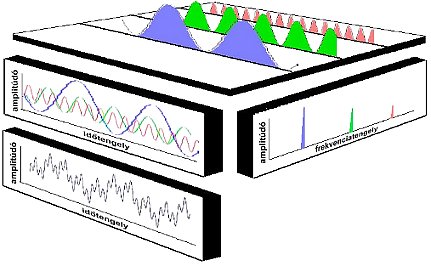
Vibrations can be precisely detected in individual machine elements through spectrum analysis, allowing to determine whether a setup or balancing error is present. For example, in case of a bearing fault, this method is capable of separately identifying damage to the inner or outer ring or the cage. By measuring the electrical parameters of electric motors, electrical faults (such as breakage of squirrel cage rotor bars in asynchronous motors) can also be detected.
By performing spectrum analysis of machine vibrations, it is possible to know exactly what needs to be done before repairs are carried out. Moreover, the success of repairs can be very quickly and accurately verified by comparing the spectra of measurements taken before repairs and during recommissioning. Machines repaired and checked in this way exhibit significantly increased reliability, along with reduced maintenance costs.
We will now delve into an overview of the physical basics that underlie spectrum analysis.
Definition of Frequency
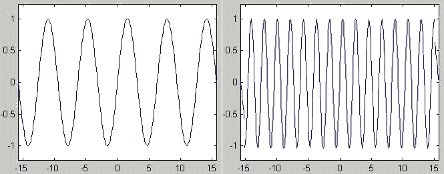
In our everyday lives, we encounter frequency in relation to the pitch of sounds, as a quality characteristic of music players, as a measure of the refresh rate of television images, or for example in connection with the periodicity of the voltage in the electrical network. Frequency always denotes the number of repetitions of a periodic phenomenon within a unit of time. The same can be interpreted for machine vibrations, as they involve alternating - periodic - movements: frequency expresses the number of complete (back and forth) vibration movements per unit of time. Of course, this is only true if the vibration in question is purely sinusoidal. For example, two time signals can be seen in the figure, with the same amplitude but different frequencies.
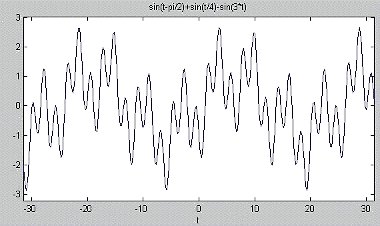
In practice, measurable machine vibrations are inherently complex, as vibrations of different frequencies and amplitudes originating from unbalance, incorrect shaft alignment, bearing faults, and many other reasons are present simultaneously at the measuring point (e.g., on the bearing housing). If we are interested in the frequencies present in the measured signal, we are forced to decompose the signal into its elementary sinusoidal components (fundamental vibrations) - hence perform frequency analysis (also known as spectrum analysis).
Rahne Eric (PIM Ltd.) pim-ltd.com, machineryexpert.com
The content of this publication is protected by copyright. Any (even partial) use, electronic or printed re-publication, is permitted only with the indication of the source and the author's name, and with the prior written permission of the author. Violation of copyright (Copyright) entails legal consequences.
Copyright © PIM Professzionális Ipari Méréstechnika Kft.
2026 | Minden jog fenntartva
Impresszum | Adatkezelés