


"Instead of firefighting and major repairs"
Resonance problems can be solved by structural modifications (such as changing the natural frequencies of structural elements, detuning the resonance frequency, or damping the resonance), as well as by changing the excitation frequency (by eliminating machine faults, changing the operating speed or load mode). However, we need to ensure that we are indeed dealing with resonance and we need to know its frequency.
From the perspective of industrial rotating machinery, we can state that every machine has one or more resonances, as this is a property of the machine structure. Trouble only arises when one of the resonance frequencies coincides with the machine's rotational frequency or its multiples. For variable speed machines, this is where the problem lies: the wider the operating speed range, the greater the likelihood that the equipment will operate at one or more resonance frequencies or their multiples. Resonance issues must be addressed if minor changes in speed result in significant changes in vibration amplitude. (So, a slight change in excitation frequency leads to a drastic change in vibration magnitude.) There are various methods for assessing resonance frequency and damping. Some methods require testing next to a stationary machine (impact testing), while others utilize the variable frequency excitation that occurs during the acceleration and deceleration of rotating machinery (based on vibrations resulting from machine rotation). It is important in all cases to measure the response to excitation in multiple directions (e.g., horizontally and vertically) due to the location- and direction-dependent nature of resonances. Significant - even orders of magnitude - differences can occur during this process.
Impact Testing and Its Limitations
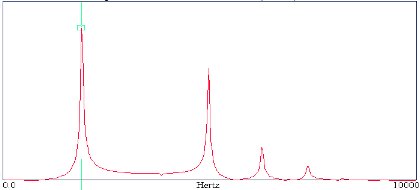
The simplest resonance test is the impact test, which should be performed on a stationary machine. A single impact excites the machine structure, and the spectrum of vibrations resulting from the impact is recorded. The resonance frequencies appear as peaks in the spectrum. Anti-resonant regions, on the other hand, appear as valleys. The width of the peaks and valleys is crucial for damping. The frequency range that can be excited by impact depends on the duration of the impact impulse (τ). In the 1/τ frequency range, 90 percent of the energy imparted to the structure by the impact acts as vibration excitation. Soft impacts (e.g., with a rubber mallet) can only excite vibrations up to a few hundred Hz, while hard impacts (e.g., with a metal hammer) can induce vibrations in frequency ranges up to several kHz. This relationship clarifies that impact testing is not very effective for large structures and higher frequency ranges, or may not be applicable at all.
Run-Up and Coast-Down Tests
The methods described below utilize the variable frequency "natural" vibrations (resulting from machine rotation) that occur during the acceleration and deceleration of rotating machinery to detect resonances. The "flaw" of these methods is that the excitation they use can also be a function of rotational speed (consider unbalance, for example: the centrifugal force causing vibration increases proportionally with the square of the rotational speed).
Peak-Hold Spectrum Recording
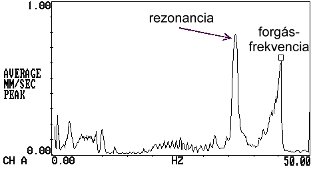
This method leverages the capability found in most instruments to average multiple spectra, typically in a peak-hold manner. (It retains the highest amplitude value found at each frequency.) Spectra are continuously recorded and peak-hold averaged during machine coast-down and run-up. The result is a "blurred" spectrum from which amplitude peaks indicating resonances can be identified.
Waterfall Spectrum Recording
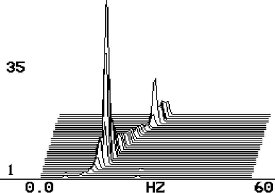
This procedure requires high-end (high storage capacity and fast spectrum analysis capable) handheld devices, as vibration spectra need to be recorded during coast-down or at intervals based on rotational speed (reaching a fraction of the operating rotational frequency). These spectra are typically displayed sequentially to create a waterfall spectrum representation. In this highly illustrative form of representation, all amplitude peaks are easily recognizable.
Rotational Speed-Dependent Recording of Vibration Amplitude and Phase Angle
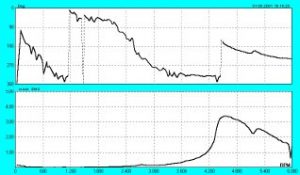
This method involves continuously recording vibration amplitude at the rotational frequency and the corresponding phase angle during coast-down or run-up. Graphical representation not only shows amplitude peaks but also reveals the phase angle reversal occurring at the resonance frequency (an approximate 180° jump).
Defects in Ball and Roller Bearings
Damage to bearings can be attributed to various reasons: incorrect assembly, technological errors during the assembly of shaft components, steam impact, overload, excessive speed, poor or missing lubrication, material and manufacturing defects. However, fundamentally, the normal operation of the bearing itself - depending on the bearing's service life - eventually leads to material fatigue, followed by initially minor and then progressively more severe damages. When a bearing is damaged, vibrations occur, and their frequency depends on which bearing component the failure occurred. These fault frequencies - often referred to as bearing frequencies or bearing fault frequencies - can be easily calculated if certain basic geometric dimensions of the bearing are known.
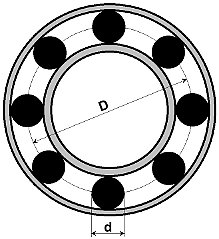
The following data is required to calculate fault frequencies:
In our next continuation, we will take a closer look at bearing faults, the calculation of fault frequencies, and the examination with vibration spectrum recording. The following basic bearing fault frequencies exist:
The most common bearing fault is damage to the outer ring, as in most cases the outer ring remains stationary, and the load (such as the weight of the rotating part) always acts on the same point of the outer ring through the rollers. The calculation of fault frequencies should be performed depending on whether the inner or outer ring of the bearing rotates.
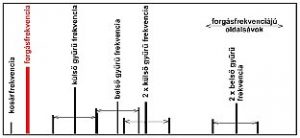
Due to the axial forces acting on individual machines, the force transmission does not occur at the contact angle specified in the bearing specification. The contact point shifts minimally to the side, thus changing the actual contact angle. This affects the expected fault frequencies obtained by calculation. In practice, this mainly occurs with high axial loads, where axial forces increase the contact angle, influencing the development of fault frequencies. The effect is quite small, up to 2 percent at most, but even at this point, the calculated fault frequencies do not exactly match the frequencies measured in reality. In most common cases (inner ring rotates, outer ring remains stationary), vibration frequencies typical of bearing faults can be estimated with an accuracy of ±20 percent based on the following equations:
Rahne Eric (PIM Ltd.) pim-kft.hu, gepszakerto.hu
The content of the publication is protected by copyright, and its (even partial) use, electronic or printed re-publication is only permitted with the indication of the source and the author's name, as well as with the author's prior written permission. Violation of copyright (Copyright) will have legal consequences.
Copyright © PIM Professzionális Ipari Méréstechnika Kft.
2026 | Minden jog fenntartva
Impresszum | Adatkezelés