


"Instead of firefighting and major repairs"
One possible technology complementing vibration-based testing in the condition monitoring of machines and equipment is ultrasonic diagnostics. In the continuation of our series, we present the basics of ultrasonic measurement and analysis, as well as the applicability of this technology for machine diagnostics, bearing condition monitoring, and density checking tasks.
Before delving deeper into ultrasonic diagnostics, we review the basic concepts and relationships related to the technology. Sound waves are longitudinal waves that propagate through the excitation of the molecules in the medium. Each molecule - with some damping - passes on the received excitation (energy) to the next molecule. In our atmosphere, this naturally refers to the air molecules, with the transmission occurring at the speed of sound (343 m/s at 20°C). Sound wave propagation also occurs in other media, but at different speeds (denoted as v, unit m/s) and with damping. Some examples of different propagation speeds include 5100 m/s for steel or aluminum, 3800 m/s in concrete, 40 m/s in rubber, and assuming a water medium, 1460 m/s.
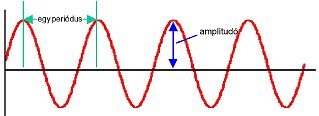
Generally speaking, sound waves propagate faster in solids (except for rubber) and liquids than in gases. In gases, sound propagation depends on pressure and temperature: the higher the pressure or temperature, the faster the wave travels. The propagation within a medium is linear, and its direction remains constant.
The properties of sound waves are expressed in terms of frequency (denoted as f, unit Hz) or wavelength (denoted as λ, unit m), as well as amplitude, and task-specifically, sound pressure (Pa) or sound intensity (dB). Frequency indicates how many periods occur in one second (1 Hz=1/s). Given a known frequency and propagation speed, the wavelength can be easily calculated as the ratio of propagation speed to frequency (λ=v/f). Therefore, in a given medium, specifying either the frequency or wavelength is sufficient, as one can be derived from the other. According to the relationship, higher frequency sound waves have a shorter wavelength.

Behavior of Sound Waves
The behavior of sound waves conforms to several physical laws. From a measurement perspective, it is important to mention the laws of reflection, modulation (change in a characteristic such as amplitude or frequency due to external influences), and interference (interaction of waves). Reflection on the surfaces of solids and liquids follows the well-known optical law: the angle of incidence equals the angle of reflection. During reflection, neither the frequency (wavelength) nor the amplitude changes, except for minimal losses. It is noteworthy that reflection occurs not only between air and solid/liquid surfaces but also at interfaces between any media with different sound propagation speeds. Interference arises when multiple sound waves (at least two) meet. If two sound waves have the same frequency, their reinforcement or cancellation depends on their phase difference (the relative shift of wave periods, ranging from 0 to 360 degrees). A phase difference less than 90 degrees or greater than 270 degrees results in reinforcement, while a difference between 90 and 270 degrees leads to attenuation, and a precise 180-degree phase difference results in complete cancellation according to vectorial summation. (This is also the origin of the idea of noise reduction through anti-phase.) When sound waves of different frequencies meet, the resulting sound wave has a frequency equal to the sum of the source wave frequencies, while its amplitude may increase or decrease compared to the original (depending on the phase angle difference and amplitude ratio). In the case of significantly different frequency sound waves, modulation occurs. Sound intensity is commonly expressed in dB (decibels). dB represents a logarithmic scaling that expresses sound intensity as the ten-based logarithm of sound energy P. The human ear (depending on inherited abilities, age, and health condition) can perceive sounds between 20 and 20,000 Hz. Since not all frequencies are heard with the same sensitivity (certain frequencies are perceived more strongly than others), the measurement of sound intensity corresponding to human perception is carried out with A-weighting, using an A-weighted frequency characteristic filter. Sound intensity measured considering human frequency sensitivity is typically indicated on the dB(A) scale. The quietest - still audible - sound is 0 dB(A), while the loudest (bearable by the ear) sound intensity is 120 dB(A).
Tools for Ultrasonic Measurement
The frequency range above 20 kHz is not perceptible to the human ear (although it is to dogs), so we need tools that enable the measurement of ultrasonic waves, display their strength (e.g., in the form of a diagram or digital value), and make them audible to us by transforming them into a lower frequency range with amplification. Ultrasonic measurement allows for the examination of the condition and operation of numerous tools and equipment. For instance, bearings operate with high-frequency vibrations depending on their condition and lubrication, with the frequency range falling into the ultrasonic spectrum in the case of incipient faults or inadequate lubrication. Therefore, ultrasonic measurement - whether through contact using a stethoscope or through air using a microphone - can identify early bearing faults or insufficient lubrication. If the applied ultrasonic measuring device is capable of transforming ultrasonic waves, the nature and extent of bearing failure can become audible.
As a practical application, bearing lubrication performed alongside ultrasonic monitoring can be mentioned: lubricant should be supplied to the bearing until its sound becomes appropriate. This method helps to avoid excessive greasing, which can lead to unfavorable consequences such as heating due to the mechanical resistance exerted by the grease and the resulting undesired decrease in bearing clearance (bearing seizure).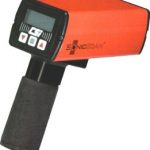
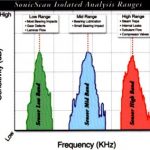
Ultrasonic Applications
Ultrasonic measurement is also suitable for checking bearings on conveyor belts (detecting faulty bearings). While with vibration measuring devices, each bearing would need to be non-contact measured and analyzed for vibrations, ultrasonic waves can be observed while passing by the conveyor belt. Strong ultrasonic sources indicate damaged or extremely poorly lubricated bearings. (Of course, faulty bearings on conveyor belts can be more precisely and quickly detected by the heat generated, detectable with thermography, but the investment cost of a thermal camera required for thermography is orders of magnitude higher than the procurement cost of ultrasonic measuring instruments.)
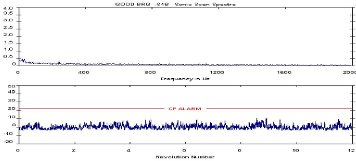
(Images below: good bearing, bad bearing, insufficient lubrication)
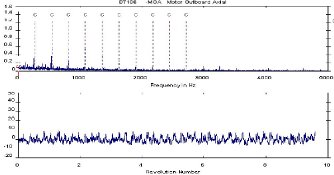
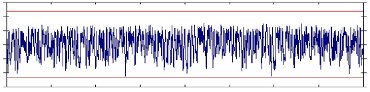
The density can also be examined in various gas and steam systems, as turbulence generated in the gas escaping through narrow gaps (holes) produces ultrasonic waves that can be localized and their strength and characteristics examined. This way, the proper operation of valves, steam traps, condensate separators, and pressure reducers can also be verified. To further aid this, the most advanced instruments incorporate expert procedures that evaluate data from multiple frequency bands, measurements performed in various locations successively, with different parameters, allowing for a clear determination of whether the inspected equipment is good or faulty.
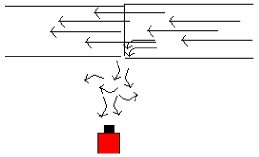
It is important to mention that the intensity of emitted ultrasonic waves is not proportional to the size of the gap or hole. Smaller and narrower gaps produce greater turbulence and thus stronger sound than larger and more spacious holes. Additionally, the pressure difference between the outflow and the external environment also influences the detectability of density irregularities. The greater the pressure difference, the stronger the ultrasonic waves expected.
For insulated or multi-layered (jacketed) gas and steam pipes, it must be considered that ultrasonic waves appear on the surface that can be inspected with the measurement where they can "leak" through the upper layers. Often these external gaps are more or less distant from the location of the density irregularity in the pressure-containing pipe, connection, or tank, so the ultrasonic waves are not measurable where the actual fault is located.
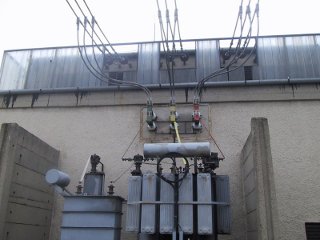
Among the diagnostic possibilities, the inspection of electrical equipment is noteworthy. It happens that high-frequency vibrations occur due to loose elements in transformers, switchgear, or voltage transformers, while voltage surges, as well as leakage currents, occur due to faulty connections or insulators. These phenomena (whether in low, medium, or high-voltage networks) mostly occur accompanied by ultrasonic waves. It is also characteristic that as the spark gap shortens, the accompanying ultrasonic frequency increases.
Evaluation of Results Obtained
The most advanced ultrasonic measuring and analyzing devices make the measured ultrasonic waves audible through headphones and indicate them numerically (in dB), as well as capable of displaying the results of evaluations for digitally filtered frequency ranges - such as average value, absolute peak value, continuous peak value, peak multiple amplitude value, etc. They also provide additional signal processing capabilities (such as the CSi SonicScan 7000 device), as they can output digitally generated envelope time signals to portable data collectors or other signal processing devices, such as oscilloscopes. The identification of faults is usually facilitated by focusing ultrasonic waves using funnels or parabolas. Various sensors can be used to better differentiate between different phenomena: tactile spike or magnetically attached body sound sensors, ultrasonic microphones. For example, if tanks need to be inspected for density and there is no way to pressurize them, ultrasonic sources available for the instruments can be used. In this case, ultrasonic waves are excited inside the tank, and then it is measured where they exit the tank. Based on the above, it is evident that ultrasonic measurement excellently complements vibration diagnostics, thermography, and various material inspections when assessing the condition of machinery and equipment. The most common application areas are summarized below.
Typical Applications of Ultrasonic Measurement
Mechanical inspections with trendable data
Detection of leaks, density irregularities
Rahne Eric (PIM Ltd.) pim-kft.hu, gepszakerto.hu
The content of the publication is protected by copyright, and its (even partial) use, electronic or printed re-publication is only allowed with the indication of the source and the author's name, as well as with the author's prior written permission. Infringement of copyright (Copyright) will result in legal consequences.
Copyright © PIM Professzionális Ipari Méréstechnika Kft.
2026 | Minden jog fenntartva
Impresszum | Adatkezelés