


"A universal measurement procedure"
The creation of thermal images, i.e., thermography – or less accurately termed thermovision – is an extremely versatile measurement procedure that could not spread more rapidly in practice solely due to the high cost of thermal cameras.
Thermal imaging measurements and monitoring solutions occur in almost every field, from healthcare to law enforcement and military applications. Among non-military applications, examples include inspecting the insulation of buildings, pipelines, and refrigeration units, checking electrical cables and connections, conducting maintenance-oriented condition assessments of machinery and equipment, quality control during production based on certain product parameters (think of refrigerators and heating devices, for instance), process monitoring (including overseeing the technological steps in lamp manufacturing), developmental tasks such as in power electronics, biological and chemical experiments, as well as medical measurements and experiments. It is clear that there are few other measurement methods as universal as thermography. The handling of modern thermal cameras can now be compared to that of common digital cameras. However, no one should assume that creating correct (in terms of measurement) thermal images is as simple as operating the thermal camera itself. A lot of professional (theoretical) knowledge, experience, and proper measurement preparation are required to ensure that the images are not just "nice colorful pictures" but rather evaluable thermal images. It is a sad fact that distributors of thermal cameras and those who create thermal images often make serious professional errors in relation to producing the thermal images. In our series, in the current and upcoming parts, we aim to present the theoretical background and practical aspects of thermography so that both the creators of images and the users performing evaluations can better utilize the theoretically provided advantages of thermal images. Let's start with the physical principles!
Basis of Infrared Temperature Measurement
Infrared temperature measurement, based on infrared radiation, or thermography and remote temperature measurement (non-contact temperature measurement, often mistakenly referred to as laser temperature measurement due to the applied laser targeting illumination), utilizes the physical phenomenon that bodies emit electromagnetic waves above absolute zero Kelvin temperature (–273.15 °C), such as radio waves, light, and heat (radiation). Infrared radiation is a part of the electromagnetic spectrum, located on the long-wavelength side of visible red light, roughly in the wavelength range between 760 nm and 1 mm (see our table). For temperature measurement, the range up to 20 µm is significant, which can be further divided into three subranges: 0.8–2 µm is the short, 2–6 µm is the medium, and 6–20 µm is the long-wavelength infrared radiation range. The electromagnetic spectrum
| Wavelength | Wavelength range |
| 1000 km 100 km | Long waves (RF and ELF) |
| 10 km 1 km 100 m 10 m | Radio frequencies |
| 1 m 10 cm 1 cm | Microwaves |
| 1 mm 100 µm 10 µm | Infrared radiation |
| 1 µm 100 nm | Visible light |
| 10 nm | Ultraviolet radiation |
| 1 nm 0.1 nm 0.01 nm | X-ray radiation |
| 0.001 nm 0.0001 nm 0.00001 nm | Gamma radiation |
Planck's Radiation Law
Temperature measurement is based on the electromagnetic waves (infrared radiation) emitted by the object being measured. To infer the temperature, the relationship between the object's temperature and the emitted radiation must be considered. This relationship is primarily defined by Planck's radiation law, which describes the spectral distribution of radiation emitted by an ideal radiator (black body).
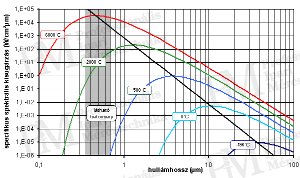
In summary: the hotter an object, the more radiation it emits, and the shorter the wavelength of the most intensely emitted radiation. As an illustration of this relationship, our table presents the radiation maxima of some practical materials. It is noteworthy that longer wavelengths are always present (and even strengthened with increasing temperature), while shorter wavelengths are only found in the heat radiation emitted by hot objects.
Radiation Maxima of Materials Encountered in Practice
| Radiating Body | Temperature | Radiation Maximum |
| Deep-frozen food | –18 °C | 11.4 µm |
| Skin | 32 °C | 9.5 µm |
| Boiling water | 100 °C | 7.8 µm |
| Glowing dark red iron | 600 °C | 3.3 µm |
| Glowing white iron | 1200 °C | 2.0 µm |
Properties of Objects to be Measured
The so-called black body is the ideal physical radiation model that is essential for studying the principles of thermography. However, the objects measured in practice more or less deviate from this model, so it is important to consider these differences during measurements. The radiation capability of real objects falls short of the black body model, and the emissivity factor (ε) serves to account for this difference, describing a body's infrared radiation emission capability compared to that of a black body. The emissivity factor primarily depends on the material (its surface), surface roughness, and wavelength (thus, also on the object's temperature).
In the long-wave range, many non-metallic materials are characterized by a high-value, relatively wide temperature range constant emissivity factor independent of surface machining. Good examples include human skin surface and many mineral structures (including construction materials), as well as plastic-based paints. The emissivity factor of metals is usually small, and it greatly depends on surface characteristics, decreasing with increasing wavelength (decreasing temperature).
Thermography measurement setup
When it comes to thermography, the unique characteristics of this temperature measurement procedure based on physics must be considered: on the one hand, it is an optical measurement method, so the measurement object must be visible from the measuring device; on the other hand, besides the two key elements of the measurement setup, the characteristic state of the measurement path and the possible presence of radiation sources in the foreground or background play a crucial role in the measurement.
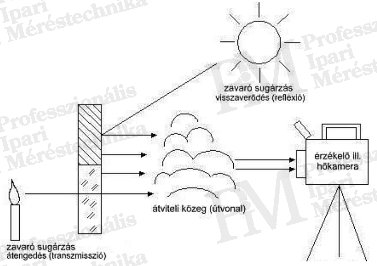
The effect of the transmission section on the measurement result Since infrared thermography is a non-contact method, the infrared radiation forming the basis of the measurement must pass through some medium from the object to be measured to the measuring device, and the behavior (characteristics) of the medium in the infrared range naturally affects the measurement. In most cases, the medium is air, but other materials that transmit infrared waves (such as special measuring windows) are also present. In the case of air, the transmission of infrared radiation is affected by the water vapor and carbon dioxide it contains.
As shown in the figure, the transmission properties of air greatly depend on the wavelength. In regions characterized by high transmission losses, regions with good transmission capacity (shaded) can also be observed nearby. The latter are commonly referred to as atmospheric windows. While the transmission factor in the 8-14 µm range - the long-wave atmospheric window - provides almost perfect transmission even over long distances, in the 3-5 µm range - the short-wave atmospheric window - the atmosphere causes measurable losses even at distances of several tens of meters.
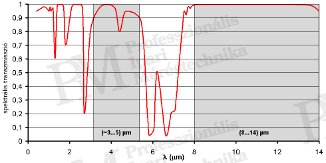
The measuring instrument and its effect on the measurement result Since air is the most common transmission medium in non-contact temperature measurements, measurements should only be made in the wavelength ranges corresponding to the mentioned atmospheric windows (otherwise, a nonlinear temperature dependence would be obtained). Therefore, for measurements, thermal cameras sensitive to the 8-14 µm wavelength range - operating using the long-wave atmospheric window - and capable of detecting the 3-5 µm wavelength - measuring in the short-wave atmospheric window - are used. Depending on this, they are named long-wave or short-wave thermal cameras. Thermal cameras for measuring in the ultrashort wavelength range are less common.
The spectral measurement range of non-contact temperature measurement instruments usually covers only a part of the total radiation emitted by the object. The diagram in the figure illustrates the impact of this on the measurement result for some typical measurement ranges applied according to the atmospheric windows. It is easy to see that the short-wave (3-5 µm) range is quite insensitive to relatively low temperatures, but (for a black body) above 350 °C, the detectability of radiation in this range is better than in the long-wave (8-14 µm) band. This is because the radiation maximum has shifted to the short-wave range. For detecting low temperatures (including typical temperatures of buildings and their surroundings), long-wave thermal cameras are the most suitable.

Practical issues
The impact of the emissivity factor and environmental temperature on measurement accuracy This is the most common and significant error in the practical application of non-contact temperature measurement methods. The measuring device can only correctly determine the temperature of an object if the emissivity factor set on the measuring instrument (or in the evaluation software) corresponds to the real characteristic of the object being measured. Reflection of thermal radiation from the front surface of the object The more a body's emissivity factor deviates from the ideal value of 1, the more its reflective (radiation reflection) property strengthens (assuming an opaque object in the infrared range). This means that in addition to the thermal radiation emitted in proportion to the body's temperature (in the worst case, instead of it), the measuring instrument measures the thermal radiation reflected from the environment on the measured object's surface. Signal loss in the transmission section The transmission section is usually the common atmosphere, through which only a part of the infrared radiation spectrum passes (so-called atmospheric windows). The losses occurring at greater distances are determined by factors that absorb or attenuate infrared radiation (such as fog, aerosols, carbon dioxide, carbon monoxide, other gases, or the presence of water). Transmission of thermal radiation from the background of the object This error occurs when the object is partially transparent, naturally in terms of infrared radiation. In such cases, the background of the object must be taken into account as much as the foreground in terms of thermal radiation reflection.
Rahne Eric (PIM Ltd.) pim-kft.hu, termokamera.hu
The content of the publication is protected by copyright, its (even partial) use, electronic or printed further publication is only permitted with the indication of the source and the author's name, and with the author's prior written permission. Infringement of copyright (Copyright) has legal consequences.
Copyright © PIM Professzionális Ipari Méréstechnika Kft.
2026 | Minden jog fenntartva
Impresszum | Adatkezelés