


"A universal measurement method"
In continuation of our previous article on the theoretical basics of thermography (ManufacturingTrend 2010/12), we now focus on practical aspects. First, we address the possible error sources of non-contact temperature measurement, then we present the considerations for quantitative evaluation of measurement errors and the possibilities for error reduction.
The measurement error of non-contact temperature measurement results from several factors. Among these, the measurement inaccuracy originating from the used measuring instrument can be mentioned. Like any measuring device, a non-contact temperature measuring instrument is only capable of performing its task with a certain level of measurement error. However, many other measurement or operational errors may occur, which do not happen in contact temperature measurement and can result in errors - potentially completely incorrect data - significantly larger than the inaccuracy of the measuring instrument. Below, we detail some of these possible - and particularly noteworthy - error sources.
Issues with non-contact measurement
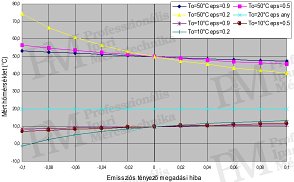
The impact of emissivity factor and environmental temperature on measurement accuracy This is the most common and, in terms of error magnitude, the most significant error source in the practical application of non-contact temperature measurement method. The measuring device can only correctly determine the temperature of an object if the emissivity factor set on the measuring instrument (or in the evaluation software) corresponds to the real characteristic of the object being measured.
Reflection of thermal radiation from the front surface of the object (radiation reflection) The more the emissivity factor of an object deviates from the ideal value of 1 (i.e., the lower the radiation emission capacity), the stronger its reflective (radiation reflection) property becomes (assuming an opaque object). This results in the measuring device measuring the radiation reflected from the environment on the measured object's surface alongside (or even instead of) the thermal radiation emitted proportionally to the object's temperature (in the worst case).
Signal loss in the transmission stage (radiation decrease in the atmosphere and other materials) The transmission stage is typically the ordinary atmosphere, through which only a part of the infrared radiation spectrum passes (atmospheric windows). The losses occurring at greater distances are determined by factors that absorb or attenuate the infrared radiation (e.g., fog, aerosols, high concentrations of carbon dioxide, carbon monoxide, other gases, or the presence of water). In the presence of other materials (e.g., infrared-transparent measuring windows), their attenuation effects must also be taken into account.
Transmission of thermal radiation from the background of the object The error occurs when the object is partially transparent, especially in terms of infrared radiation. In such cases, the background of the object must be considered as much as the foreground in terms of thermal radiation reflection. This can be particularly problematic when strong heat sources (e.g., technologically necessary heating devices) are located directly behind the object being measured.
Identification and mitigation of errors
A significant part of the total temperature measurement error can be calculated from the deviation of the emissivity factor from its true value. The measurement error resulting from an incorrect emissivity factor is greater the more the temperature of the object being measured differs from the environmental temperature. It is also evident that such an error can be quite large, potentially exceeding several times the regular internal error of the measuring instrument. While the effects of errors arising from reflected and transmitted interfering radiation sources can usually be easily detected on the thermal image based on their optical appearance ("out-of-place" points, spots, or circles) and corrected thereafter, this is not as straightforward in remote temperature measurement since the distribution of radiation is not visible. In order to eliminate or at least minimize errors in temperature measurement, consider the following advice during the execution of measurements. Before starting the measurement, ensure that no reflected thermal radiations fall into the measuring direction of the thermometer - especially during mobile measurements. If this occurs, take at least one of the following steps:
Useful practical advice
It is important to note that not only obvious interfering radiation sources, such as light bulbs, flames, or hot (or cold) machine parts that can disturb measurements by reflecting on the object being measured, but also the person performing the measurement is a heat source and can also reflect on the measured surface. If the emissivity factor of the object clearly differs from that of a blackbody, set the emissivity factor on the measuring device as close to reality as possible with the smallest possible deviation. Information on the emissivity factor to be set can be obtained in various ways: * conduct an experiment on a real object or a reference object with comparable characteristics in terms of thermal radiation * use empirical or supplier information on typical thermal emissive properties of specific materials and surfaces, or look for such information in the literature. Another important aspect to highlight is that if the emissivity factor deviates from 1, the environmental temperature value also plays a role in determining the temperature measurement value. In this case, ensure that the setting of the measuring instrument for this value is correct.The environmental temperature is NOT the temperature of the ambient air, but the surface temperature of objects reflecting radiation! If the measurement distance exceeds 10 meters in the mid-wave measurement range, the effect of atmospheric transmittance reducing radiation intensity must also be taken into account for correction. The temperature of the measurement path should be set as accurately as possible as a supplement to the transmittance value (if possible, use the most automatic functions built into most thermal cameras).
Optical Laws
Since thermal radiation is practically the same electromagnetic wave as visible light, many of its properties are similar to those of light. The main difference lies in the wavelength. This is why some materials behave differently towards visible light than they do towards thermal radiation. However, the optical laws applicable to visible light are 100% valid for thermal radiation. In terms of contactless temperature measurement, we would emphasize the correct optical focusing, as ignoring it can cause significant measurement errors.
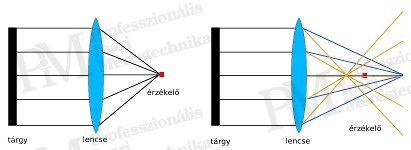
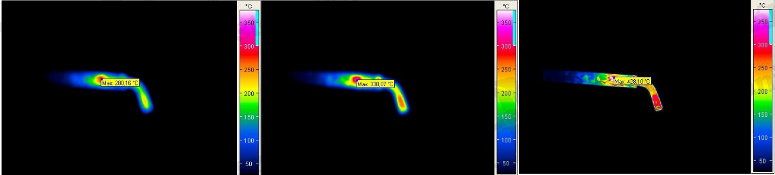
The optical focus works in the same way as we are used to in photography: the task of the collector or focus lens inside the camera is to project the incoming rays onto the sensor surface (in traditional photography, onto the film). In case of incorrect focus, the rays are collected in front of or behind the sensor plane. In such cases, the image becomes blurred. But in the case of a thermal image, the problem is greater: only a part of the actual amount of radiation reaches the sensor, the rest is projected around it. This leads to the measured temperature always being lower than the actual temperature. The worse the focus setting, the more it deviates from the correct value.
Rahne Eric (PIM Ltd.) pim-ltd.com, thermalcamera.com
The content of this publication is protected by copyright, and its (even partial) use, electronic or printed re-publication is only permitted with the indication of the source and the author's name, as well as with the prior written permission of the author. Violation of copyright (Copyright) will have legal consequences.
Copyright © PIM Professzionális Ipari Méréstechnika Kft.
2026 | Minden jog fenntartva
Impresszum | Adatkezelés