


"A universal measurement procedure"
When attempting to solve certain measurement tasks with thermographic tools, we easily encounter various widely used thermal imaging principles and numerous difficult-to-determine and weigh technical parameters, all of which must be taken into account in choosing the correct path to the solution.
Shortly after the discovery of infrared radiation (physically more correct would be the designation of electromagnetic waves in the infrared range), the first imaging systems of military importance were realized. For example, military infrared reconnaissance became the decisive driving force behind the development of infrared thermography (an example of this is the so-called sniper scope or snooper scope infrared target locators from the USA dating back to 1939). Thermal imaging equipment for civilian applications only appeared a few decades later, in the 1960s. In contrast to military target locators, these civilian devices were already used for measuring the intensity of infrared radiation and determining temperatures from thermal images using non-contact methods known from remote temperature measurement. Our diagram illustrates the emergence and development of various detector technologies, as well as the technologies of thermal cameras in thermography.
Thermographic Imaging Principles
The core of a thermographic device is the infrared radiation detector, which electronically converts the intensity of the object's radiation into an analyzable signal. The thermographic devices available today are based on one of the principles described below.
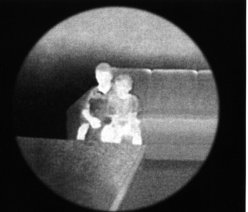
Thermal detector vidicon system In the historical development of thermography, thermal detector vidicon tubes - i.e., vacuum tubes sensitive to infrared light - were used very early in the production of thermographic equipment. These devices were made with infrared-sensitive materials, such as triglycine sulfate, similar to the television camera tubes of that time. While these devices did not require any physical detector cooling and did not provide sufficient stability for temperature measurement, they mostly served observational purposes. This technology hardly deserves further development attention today, but it is still used - for example in shooting - because it is compact and inexpensive.
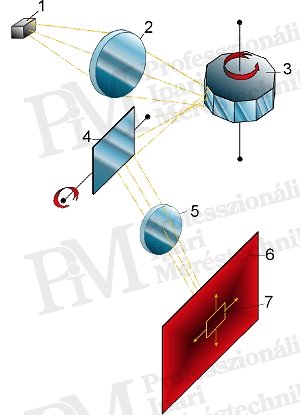
Scanning thermal cameras Scanning cameras use a single-element (point) detector to convert infrared radiation and mechanically scan the object to be measured. While the practical implementation of this imaging principle requires high-speed detectors and high-precision components, it has significant advantages over all other methods in the field of measurement applications. Each signal for each pixel is converted by a single (point) detector. This results in very good image homogenization since the electrical data to be evaluated later are created under perfectly identical conditions from every pixel on the thermal image (the difference displayed between points of the same temperature is minimal or nonexistent). In the example illustrated in the diagram, the horizontal deflection of the scanning thermal camera within the camera is produced by a rotating mirror, while the vertical deflection is provided by a tilting (oscillating) mirror. Other types - such as rotating mirror prisms - are also possible solutions.
Matrix detector (Focal Plane Array, FPA) thermal cameras In recent years, matrix detector thermal cameras have been increasingly used in infrared thermography. When using such detectors, there is no need for a mechanical scanning unit, making the camera mechanically simpler, smaller, and lighter.
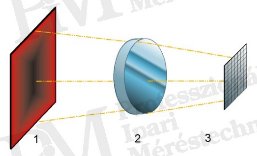
Although the optical path of matrix detector thermal cameras is surprisingly simple, the devil is in the details: one of the main problems is that each pixel of the thermal image is converted by a unique sensor, whose characteristics may closely resemble those of neighboring elements but still measurably differ. Compensating for this lack of uniformity requires a significant amount of real-time data processing. This is evidenced by the fact that the first thermal cameras made with matrix detectors were recommended without temperature measurement functions. Camera manufacturers only later integrated this technology into the camera, initially with only one - in the center of the image - measuring point, later extending it to all image points. Most cameras with matrix detectors operate in the shortwave range, using highly efficient InSb, CdHgTe, and very inexpensive PtSi-based detectors.
Matrix detectors characterized by a long wavelength measurement range can only be produced on the expensive CdHgTe basis, and so far, they are not manufactured with a large number of pixels. An alternative is the relatively new quantum well (thermoresistive or bolometric) sensor technology, which enables the production of high-resolution and high-geometry sensors within the long wavelength range. In some cases, the not very strict requirement for the reaction time of the individual elements of matrix detectors allows for the use of non-cooled detectors. However, due to radiation physics reasons, achieving the expected high thermal resolution at low temperatures with non-cooled devices is only conceivable within the long wavelength range. In addition to the previous classification, some other aspects may also arise:
Determination and Evaluation of Device Parameters
If we want to solve certain measurement tasks with thermographic instruments, we easily encounter numerous technical parameters that are difficult to determine and weigh. If the planned use is not clearly standard, then in many cases the correct solution can only be determined based on trial measurements. However, there are some parameters that must be carefully considered before any test. Here we present some basic technical parameters with their explanations. Spectral measurement range The wavelength range of infrared radiation that can be used for contactless measurement of technically relevant temperatures starts at approximately 0.8 µm and extends up to 20 µm. While long-distance heat measurement similar to infrared thermography uses multiple spectral ranges, the range for thermography is limited to either the 3(2)–5 µm or the 8–14(12) µm interval, which results from utilizing the so-called mid and long-wave atmospheric windows. Since the atmosphere mostly perfectly transmits long-wave heat radiation, this range is very suitable for outdoor measurements over long distances. Atmospheric elements such as water vapor, carbon dioxide, hydrocarbons, etc., can strongly influence (attenuate) the mid-wave range beyond a few meters. What may seem like a disadvantage also has a positive effect: the temperature of flames, combustion gases, etc., can be determined with short-wave thermography, while they are transparent in the long-wave range. There may also be a need for measurements that must be carried out through infrared radiation-transmitting windows. Materials used for making such windows may have completely different spectral properties, so the wavelength range of the thermal camera must be decided based on them. Finally, the spectral emissivity factor of the object can also influence the wavelength range to be selected. Temperature resolution Especially when the range to be measured falls between room temperature and the lower limit of the measurement range, temperature resolution decisively determines the image quality. "NETD" (noise equivalent temperature difference) represents the effective value of the camera's own noise, expressing the temperature difference in the object that results in the same electrical signal magnitude (usually measured at 30°C). (In other words: "NETD" is the value of the temperature change in the object that results in an electrical signal change equivalent to the camera's own noise.) Geometric resolution In addition to temperature resolution, geometric resolution significantly influences the image quality of the camera. The IFOV parameter (instantaneous field of view, smallest elemental viewing angle) specifies the viewing angle that is imaged with a single sensor (pixel). For example, a value of 1.5 mrad indicates that each measurement point projected onto the object has a diameter of 1.5 mm at a distance of 1 m, and at a distance of 2 m, the projected surface has a diameter of 3 mm, and so on. (This should be imagined as the beam of a flashlight, which covers an increasingly larger circular surface depending on the distance.) Since this value always refers only to the optics being used, it is essential to check whether this optics is suitable for the desired field of view or focal length.
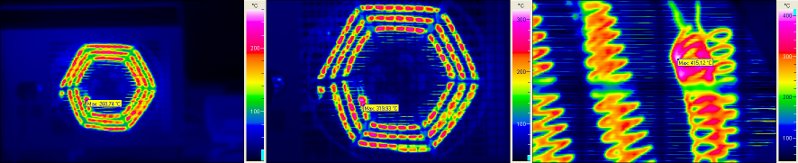
It is important that the object being measured be at least three times (but at least twice) larger than the measuring surface projected at the given distance; otherwise, the measurement spot may contain not only the surface of the object but also its background. Since averaging occurs within the measurement spot, the measurement result may be higher or lower than the actual temperature of the object due to the background temperature. Image capture frequency Thermal cameras on the market today cover a wide range of recording frequencies; they generally distinguish between slow devices with a scanning rate of about 1 Hz and real-time devices around 50 Hz. There are also thermal cameras offering even faster image capture frequencies of up to 6 kHz. This parameter can significantly affect the price, so the maximum image frequency should be carefully considered. With few exceptions, thermal processes usually have a large time constant, and if the object is stationary, one image per second is usually sufficient. In return, this provides the best image quality and resolution. Detector cooling Nowadays, there are many long-wave devices based on detectors without cooling that have temperature measurement capabilities. The most accurate measurement and short- and mid-wave thermal cameras, however, are equipped with cooled photon detectors. Instead of liquid nitrogen solutions, high-reliability miniature cooling compressors (Stirling coolers) have become more common for their cooling. For some detector types, another option is the use of thermoelectric (Peltier) cooling, although this does not achieve such low temperatures.
Rahne Eric (PIM Kft.) pim-kft.hu, termokamera.hu
The content of the publication is protected by copyright, and its (even partial) use, electronic or printed re-publication, is only permitted with the indication of the source and the author's name, and with the author's prior written permission. Violation of copyright (Copyright) will result in legal consequences.
Copyright © PIM Professzionális Ipari Méréstechnika Kft.
2026 | Minden jog fenntartva
Impresszum | Adatkezelés