


"A universal measurement procedure"
In order to create thermal images with the thermal camera that can be evaluated by architects, energy experts, structural engineers, and operators – allowing for correct conclusions – several conditions must be met, not just producing "colorful" images of the building to be inspected.
The conditions mentioned in the introduction and related to the measurement circumstances are primarily as follows:
It follows that building thermography can only be carried out during the heating season, in appropriately cold (below 5 °C) weather conditions.
Requirements for the thermal camera system When creating high-quality, evaluable thermal images, there are very serious expectations for the thermal camera itself, without meeting which we obtain unrecognizable thermal images incapable of detecting faults. The thermal camera must minimally meet the first six points of the following list:
In addition to geometric resolution, the number of pixels of the thermal camera determines the image quality achievable with the thermal camera – or more precisely, the detail of the measurement. While digital cameras are discussed in terms of resolutions of 5, 6, 7, or even more than 10 megapixels (10 million pixels), matrix thermal cameras typically have 320×240 (thus 76,800) pixels. There are cameras with lower capabilities as well – the 160×120 pixel resolution type is common (with only 19,200 pixels), capable of displaying acceptable details only for smaller areas. The presented thermal image examples "visually" illustrate the importance of adhering to the mentioned diverse rules.
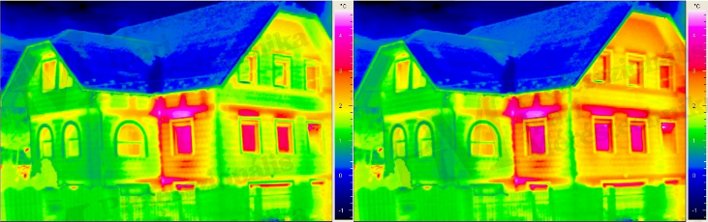
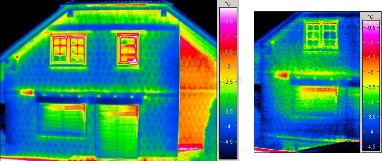
Effect of wind. Thermographic survey conducted in strong wind on the left: the wind takes away heat from the right-side wall, making it cooler; it appears as if the insulation of the wall seen in the middle of the thermal image is better. The same measurement in calm wind on the right: it is evident that the insulation of the right-side wall is as poor as that of the wall in the middle of the thermal image (and with equally strong thermal bridges). Note for both thermal images: the left side of the building is not heated (staircase)
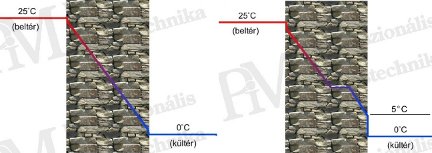
Effect of strong daytime heating. Ideal thermal gradient of the external wall on the left (stationary state), indoor (measurable) wall temperature 21 °C, outdoor (measurable) wall temperature 3 °C. After strong daytime heating on the right, nighttime state, indoor (measurable) wall temperature 21 °C, outdoor (measurable) wall temperature 8 °C. Note: the horizontal segment on the right graph is a consequence of daytime (temporary) heating. The graph shows the evening (after cooling of the outdoor temperature) thermal gradient. The increased temperature of the external wall leads to the mistaken conclusion of poor insulation or the presence of thermal bridges, although we assumed the same wall structure as in the left graph
Effect of lack of heating. The room or apartment shown in the image (top left) is not heated. It is naturally impossible to detect insulation and other architectural flaws in this room or apartment
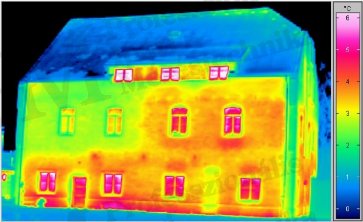
Effect of emissivity factor angle dependence. Since the emissivity factor depends, among other things, on the angle of view, we must consider that the greater the angle deviates from the perpendicular, the more increasing reflection is observed. This effect is most noticeable in measurements of curved surfaces, but we also encounter this problem when measuring the upper floors of tall buildings: seemingly, the upper floors are getting cooler (although in reality, they are getting warmer). The explanation is that without clouds, theoretically the –273 °C temperature of the sky is increasingly reflected on the external surface of the building, even though the emissivity factor of surfaces made of about 95% silicate-based materials is high, as it is only this high for observations perpendicular to the surface.
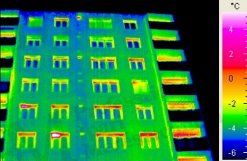
Effect of the number of pixels and thermal resolution of the thermal camera on the detail of a family house thermal image. The thermal image on the left was taken with a professional camera (640×480 pixels, 50 mK temperature resolution), while the one on the right was taken with a less capable camera (120×160 pixels, 100 mK temperature resolution)
Typical building damages and defects
If the measurement conditions detailed earlier have been adhered to, we only need to learn how to evaluate and analyze the measurement results obtained in this way (graphically represented, i.e., thermal images). Therefore, we discuss the appearance and recognizability of the most common structural and building services defects. In this context, we particularly address the following issues: thermal bridges, insulation deficiencies, discovery of hidden building structural and building services elements; investigation of condensation, capillary moisture, and leaks; searching for leaks and imperfections; quantification of heating costs; as well as air tightness tests.
Rahne Eric (PIM Ltd.) pim-kft.hu, termokamera.hu
The content of the publication is protected by copyright, and its (even partial) use, electronic or printed re-publication is only permitted with the indication of the source and the author's name, as well as with the author's prior written consent. Violation of copyright (Copyright) will result in legal consequences.
Copyright © PIM Professzionális Ipari Méréstechnika Kft.
2026 | Minden jog fenntartva
Impresszum | Adatkezelés