


"A universal measurement procedure"
Distributors of thermal cameras and providers of thermal imaging services often make serious professional mistakes when creating thermal images or selecting thermal cameras suitable for the task. Below we present the most important information for selecting the type of thermal camera based on the task at hand.
The creation of thermal images, i.e., thermography, is an extremely versatile measurement procedure. Handling modern thermal cameras is similar to popular digital video cameras. However, this simplicity should not deceive anyone: professional knowledge, proper measurement preparation, and a measuring instrument (thermal camera) that meets the requirements of the task are necessary for creating thermally correct thermal images. Otherwise, instead of measurement results, only uninterpretable "color images" will be produced. Furthermore, it must be acknowledged that due to physical reasons, there is no universal thermal camera that satisfies all possible requirements. It is a sad experience that distributors of thermal cameras and providers of thermal imaging services often make serious professional mistakes when creating thermal images or selecting thermal cameras suitable for the task. Therefore, we present the most important information here for the task-dependent selection of a thermal camera, as a device selected based on inappropriate parameters usually results not only in wasted money but also in the impossibility of executing the measurements.
Steps of Selection
So how should we select a thermal camera that meets our measurement tasks? First of all, let's understand what the technical parameters and characteristics of thermal cameras mean, how they affect the measurement results, and what physical limitations they imply. In the next phase, clarify what minimal requirements the selected device must meet based on our measurement task, what physical laws it must comply with. As a third step, determine in what quality and form the measurement data evaluation (and related report) should be prepared. Finally, look for all thermal cameras and evaluation software that definitely meet the previously established requirements (it is important not to compromise on measurement parameters or physical limitations, as this can easily lead to the uninterpretability of the measurement). If you find multiple - all suitable - devices, it is advisable to choose the most financially advantageous one (or the one that offers greater knowledge or better quality for the same price). Of course, it is advantageous to purchase the selected device from a supplier or service provider who is professionally prepared and provides thorough advice to help select the right tools (due to potentially incomplete professional knowledge and experience, this could be what saves our measurement). The following parts of our series aim to clarify the physical (theoretical) background of thermal camera selection and provide advice to help in selecting the right device for typical applications. The items listed in the article are not manufacturer-specific data but parameters applicable to all thermal cameras. Therefore, if certain measurements cannot be performed with certain camera types, there is no camera manufacturer capable of producing a camera suitable for the task. (For example, measuring through glass is not possible with any long-wave camera, regardless of the manufacturer.) If we intend to solve certain measurement tasks with thermographic tools, numerous difficult-to-determine and weigh technical parameters must be taken into account. If the planned use cannot be clearly defined as standard, the correct solution path is often determined only through trial measurements. However, there are a few parameters that must be carefully considered before any trial, to be able to assess the effect of the measuring instrument on the measurement results in advance.
Thermal Camera Wavelength Range
The wavelength range of infrared radiation usable for contactless measurement of technically relevant temperatures starts approximately at 0.8 μm and extends up to 20 μm. While remote heat measurement similar to infrared thermography uses multiple spectral ranges, the range for thermography is limited to two intervals: 3 (or 2) to 5 μm and 8 to 14 (or 12) μm, resulting from utilizing the so-called mid- and long-wave atmospheric windows. Since the atmosphere mostly perfectly transmits long-wave heat radiation, this range is highly suitable for outdoor measurements at long distances.
The elements of the atmosphere - water vapor, carbon dioxide, hydrocarbons, etc. - can strongly influence (attenuate) the short- and mid-wave range even at distances of a few meters. What appears to be a disadvantage also has a positive effect: for example, the temperature of flames and combustion gases can be determined using short- and mid-wave thermography, while they are transparent in the long-wave range. It may also be necessary to perform measurements through infrared-transmitting windows. The materials used to make such windows may have completely different spectral properties, so the range of the thermal camera's measurement wavelength must be decided based on them. Finally, the object's spectral emissivity factor can also influence the range of wavelengths to be selected.
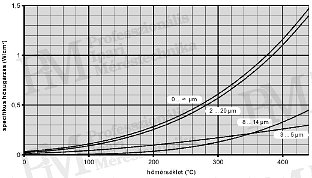
Due to the transmission properties of air for measurements, thermal cameras sensitive to the 8–14 μm wavelength range - operating with the utilization of the long-wave atmospheric window - and capable of detecting the 3–5 μm wavelength - measuring in the short-wave atmospheric window - are manufactured. Depending on this, they are called long-wave or mid-wave thermal cameras. The spectral measurement range of such instruments covers only a part of the total radiation emitted by the object. The diagram shown illustrates the impact of this on the measurement results for some typical measurement ranges (applied according to the atmospheric windows).
It is easy to recognize that the mid-wave (3-5 μm) range is quite insensitive to relatively low temperatures, however, (for a black body) above 350 °C, the detectability of radiation in the 3-5 μm range is better than in the long-wave (8-14 μm) range. The reason for this is that the maximum radiation has shifted to the mid-wave range (Wien's displacement law).
Conclusions regarding wavelength ranges
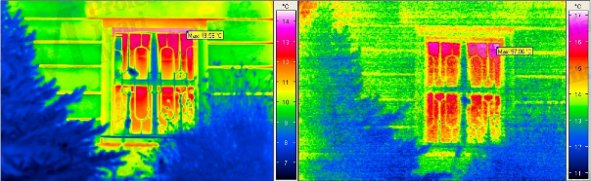
While with long-wave (8-14 μm) cameras the coldest and hottest objects can be measured, with mid-wave (3-5 μm) thermal cameras, cold objects (e.g., -80 °C) cannot be examined because cold objects do not emit short- and mid-wave radiation. On the other hand, a major advantage of mid-wave thermal cameras is their suitability for measurements through glass. The basis for this is that glass transmits short- and mid-wave thermal radiation (up to 4 μm), but not long-wave, so long-wave cameras cannot "see through" glass.
Various thermal camera technologies
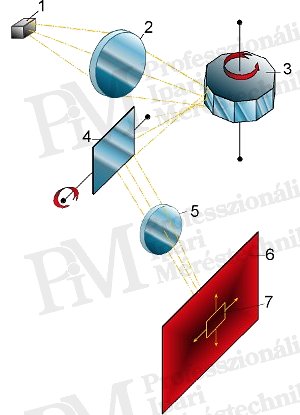
Scanning thermal cameras Scanning cameras use a single-element (point) detector to convert infrared radiation and mechanically scan the object to be measured. This imaging method requires a high-speed detector and high-precision mechanical components. A major advantage over all other methods is that each signal for every single pixel is converted by a single - very precisely adjusted and corrected sensitivity-curve - point detector.
As a result, the thermal image is created under perfectly uniform conditions from every point, leading to very good image homogeneity. (The difference displayed between points of the same temperature is minimal or non-existent.) In the example shown in the figure, the horizontal deflection of the scanning thermal camera is done by a rotating mirror, while the vertical deflection is provided by a tilting (vibrating) mirror. The same can be achieved with other methods - for example, using rotating prisms.
Matrix detector (focal plane array, FPA) thermal cameras In recent years, matrix detector thermal cameras have been increasingly used in infrared thermography. In this case, there is no need for a mechanical scanning unit, making the camera mechanically simpler, smaller, and lighter.
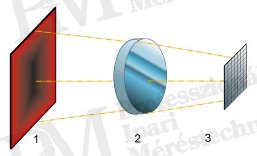
Although the optical path of matrix detector thermal cameras is surprisingly simple, there are several issues in detail: one main problem is that each pixel of the thermal image is converted by a unique sensor, whose characteristics may closely resemble those of neighboring elements but still measurably differ. Compensating for the lack of conformity requires a significant amount of real-time signal processing (correction) based on calculations. Therefore, the first thermal cameras made with matrix detectors were recommended without temperature measurement functions. Camera manufacturers only later integrated this technology into the devices, initially with only one - in the center of the image - measuring point, later extending it to all image points.
Most matrix detector cameras operate in the mid-wave range and mainly use highly efficient InSb, CdHgTe, and relatively inexpensive PtSi-based detectors. Matrix detectors characterized by a long-wave measurement range can only be produced on the very expensive CdHgTe base and are not yet manufactured with a large number of pixels. An alternative is the relatively new so-called thermal resistance or bolometer sensor technology, which enables the production of high-resolution thermal and geometric detectors within the long-wave range. In some cases, the not overly strict requirement for the reaction time of individual elements of matrix detectors allows for the use of uncooled detectors. However, due to radiation physics reasons, achieving high thermal resolution expected at low temperatures can only be imagined with uncooled devices in the long-wave range.
Rahne Eric (PIM Ltd.) pim-kft.hu, termokamera.hu
The content of the publication is protected by copyright, and its (even partial) use, electronic or printed republication, is only permitted with the indication of the source and the author's name, as well as with the author's prior written permission. Violation of copyright (Copyright) entails legal consequences.
Copyright © PIM Professzionális Ipari Méréstechnika Kft.
2026 | Minden jog fenntartva
Impresszum | Adatkezelés