


Theorie und Auswertungsmethoden
Die Erstellung von Wärmebildern, also die Thermografie - oder fachlich weniger korrekt Thermovision genannt - ist ein äußerst vielseitiges Messverfahren, und der Umgang mit modernen Wärmebildkameras kann mit dem von weit verbreiteten digitalen Videokameras verglichen werden. Doch diese Einfachheit sollte niemanden täuschen: Für die korrekte (aus messtechnischer Sicht richtige) Erstellung von Wärmebildern sind fachliches (theoretisches) Wissen, Erfahrung und eine angemessene Messvorbereitung erforderlich. (Andernfalls entstünden lediglich "schön bunte" - aber nicht auswertbare, zu fehlerhaften Schlussfolgerungen führende - Bilder.)
Es ist bedauerlich, dass sowohl die Vertriebspartner von Wärmebildkameras als auch die Anbieter von Wärmebildaufnahmen häufig schwerwiegende fachliche Fehler bei der Erstellung von Wärmebildern begehen. Aus diesem Grund wiederholen wir im Folgenden die wichtigsten theoretischen und praktischen Gesetzmäßigkeiten der Thermografie, damit die Ersteller von Aufnahmen und die Nutzer von Auswertungen die von den Wärmebildern gelieferten Informationen besser nutzen können!
Theoretische Einführung
Grundlagen der Infrarot-Temperaturmessung Die Infrarot-Temperaturmessung, also die Thermografie, die auf Infrarotstrahlung basiert, nutzt das physikalische Phänomen aus, dass Körper oberhalb der absoluten Nulltemperatur K (-273,15 °C) elektromagnetische Wellen aussenden, wie beispielsweise Radiowellen, Licht und Wärme(strahlung). Die Infrarotstrahlung befindet sich im elektromagnetischen Spektrum im Wellenlängenbereich von 760 nm bis 1 mm. Für die Temperaturmessung ist der Bereich bis zu 20 µm technisch relevant. Dieser kann wie folgt unterteilt werden:
| Wellenlänge | Infrarot-Teilbereich |
| 0,8 µm ... 2 µm | kurzwelliges Infrarot |
| 2 µm ... 6 µm | mittelwelliges Infrarot |
| 6 µm ... 20 µm | langwelliges Infrarot |
Die Temperaturmessung erfolgt anhand der elektromagnetischen Wellen (Infrarotstrahlung), die vom zu messenden Körper abgegeben werden. Um auf die Temperatur schließen zu können, muss der Zusammenhang zwischen der Körpertemperatur und der abgegebenen Strahlung betrachtet werden. Dieser Zusammenhang wird durch das Plancksche Strahlungsgesetz beschrieben, das die spektrale Verteilung der von einem idealen Strahler (schwarzer Körper) abgegebenen Strahlung angibt. Kurz gesagt besagt es: Je heißer ein Körper ist, desto mehr Strahlung gibt er ab, und desto kürzer ist die Wellenlänge der am stärksten abgestrahlten Strahlung. Beachtenswert ist auch, dass die langen Wellenlängen immer vorhanden sind (sie verstärken sich mit steigender Temperatur), während die kurzen Wellenlängen nur von heißen Körpern abgegeben werden.
Zur Veranschaulichung dieses Zusammenhangs zeigen wir hier die Strahlungsmaxima einiger praktischer Materialien:
| Strahlender Körper | Temperatur | Strahlungsmaximum |
| Tiefgekühltes Lebensmittel | -18 °C | 11,4 µm |
| Haut | 32 °C | 9,5 µm |
| Kochendes Wasser | 100 °C | 7,8 µm |
| Dunkelglühendes Eisen | 600 °C | 3,3 µm |
| Weißglühendes Eisen | 1200 °C | 2,0 µm |
Tabelle: Strahlungsmaxima von in der Praxis vorkommenden Materialien
Praktische Probleme bei der berührungslosen Temperaturmessung
Eigenschaften der zu messenden Objekte - Wärmestrahlung und Reflexion Die sogenannte schwarze Strahlung ist das ideale physikalische Strahlungsmodell, das diejenige Wärmestrahlung zu 100 Prozent abgibt, die gemäß dem Planckschen Strahlungsgesetz entsprechend der Temperatur zu erwarten ist. Die Strahlungsfähigkeit realer Körper weicht jedoch mehr oder weniger vom schwarzen Körpermodell ab. Die Strahlungseigenschaften eines Körpers im Infrarotbereich im Vergleich zum schwarzen Körper werden durch den Emissionsgrad (ε) beschrieben, der hauptsächlich vom Material (besser gesagt von seiner Oberfläche), der Oberflächenrauheit und der Wellenlänge abhängt (also von der Temperatur des Körpers). Es ist wichtig zu wissen, dass die fehlerhafte Berücksichtigung des Emissionsgrades der häufigste Fehler ist und in Bezug auf die Fehlergröße den größten Einfluss auf das Ergebnis der thermografischen Messung hat.Tatsächlich verstärkt sich die Reflexionseigenschaft eines Objekts umso mehr, je weiter der Emissionsfaktor von dem idealen Wert 1 abweicht (also je geringer die Emissionsfähigkeit ist). Daher misst das Messgerät neben der von der Objekttemperatur abhängigen Wärmestrahlung (im schlimmsten Fall sogar anstelle davon) auch die auf der Oberfläche des Messobjekts reflektierte Wärmestrahlung aus der Umgebung. Um diesen Fehler zu verringern, muss der Emissionswert so genau wie möglich angegeben und auch die Umgebungstemperatur bei der Bestimmung der Objekttemperatur berücksichtigt werden. Einfluss des Übertragungsbereichs auf das Messergebnis - Übertragungsverlust Da die für die Thermografie verwendete Infrarotstrahlung durch ein Medium hindurchgehen muss (vom zu messenden Objekt zum Messgerät), beeinflusst das Verhalten des Mediums im Infrarotbereich natürlich die Messung. In den meisten Fällen handelt es sich um Luft, aber auch andere - Infrarotstrahlen durchlassende - Materialien (z. B. spezielle Messfenster) sind vorhanden.
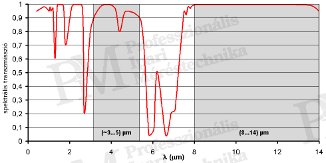 |
| Abbildung: Spektraler Übertragungsfaktor der Luft [Quelle: Infratec] |
Es ist zu erkennen, dass die Übertragungseigenschaften der Luft stark von der Wellenlänge abhängen. Bereiche mit guter Übertragungsfähigkeit (schattiert) werden als atmosphärische Fenster bezeichnet. Während der Übertragungsfaktor im Bereich von 8...14 μm - im langwelligen atmosphärischen Fenster - nahezu perfekte Übertragung auch über große Entfernungen ermöglicht, verursacht die Atmosphäre im Bereich von 3...5 μm - im mittelwelligen atmosphärischen Fenster - bereits messbare Verluste auch bei Entfernungen von nur wenigen Metern.
Transmission von Wärmestrahlung aus dem Hintergrund des Objekts Dieser Fehler tritt auf, wenn das Objekt teilweise transparent ist, natürlich im Hinblick auf die Infrarotstrahlung. In solchen Fällen muss der Hintergrund des Objekts genauso berücksichtigt werden wie der Vordergrund bei der Reflexion der Wärmestrahlung. Dies kann insbesondere dann problematisch sein, wenn sich direkt hinter dem zu messenden Objekt starke Wärmestrahler befinden (z. B. technisch notwendige Heizeinrichtungen). Bedingungen für Gebäude- und Gebäudetechnik-Thermografie Wenn wir uns die zu Beginn erläuterten theoretischen Aspekte überlegen, wissen wir bereits, dass für die Messung niedriger Temperaturen eine langwellige Wärmebildkamera ausgewählt werden muss. Das ist für uns von Vorteil, da wir aufgrund der günstigen Übertragungseigenschaften des langwelligen atmosphärischen Fensters die Wärmestrahlung sogar aus hundert Metern Entfernung nahezu "verlustfrei" erfassen können. Darüber hinaus ist es vorteilhaft, dass typische Baumaterialien (mit Ausnahme von Fensterglas und glänzenden Metallverkleidungen!) relativ hohe Emissionsfaktoren aufweisen und da die Temperaturen der zu messenden Objekte typischerweise nur geringfügig von der Umgebungstemperatur abweichen, müssen wir nur geringfügig die Reflexion berücksichtigen. (Die Situation ist völlig anders bei Glasoberflächen oder brandneuen Aluminiumverkleidungen! Diese können in diesem Zustand einfach nicht gemessen werden!)
Besonderheiten der Gebäudethermografie
Das primäre Ziel der Gebäudethermografie ist die objektive und umfassende Zustandsbewertung der Gebäudedämmung. Doch vergessen wir nie, dass die thermografische Messung eine Momentaufnahme der Oberflächentemperaturen darstellt, die von den unterschiedlichsten Messbedingungen beeinflusst werden. Im Zusammenhang mit Gebäuden unterscheiden wir folgende thermografische Verfahren voneinander: Quantitative Thermografie-Untersuchungen: Das Ziel der quantitativen Gebäudethermografie ist die Bewertung der gesamten Oberflächentemperaturverteilung des Gebäudes und die Bestimmung des Wärmeleitkoeffizienten (z. B. Berechnung des Wärmeverlusts oder des Heizenergiebedarfs). Da dies nur auf der Grundlage äußerst genauer (absolut genauer) Temperaturdaten berechnet werden kann, müssen sehr strenge Anforderungen an die Datenerfassung mit der Wärmebildkamera erfüllt werden. Die Verfahrensmerkmale sind:
Qualitative Thermografie-Untersuchungen:
Das Ziel der qualitativen thermografischen Gebäudeuntersuchung ist die Suche und Dokumentation von Wärmebrücken und "Fehlern" in der Wärmedämmung des Gebäudes (qualitative Abweichungen). Die meisten Probleme können anhand von Wärmeunterschieden, die mit einer Wärmebildkamera mit ausreichend hoher Temperaturauflösung sichtbar sind, aufgedeckt werden, wobei die absoluten (numerisch genauen) Temperaturdaten hierbei eine untergeordnete Rolle spielen. Die Verfahrensmerkmale sind:
Bei der quantitativen und qualitativen Gebäudethermografie sollten sowohl Innen- als auch Außenuntersuchungen durchgeführt werden. Insbesondere bei quantitativen Untersuchungen ist die Durchführung von Innenmessungen praktisch "obligatorisch", da nur so die Wärmeübertragungseigenschaften der einzelnen Oberflächen berechnet werden können. Die folgende Tabelle gibt einen Überblick über die bei Innen- und Außenmessungen zu berücksichtigenden Messbedingungen sowie die Unterschiede (Schwierigkeiten) bei der Durchführung der Messungen.
Allgemein empfohlene Messbedingungen und -voraussetzungen
Um mit der Wärmebildkamera nicht nur schöne bunte Bilder vom zu untersuchenden Gebäude zu machen, sondern Wärmebilder zu erstellen, die vom Architekten, Energieberater, Statiker und vom Betreiber ausgewertet werden können - die richtige Schlussfolgerungen zulassen -, müssen die folgenden MINDESTANFORDERUNGEN unbedingt erfüllt sein:
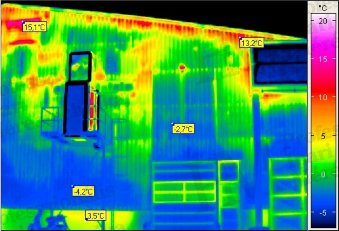 |
| Abbildung: Zustandsbewertung einer industriellen Halle - Luftdichtigkeitsfehler und Kondensation [Quelle: PIM] |
Spezielle Anwendung: Lecksuche mit Thermografie
Die Lecksuche mit Thermografie basiert auf den physikalischen Gesetzmäßigkeiten der Wärmeleitung. Wenn die Temperatur des Mediums (meist Wasser), das durch das Rohrsystem fließt, höher ist als die Umgebungstemperatur (Heizungs- oder Warmwasserrohre, Fußbodenheizung usw.), tritt Wärmeleitung durch die umgebenden Materialien bis zur äußeren (sichtbaren) Oberfläche auf. Während des Aufheizens wird zunächst die Lage der Leitung mit thermografischen Geräten sichtbar. An der Stelle des Lecks tritt das warme Fluid aus, so dass es entlang der Leitung und seitlich und nach unten zwischen den Schichten des umgebenden Materials auslaufen kann. Auch von dem warmen Fluid ausgehend erfolgt nun Wärmeleitung in alle Richtungen, auch zur sichtbaren Oberfläche hin. Mit ausreichend empfindlichen thermografischen Geräten kann festgestellt werden, dass die sichtbare Wärmeverteilung an der Oberfläche von der "normalen" Wärmeverteilung der unbeschädigten Leitung abweicht. Es gilt immer, dass Undichtigkeiten nur mit thermografischen Geräten entdeckt werden können, wenn an der Leckstelle ein Temperaturunterschied vorhanden ist oder erzeugt werden kann, der durch Wärmeleitung auf der mit der Wärmebildkamera beobachtbaren Oberfläche spürbar ist. An den vermuteten Leckstellen sollte die thermografische Aufnahme idealerweise aus verschiedenen Blickwinkeln wiederholt werden, um Reflexionen sicher ausschließen zu können. Anforderungen an das Wärmebildkamerasystem:
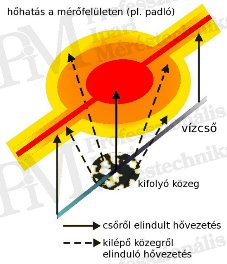 |
| Abbildung: Theorie der Lecksuche [Quelle: PIM] |
Auswertung von Gebäudethermografie-Messungen mit spezieller Software
In den bisherigen Abschnitten unseres Artikels haben wir uns hauptsächlich mit der qualitativen Gebäudethermografie befasst. Im Folgenden möchten wir jedoch eine spezielle Gebäudethermografie-Bildauswertungssoftware vorstellen, die sowohl qualitative Untersuchungen als auch quantitative Auswertungen unterstützen kann. Natürlich ist eine grundlegende Voraussetzung für jede Auswertung, dass die Wärmebilder unter Einhaltung der oben genannten Messbedingungen erstellt werden und wichtige Umgebungsparameter für die Auswertung erfasst werden. Darüber hinaus ist eine genaue Kenntnis der Materialstruktur des Gebäudes (z. B. verwendete Materialien, Schichtdicken sowie Elemente für Heizung, Belüftung, Klimatisierung) erforderlich.
 |
| Bild: FORNAX Auswertungssoftware in Aktion [Quelle: Infratec] |
Geometrische Bildkorrektur
Selbst wenn Gebäude gut zugänglich sind, haben die Aufnahmen (wie auch bei herkömmlichen Fotografien) bestimmte Parallaxenfehler, Verzerrungen und perspektivische Fehler. Für die Auswertungen benötigen wir in der Regel ein orthogonales Bildmaterial. Die FORNAX-Software führt diese Korrektur mit einem oder zwei Tastendrücken für uns durch.
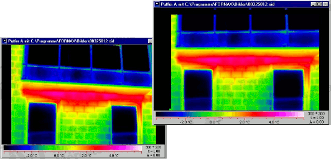 |
| Bild: Wärmebild vor und nach der geometrischen Korrektur [Quelle: Infratec] |
Temperaturstatistik
Die Temperaturstatistik hilft sowohl bei der Bewertung der schwerwiegendsten Wärmebrückenprobleme (also bei der Frage "Lohnt es sich damit zu befassen?"), als auch bei der Bewertung der in der Struktur auftretenden Wärmespannungen.
 |
| Bild: Auswertung der Temperaturstatistik [Quelle: Infratec] |
Kondensation, Schimmelbildung
Nachdem bekannt ist, bei welcher Lufttemperatur und Luftfeuchtigkeit die Kondensation (aufgrund des Erreichens des Taupunkts) an welchen temperierten Oberflächen (Wänden) stattfindet, kann basierend auf den unten aufgeführten Umgebungsparametern anhand der internen Wärmebildaufnahme bestimmt werden, wo Kondensation und Schimmelbildung zu erwarten sind.
 |
| Bild: Markierung der Kondensation und Schimmelbildung auf dem Wärmebild [Quelle: Infratec] |
Erforderliche Parameter für die Auswertung:
Durchfeuchtung der Wandstruktur
Abhängig von der Kenntnis des Aufbaus der Wandstruktur kann nicht nur die Gefahr der Kondensation (und Schimmelbildung) nachgewiesen werden, sondern es kann auch berechnet werden, wie lange es dauert (unter Beibehaltung der aktuellen Raumnutzung), bis das Baumaterial oder die Wärmedämmung durchfeuchtet. (Dies würde natürlich zum vollständigen Verlust ihrer Wärmedämmeigenschaften führen und muss daher unbedingt gestoppt werden!) Für die Auswertung sind genaue Kenntnisse der klimatischen Bedingungen, der Raumnutzung und der Schichtstruktur der Wand erforderlich.
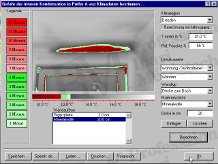 |
| Bild: Vorhersage der Durchfeuchtung der Wandstruktur auf dem Wärmebild [Quelle: Infratec] |
Gefahr von Frostschäden
Alle Bauelemente, in denen aus irgendeinem Grund Feuchtigkeit angesammelt ist und deren Temperatur unter den Gefrierpunkt fällt, sind Frostschäden ausgesetzt. Basierend auf den klimatischen Bedingungen kann das Programm das Auftreten von Frostschäden in vier Kategorien analysieren: Frostschaden nur bei sehr kaltem Winter, Frostschaden bei kaltem Winter, Frostschaden im Herbst und Winter, kein Frostschaden im Herbst und Winter
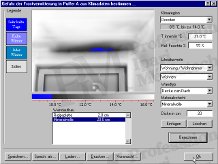 |
| Bild: Kennzeichnung der Frostschadengefahr an der Wandstruktur auf dem Wärmebild [Quelle: Infratec] |
Numerische Bestimmung des Wärmeflusses
Die wichtigste Auswertung der quantitativen Gebäudethermografietechnologie ist die numerische Bestimmung des Wärmeflusses. Das Programm geht davon aus (sehr vereinfacht), dass die abgestrahlte Wärmemenge im Verhältnis zur durch den Wärmefluss von innen nach außen "transportierten" Wärmemenge steht. Vergessen wir jedoch nicht, dass dafür sehr strenge Messbedingungen und aufgenommene Wärmebilder erforderlich sind! (Andernfalls erhalten wir vollständig falsche Daten!)
 |
| Bild: Numerische Bestimmung des Wärmeflusses anhand eines Wärmebildes [Quelle: Infratec] |
Die numerische Bestimmung des "U"-Faktors (Wärmeverlustfaktor)
Basierend auf dem Wärmefluss kann der sogenannte "U"-Faktor (der Wärmeverlustfaktor) bestimmt werden. Natürlich müssen dazu auch die Innen- und Außentemperaturen angegeben werden.
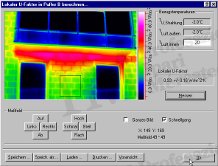 |
| Bild: Numerische Bestimmung des "U"-Faktors (Wärmeverlustfaktor) [Quelle: Infratec] |
Die numerische Bestimmung der Heizkosten
Es ist kein großer Schritt mehr, vom Wärmeverlustfaktor zur Berechnung der Heizkosten zu gelangen. Basierend auf dem Wärmeverlustfaktor kann nämlich ermittelt werden, wie viel Energie für die Beheizung des Gebäudes erforderlich ist (unter Berücksichtigung der klimatischen Bedingungen, der gewünschten Innentemperatur und der Lüftungsgewohnheiten). Wenn die Energiekosten verschiedener Heiztechnologien und Brennstoffe bekannt sind, kann durch "einfache" Multiplikation der voraussichtliche jährliche Gesamtbetrag der Heizkosten bestimmt werden.
Rahne Eric (PIM Kft.) pim-kft.hu, gepszakerto.hu
Der Inhalt der Veröffentlichung ist urheberrechtlich geschützt. Die (auch teilweise) Nutzung, elektronische oder gedruckte Weiterveröffentlichung ist nur mit Angabe der Quelle und des Autors sowie mit vorheriger schriftlicher Genehmigung des Autors gestattet. Die Verletzung des Urheberrechts (Copyright) hat rechtliche Konsequenzen.
Copyright © PIM Professzionális Ipari Méréstechnika Kft.
2026 | Minden jog fenntartva
Impresszum | Adatkezelés