


Eric Rahne, B.Sc. in Electrical Engineering, Forensic Expert (PIM Ltd.)
SUMMARY Successful application of vibration diagnostics requires thorough expertise. In order to provide effective training, PIM Ltd. developed a portable test bench called VibDemo capable of demonstrating all types of mechanical faults between 1999 and 2004. Today, it is a successful product with nearly 70 sales worldwide and CE certification. In addition to the development steps and challenges of VibDemo, we also present the product itself and its potential for further development. CONTENT Successful application of vibration diagnostics requires thorough expertise. PIM GmbH developed a VibDemo test bench between 1999 and 2004, capable of demonstrating all types of mechanical faults. With nearly 70 units sold worldwide and CE certification, this is a successful product. In addition to the phases and difficulties of developing VibDemo, we present the product and its potential for further development. 1. BACKGROUND Successful application of vibration diagnostics requires not only suitable instruments and software but also thorough expertise. This is essential, especially for machine condition monitoring tools based on spectrum analysis. It is not feasible to provide every professional beginner with practical training in a university or college mechanical laboratory or through practical training at an industrial company. The problem with the latter is that faulty machines are needed to recognize fault phenomena, preferably from various constructions and with various faults. In 1999, our company recognized that providing on-site practical training to our customers (i.e., on their machines) did not meet the training needs mentioned above. Because there were not always enough faulty machines available, or only very few types of faults were present. And of course, no one intentionally damages their machines... Using industrial machines as training tools was also not a viable solution due to their size and weight. Based on these considerations, we started developing a specifically portable training tool. 2. THE FIRST VERSION (1999) The development was literally fraught with initial difficulties. The first VibDemo test bench we completed in 1999 (shown in the image below) far exceeded 50 kg in weight. In basic version, without plexiglass cover and additional accessories!

In addition to its weight, we were not satisfied with it for other reasons: - unfavorable belt tension/gear adjustment - inclined bearing "pulls in" itself (until it stops!) - adjustable brake needed for electrical fault demonstration - too few holes on the discs (for balancing) - missing protective cover (occupational safety) Since our company has been providing regular (accredited by FAT and MMK) vibration diagnostics training since 2000, the availability of the appropriate training tool became crucial. Therefore, to address the listed shortcomings, the tool needed to be improved. 3. THE SECOND VERSION (2001) Although the weight of our VibDemo test bench did not change (rather increased), through some "minor" modifications, its usability and completeness improved. It also received a plexiglass cover, which is crucial for occupational safety during training.
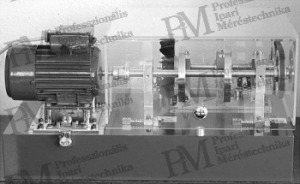
We could now consider the convenience problems related to belt and gear drive adjustments, the inclined bearing "self-pulling" issue, the addition of brakes, more disc holes, and a protective cover solved. However, the weight proved to be a disturbing factor (as evidenced by the training room on the 3rd floor of a hotel without an elevator), and some additional minor issues caused dissatisfaction: - required for teaching resonance phenomena - possibility to change speed - different stiffness or support - needed as additional accessory - curved shaft (with good bearings) - good shaft with "real" bad bearings - gears must be industrial-grade (with precisely machined ground teeth) - shafts must be ground to precision Note: The first VibDemo unit sold to Germany for testing purposes was returned by the customer citing "unusability" due to the above reasons. 4. ALMOST COMPLETELY NEW VERSION (2002) This almost completely new design also became the first commercial version of VibDemo. The development sought to take into account all previous experiences: an aluminum base replaced the heavy iron U-profile (lighter and better vibration damping), the above-mentioned accessories were born, and the precision of the components improved.

To compensate for the instability of the VibDemo base, iron plates could be mounted under the aluminum plate. Obviously, despite these, the weight of our tool was still considerable, but we managed to reduce 15 kg from the initial > 50 kg!
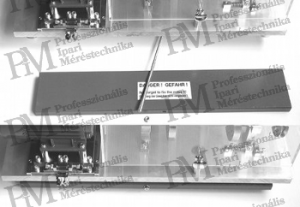
We could not emphasize enough the importance of properly securing the above-mentioned iron plates for the sold devices. Neither our customers nor we were satisfied with the total weight of 35 kg to be carried. In addition, other problems and expectations arose: - "flexible" bearing housings needed for further weight reduction - the mechanism for shaft alignment does not meet "real" adjustment conditions - fault simulations should be easily "zeroed" without instruments - vibrations of single-phase motors should not affect the other elements of the test bench 5. SUCCESSFUL MODIFICATIONS (2003) This version retained the iron plates but solved the above problems through a completely new shaft alignment (electric motor mounting) and bearing housings machined with milling (still entirely made of iron).
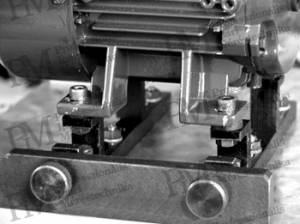
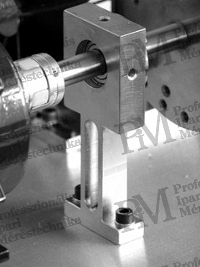
The single-phase supply frequency converter has proven to be effective for operating three-phase electric motors. In addition to allowing arbitrary speed changes (and stable maintenance), there was no need to struggle with the 50 Hz and 100 Hz vibrations typical of single-phase motors. However, the total weight of 35 kg was still not satisfactory, and new requirements emerged: - even more flexible bearing housings are needed for weight reduction (elimination of iron plates) - reduce weight with aluminum discs - have two types of "feet" (aluminum and rubber) - the motor holder plastic breaks too easily - a ring is needed on the shaft for shaft alignment practices (without it, the shaft diameter is too small for mounting the measuring heads) 6. THE "FINAL" VERSION (since 2004) This version finally achieved the targeted total weight below 25 kg. Including all accessories! The solution was provided by the experimentally designed geometrically shaped - aluminum, milled - bearing housing feet. Moreover, the production (and cost) of the two-part structure became somewhat more favorable. The iron plates have disappeared permanently, and since then, the discs are also made of lighter aluminum.
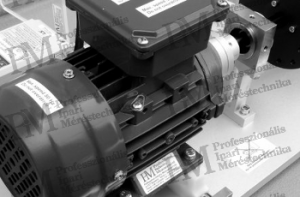
The plastic elements of the motor holder finally fulfilled their vibration damping role thanks to their curved cutouts and new material, without being easily breakable.

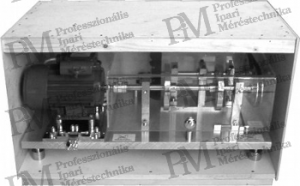
A few minor changes in the plexi cover enabled the presentation of most errors next to the closed cover, and the wooden box manufactured for the complete system (by hand) underwent simplification and several usability improvements. Its weight decreased from 7.3 kg to 4.8 kg.


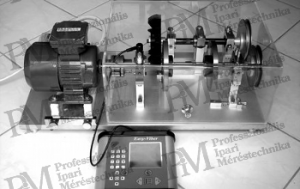
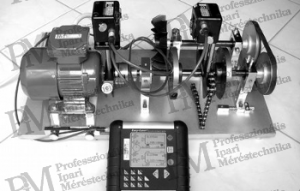
7. CE COMPLIANCE, TECHNICAL DATA CE compliance may not seem like an exciting topic at first glance, but it still gave us work. We had to hide the opening sensor of the protective cover. (We will not reveal the solution here, of course.) In addition, we had to label our VibDemo test bench with countless signs (mostly pictograms) to ensure that even the most careless (and possibly illiterate) user cannot harm themselves. As a result, we are proud that our device not only has a CE declaration but is also delivered to users in a truly safe version confirmed by real testing. The currently manufactured and distributed version of VibDemo has the following capabilities: Demonstrable faults • unbalance • static unbalance • dynamic unbalance ◦ in 2 or 3 planes ◦ on 2 different speed axes • shaft misalignment error ◦ lateral displacement ◦ angular error ◦ combination of both • skewed bearing seat • mechanical play, loose assembly • belt drive error ◦ disc misalignment error ◦ belt error ◦ belt resonance • curved shaft • rolling bearing adjustments ◦ worn bearings due to use ◦ outer ring error (temporary) • gear drive errors ◦ tight or loose tooth clearance ◦ skewed fitting ◦ various tooth errors (combination of two gears) ◦ tooth repeat frequency • electric motor frequencies VibDemo is modular, assembled with only a size 10 spanner and a size 4 Allen key. Its technical data are as follows: Drive: 3x230VAC three-phase motor, 2985 rpm, 180W, powered by a single-phase frequency converter External dimensions: 600 mm (h) x 315 mm (w) x 265 mm (d) Weight: approx. 22 kg (with all accessories) approx. 4.5 ... 5 kg shipping box 8. APPLICATION AND SUCCESS OF VIBDEMO It has been mentioned before that we have sold nearly 70 units over the years. All this without ever advertising the VibDemo test bench anywhere, as these are individually made devices and our manufacturing capacity (and that of our suppliers) is quite limited. Nevertheless, we have delivered to Belgium, South Korea, Dubai, the United Arab Emirates, Finland, the Netherlands, China, Kuwait, Hungary, the United Kingdom, Germany, Nigeria, Norway, Italy, Russia, Portugal, Romania, Spain, and Sweden (strictly in alphabetical order). In line with our engineering philosophy, we seize every opportunity to support the training of the emerging new generation of technical professionals and engineers. It is gratifying that with our products, instruments, knowledge, and decades of experience, we can also assist university and college students who approach us. We regularly hold professional presentations (involving the application of VibDemo) at several Hungarian colleges and universities, and we provide our test bench for theses and dissertations related to vibration diagnostics and machine alignment, in addition to our instruments. Several works focusing on vibration diagnostics, machine alignment, or even shaft coupling properties have been completed using VibDemo.
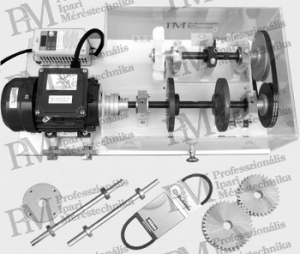
9. DEVELOPMENT OF VIBDEMO Based on the above, one might get the impression that the development of VibDemo has stopped here. However, this is not the case, as on the one hand, we are looking for solutions to facilitate easier assembly during production and reduce manufacturing costs. On the other hand, we have ideas to expand the range of mechanical faults that can be demonstrated, such as the diagnostic methods for flow faults in pumps and fans, as well as sliding bearing diagnostics. Source of photos and technical data: PIM Professional Industrial Measurement Technology Ltd. H-1221 Budapest, Tanító u. 19/A Tel .: (1) 424-00-99 Fax: (1) 424-00-97 e-mail: pim@pim-kft.hu web: www.pim-kft.hu www.termokamera.hu www.gepszakerto.hu
The content of the publication is protected by copyright, and its (even partial) use, electronic or printed re-publication is only permitted with the indication of the source and the author's name, as well as the author's prior written permission. Violation of copyright (Copyright) has legal consequences.
Copyright © PIM Professzionális Ipari Méréstechnika Kft.
2026 | Minden jog fenntartva
Impresszum | Adatkezelés