


Vibration spectrum and frequency analysis is not only trendy but also the most effective machine condition monitoring tool currently available, provided that the information it contains is "read" with expertise. While the machine condition monitoring and surveillance technologies presented so far do not require specially trained experts to be "deployed," spectrum analysis can only be applied successfully with appropriate training and experience.
Precise Detection of Machine Element Faults
The basis of spectrum analysis follows this line of thought: Every machine or machine component (shaft, casing, support element, bearing, disc, etc.) as a "rigid" body has the fundamental mechanical (physical) property that it is most capable of performing vibrations in certain directions at specific "natural" frequencies (thus resonating at this frequency due to external excitation, for example, alternating forces originating from the machine's rotation). By analyzing the recorded vibration signal spectrum, it becomes "visible" which frequencies of vibrations are present. The vibration frequencies can be assigned to specific machine components and typical machine faults, taking into account the current machine speed. Through vibration spectrum analysis, the faults of individual machine elements can be precisely identified, and it can be determined whether there is a misalignment or imbalance error. For example, in the case of a bearing fault, this method can specifically indicate damage to the inner or outer ring or the cage. By measuring the electrical parameters of electric motors, electrical faults (including breakage of asynchronous motor rotor bars) can also be detected. Through machine vibration spectrum analysis, it is possible to know exactly what needs to be done before repairs. Significant savings can be achieved in terms of components and working hours, and moreover, during repairs, the correction of less noticeable but also present faults can be ensured. Furthermore, the success of repairs can be quickly and accurately verified by comparing the spectra of measurements taken before repairs and after recommissioning. The reliability of machines repaired and checked in this way significantly increases while maintenance costs decrease.
What Lies Behind Spectrum Analysis?
The frequency is one of the most important physical quantities underlying spectrum analysis. In our everyday life, we encounter frequency most frequently as an indicator of sound pitch, a quality characteristic of audio players, a measure of television screen refresh rate, or related to the periodicity of the voltage in the electrical network, which in each case represents the number of repetitions of a periodic phenomenon within a unit time. The same can be interpreted regarding machine vibrations because we are dealing with alternating - periodic - motions: frequency expresses the number of complete (back and forth) vibratory motions per unit time. Of course, this is true only if the vibration in question is purely sinusoidal. For example, two time signals with the same amplitude but different frequencies can be seen in the following figure.
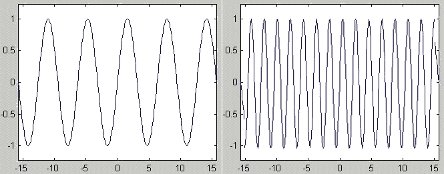
In practice, measurable machine vibrations are inherently complex because at the measurement location (for example, on the bearing housing), vibrations of different frequencies and amplitudes originating from imbalance, shaft misalignment, bearing faults, and other problems of various machine elements occur simultaneously. If we are interested in the frequencies present in the measured signal, we have to decompose the signal into its elementary sinusoidal components (fundamental vibrations) - thus perform frequency analysis (also known as spectrum analysis).
The Basis of Spectrum and Frequency Analysis
Let's look at a machine vibration-time signal, as it can be measured, for example, on a fan's bearing housing.
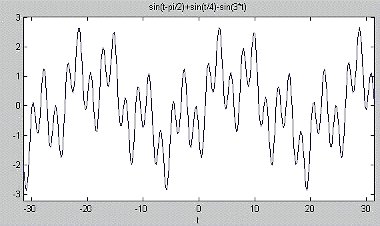
The above time signal illustrates a complex vibration measurable on a fan's bearing housing. We break down this time signal into elementary sinusoidal components and represent it in the frequency domain, as a frequency spectrum (also known as a vibration spectrum), as shown in the diagram below. Mathematically, the result shown in the graph can be obtained by applying Fast Fourier Transformation (FFT). Virtually every spectrum analyzer, machine, or vibration analyzer that is capable of digitally recording time signals for spectrum-shaped evaluation and representation is based on this procedure.
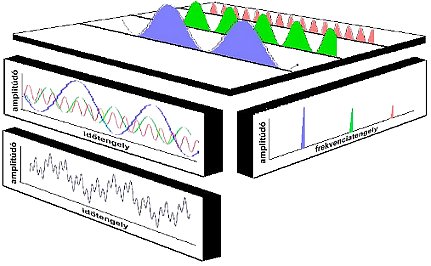
The time signal transformed into a spectrum in the above diagram consisted of three sinusoidal components, each characterized by different amplitudes and frequencies. Through FFT, these "elementary" sinusoidal signals become visible separately in the spectrum as individual vertical lines, where the position on the frequency axis represents the frequency of the sinusoidal component, and the length represents its amplitude.
Common Frequency Units in Machine Diagnostics
The most commonly used frequency unit when scaling the frequency axis of the spectrum is the hertz, abbreviated as Hz (in honor of the French scientist, Hertz, expressing the occurrence of a periodic event in one second. In other words, the Hz unit is equivalent to 1/s. Hz = 1/s (second). Since in machine diagnostics it must be assumed that the strongest vibration excitation occurs at the speed - thus at the rotational frequency - due to the rotating rotating part at this frequency, and most typical machine (mechanical) faults are related to the rotational frequency (or its integer multiples), it has become common to scale the spectrum frequency axis in "revolutions per minute" as well. However, the disadvantage of speed scaling is that it is very large, so potentially distracting numbers may need to be displayed on the axis for a quick overview. To overcome this, multiple speed scaling is commonly used. In English literature, the term "order" is used in such cases {see the numerical example below}. Example of specifying multiples of 3000 revolutions/min
| Rotational frequency | 50 Hz | = 3,000 revolutions/min | = 1 (order) |
| Twice the rotational frequency | 100 Hz | = 6,000 revolutions/min | = 2 (order) |
| Ten times the rotational frequency | 500 Hz | = 30,000 revolutions/min | = 10 (order) |
Rahne Eric (PIM Ltd.) pim-kft.hu, gepszakerto.hu
The content of the publication is protected by copyright, and its (even partial) use, electronic or printed re-publication is only permitted with the indication of the source and author's name, as well as with the author's prior written permission. Violation of copyright (Copyright) will have legal consequences.
Copyright © PIM Professzionális Ipari Méréstechnika Kft.
2026 | Minden jog fenntartva
Impresszum | Adatkezelés