


Ball and roller bearing faults
The damage to bearings can be attributed to various reasons: incorrect assembly, technological errors during the assembly of shaft components, steam exposure, overload, excessive speed, poor or missing lubrication, material and manufacturing defects. However, fundamentally, the operational load on the bearing itself - depending on the bearing's service life - eventually leads to material fatigue, followed by initially minor, later rapidly increasing damages. When a bearing is damaged, vibrations occur, the frequency of which depends on which bearing component the failure occurred. These fault frequencies - often referred to as bearing frequencies or bearing fault frequencies - can be easily calculated if certain basic geometric dimensions of the bearing are known. To calculate the fault frequencies, the following data must be known: D = diameter of the rolling path (raceway) of the rollers d = diameter of the rollers Q = contact angle (the direction of force transmission from the inner ring to the outer ring) Z = number of rollers N = shaft speed (in revolutions per minute)
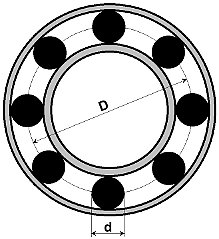
Figure: geometric data of the bearing [source: PIM]
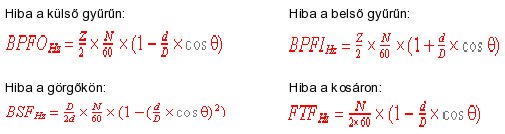
The following basic bearing fault frequencies exist: FTF = cage frequency (Fundamental Train Frequency) BPFO = outer ring frequency (Ball Pass Frequency - Outer race) BPFI = inner ring frequency (Ball Pass Frequency - Inner race) BSF = roller frequency (Ball Spin Frequency) The most common bearing fault is damage to the outer ring, as in most cases the outer ring remains stationary, and the load (e.g., weight of the rotating part) always acts on the same point of the outer ring through the rollers. The calculation of fault frequencies depends on whether the inner or outer ring of the bearing rotates. Equations for both cases are listed below, and the quantities obtained by these equations are always in Hz. Equations for calculating bearing fault frequencies for a rotating inner ring:
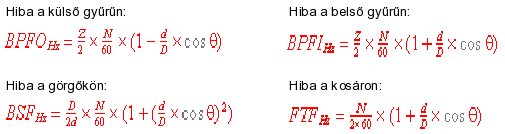
Equations for calculating bearing fault frequencies for a rotating outer ring:
The practical role of the contact angle Θ
Due to the axial forces acting in individual machines, force transmission does not occur at the contact angle specified in the bearing specification. The contact point shifts minimally to the side, thus changing the actual contact angle (or force transmission angle). According to the above equations, this also affects the expected fault frequencies. In practice, it is most common in cases of high axial loads that axial forces increase the contact angle, influencing the development of fault frequencies. Although this effect is very small (resulting in a maximum deviation of 2 percent), it still results in the calculated fault frequencies not exactly matching the frequencies measured in reality. In most traditional cases (where the inner ring rotates and the outer ring is stationary), vibration frequencies characteristic of bearing faults can be estimated with a +/-20 percent uncertainty using the following equations: cage frequency: FTF = 0.4 * N / 60 outer ring frequency: BPFO = 0.4 * N / 60 * Z inner ring frequency: BPFI = 0.6 * N / 60 * Z roller frequency: BSP = 0.23 * N / 60 * Z (Z < 10) = 0.18 * N / 60 * Z (Z ≥ 10)
Calculation example Let the shaft speed be 2940 revolutions per minute (equivalent to 49 Hz), and assume that the outer ring of the bearing is stationary while the inner ring rotates. Additional data of the bearing: Number of bearing balls Z = 8 Ball diameter d = 6.75 mm Raceway diameter D = 28.5 mm Contact angle Q = 0 degrees
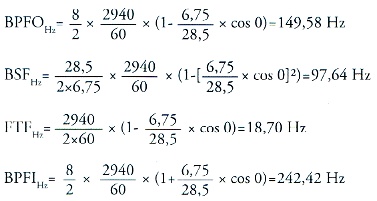
The following diagram shows the appearance of the fault frequencies of the above bearing in a simplified (schematic) form in the spectrum. The appearance of bearing problems in the frequency spectrum varies depending on whether it is a mild - initial - fault phenomenon or an established - severe - fault. Accordingly, further theoretical aspects must be taken into account during evaluation.
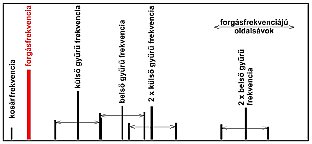
Occurrence of bearing fault frequencies
Cage frequency rarely dominates. Basket injuries often occur in the form of basket frequency modulation around the other bearing frequencies (roller, inner or outer ring frequency). If the rolling over the bearing faults occurs with continuously changing loads, occasionally speed modulations at bearing fault frequencies can be observed. In the case of an intact bearing, the fundamental frequencies are usually absent. The onset of bearing damage manifests as high-frequency multiples of bearing fault frequencies, and as the damage worsens, the fundamental frequencies of the bearing become more pronounced. Periodic impact excitations due to bearing damage always result in multiples of the impact frequency (in our case, the fundamental frequencies of the bearing). However, if pure sinusoidal excitation is present (e.g., forces resulting from balancing), only the fundamental frequency of the excitation force appears in the spectrum. For example, if the bearing components deform due to stress, sinusoidal forces are expected during the rolling of the rollers.
This can often be observed after repairs in the case of tensioning sleeves with too small clearances, or heavily loaded, deformed bearing seats (e.g. belt drives). In such cases, only the base frequency of bearing faults appears in the spectrum. With too small bearing clearances, primarily the outer ring fault frequency becomes visible. The overloaded bearing component is actually the cage, the reason for this being: the cage must withstand the bearing stress caused by the too small clearance, as it needs to press the rollers through the smallest clearance. Therefore, ultimately, the cage fault base frequency should appear, but this is not true in most cases, as the cage needs to press each roller individually through the narrow cross-section. As a result, the cage frequency multiple occurs, more precisely the product of the cage frequency and the number of rollers. This is nothing else but the outer ring fault frequency.Summary with comments
In summary, it can be said that if the multiples of the bearing fault frequency are mainly found in the higher frequency range, the cause is usually small, sharp damages on the bearing raceway. Contaminants can also produce a similar phenomenon. In such cases, the base frequencies of bearing faults are generally not detectable. On the other hand, if the low-frequency multiples of the bearing fault base frequency are present in the vibration spectrum (mostly 2-10 times frequencies), this is usually explained by large and deep bearing damages. With low bearing loads, especially in the case of very poor condition bearings (when true rolling is no longer present), bearing faults mostly appear in the form of resonance excitations. Additional comments: * Roller faults are very difficult to detect because these elements are very small. Therefore, in case of their failure, the vibration they generate (or its energy content) is relatively small, so it can only be measured if some other - larger - machine component (e.g. the bearing housing) picks up these vibrations. * Impulse-like high-frequency signals, as well as the occurrence of high-frequency energy, mostly indicate bearing faults. However, high-frequency phenomena can also be caused, for example, by chain rattling in chain drives, or by cavitation in pump structures. * Vibration frequencies characteristic of inner ring and roller faults can appear in radial-loaded bearings with sidebands characteristic of speed, or cage faults. This fault location depends on the movement into and out of the loaded zone.
Rahne Eric (PIM Ltd.) pim-kft.hu, gepszakerto.hu
The content of the publication is protected by copyright, and its (even partial) use, electronic or printed re-publication is only permitted with the indication of the source and the author's name, as well as with the author's prior written permission. Infringement of copyright (Copyright) will have legal consequences.
Copyright © PIM Professzionális Ipari Méréstechnika Kft.
2026 | Minden jog fenntartva
Impresszum | Adatkezelés