


Generation of Machine Tool Vibrations
Periodic vibrations are generated by alternating forces arising during the operation of rotating machinery. Each structural element has different mechanical (physical) properties - varying stiffness, damping, natural frequency, while the entire machine structure can be modeled as a damped, multi-degree-of-freedom system in terms of the dynamic forces acting on it (see the diagram below). Since it is difficult to obtain information about the internal forces of the machine, the machine must be examined based on the externally measurable vibrations that occur in response to the force. In this process, time signal spectrum analysis can provide the most assistance, as the vibration components made "visible" in this way only need to be checked to see if their frequencies match those characteristic of the machine components and certain machine setting errors, in other words, most setting errors and damage to various machine elements can be clearly defined with specific, so-called fault frequencies.
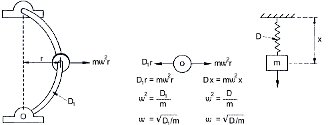
Diagram: The machine structure consisting of structural elements with different properties forms a multi-degree-of-freedom system [source: CSi]
Fault Frequencies
To understand frequency spectra, it must be assumed that each frequency peak, or combinations of frequency peaks, corresponds to a mechanically explainable alternating force within the machine. To provide a mechanical explanation, one must understand the structure of the machine and the resulting relationships. Despite significant differences in machine construction, operation, and behavior, general definitions can be given for most fault phenomena, as the frequencies of expected vibrations can be calculated based on geometric and physical relationships. It is crucial to consider that the frequency of most faults is speed-dependent. Therefore, knowledge of the machine's speed (or speeds) is essential for a clear analysis of frequency spectra. Our table contains typical vibration frequencies expected in common fault scenarios, expressed as multiples of the machine's speed.
Typical Vibration Frequencies in Common Faults
| Imbalance: | 1 times rotation frequency |
| Shaft Misalignment: | 1, 2, 3, or possibly 4 times rotation frequency |
| Looseness, Mechanical Play: | 1, 2, 3, 4, 5, or possibly 6, 7, 8, 9 times rotation frequency |
| Gear Tooth Defects: | 1, 2, 3 times number of teeth x rotation frequency |
| Blade Defects (fan, pump): | 1, 2, 3 times number of blades x rotation frequency |
| Belt Frequency (belt drive): | calculated based on the geometrical dimensions of the pulleys, belt length, and rotation frequency |
| Roller Bearing Defects: | calculated based on the bearing's geometrical dimensions and rotation frequency |
| Electric Motor Electrical Faults: | 2 times mains frequency |
According to the table, based on the machine's structure, it is possible to determine quite accurately the frequencies of vibrations expected in case of different faults. Therefore, most diagnostic software assists in diagnostic work by graphically displaying fault frequencies: one simply needs to check if the drawn fault lines coincide with the spectrum peaks of the measured vibration signal (next diagram). Following the same principles, software can also generate list-like fault reports with textual assumptions, and with the inclusion of expert program modules, it can achieve up to 80 to 95 percent reliable detection and textual evaluation of machine faults. However, let's stick to the manual analysis method for now.
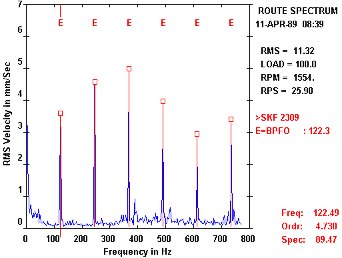
Diagram: Graphical representation of fault frequencies can greatly facilitate diagnostic work [source: DDC]
Displacement, Vibration Velocity, or Acceleration
While for broad-spectrum vibration level measurements, it is known from standards that the vibration level characteristic of machine condition should be determined in vibration velocity, the high-frequency noise of rolling bearings is typically measured in vibration acceleration - therefore, during spectrum analysis, we must decide in which physical unit to represent the vibrations. Our decision depends on whether we want to examine the low- or high-frequency components of the same vibration. Due to the relationship with frequencies, it is not possible to display the entire frequency range in a way that all frequency components are clearly visible when scaled in the same unit. However, the relationship provides clear guidance: low-frequency vibration components are best represented in displacement, those representing the mid-frequency range in vibration velocity, and high-frequency vibrations in vibration acceleration. (Displaying all information at once in a more difficult-to-read format can be achieved with logarithmic scaling, which visually magnifies small amplitudes.) The typical frequency range for signal representation is shown in the diagram below.
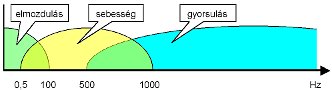
Diagram: Vibration scaling commonly used in different frequency ranges [source: PIM]
Parameters of Spectrum Analysis
Resolution, number of spectral lines, frequency range, averaging, and measurement time are parameters that are often mentioned together as they are closely related. Spectral resolution indicates the frequency distance between spectral lines - in other words, the width of the lines. The finer the resolution, the better the chances of separating closely spaced error phenomena frequency peaks. The number of spectral lines is a characteristic of the instrument's spectral resolution capability. Knowing the adjustable frequency range, it is possible to calculate the smallest line width. In order for an instrument to record the desired spectrum, it must comply with the laws of signal digitization and spectrum analysis. Fourier transformation requires twice as many time samples as the number of spectral lines we want to display. However, to avoid signal distortion due to undersampling, the Shannon theorem must also be followed, which states that the time signal must be recorded at least twice the maximum frequency to be displayed. Most manufacturers of handheld instruments comply with the Shannon theorem by using sampling rates 2.5 times the frequency. It follows from the above that the time required for spectrum measurement is as follows: T(measurement) = number of spectral lines x 2 / (Fmax x 2.5) To avoid wasting time unnecessarily, carefully consider what you want to measure, as excessive resolution increase or selecting too low upper frequency limit also prolongs the measurement time. To select the resolution (width of spectral lines), consider what may be the frequency difference between the two closest but still separable error phenomena at the given measuring point. The line width should be set to half of this - even better, to a fifth. The upper frequency limit should be determined depending on the nature and speed of the machine being measured. (We will address some of these rules in the next parts of our series.) For noise reduction purposes (improving the signal-to-noise ratio), it is common to average multiple spectra. (We will discuss the methods of averaging in a later article.) It is mathematically proven that these spectra do not necessarily need to be recorded consecutively, but even with up to 67% temporal overlap, data recording can be done without information loss. Calculation example: averaging 8 spectra (overlap: 67%), 6400 lines, Fmax = 3200 Hz (thus, based on Fmax and the number of spectral lines, the spectral resolution is 0.5Hz) T(measurement) = (1 + 7x33%) x 6400 Hz x 2 / (3200 Hz x 2.5) = 5.296 s (seconds) Note: The calculated time is not device-dependent and cannot be shortened in any way, as it is justified by mathematical laws. The difference in the speed of instruments lies in how they implement automatic measurement range setting, offset compensation, and signal processing and display with what algorithms and speeds. Their time requirements are in addition to the calculated time mentioned above.
Rahne Eric (PIM Ltd.) pim-kft.hu, gepszakerto.hu
The content of the publication is protected by copyright, and its (even partial) use, electronic or printed republication, is only permitted with the indication of the source and the author's name, and with the author's prior written permission. Violation of copyright (Copyright) will have legal consequences.
Copyright © PIM Professzionális Ipari Méréstechnika Kft.
2026 | Minden jog fenntartva
Impresszum | Adatkezelés