


From initial scanning devices to today's matrix thermal cameras
In our series starting now and continuing in each issue, with the help of our level 3 international thermography and forensic expert author, we would like to guide our readers through the increasing variety of thermal cameras, as having the right information is essential for making good decisions when selecting and using the equipment for successful applications.
Thermal imaging devices suitable for non-contact temperature measurement (thermal cameras with thermographic capabilities) have undergone rapid development in recent years. Considering that these devices appeared just 50 years ago, but have now grown into one of the most well-known and versatile inspection tools, it is no wonder that the market offers a wide variety of manufacturers and types. When considering the purchase of a thermal camera, it is no longer the lack of types that meet the requirements, but rather the complexity of the huge selection that poses a challenge.
Therefore, it is time to professionally review the development and types of these instruments and organize their current offerings based on some important technical parameters. This is of particular importance for practical use, as the measurement technology implemented in the cameras and the accessories available determine the device's application area, as well as the expected measurement accuracy and the achievable thermal image quality.
The "obsolete" peak technology of the past
The very first commercially available (civilian) thermal cameras suitable for temperature measurement were primarily produced in scanning, i.e., probing design. These cameras use only a single-element (point) detector to convert infrared radiation, scanning the object with a mechanical mirror or lens system. Since this imaging principle requires high-speed (photon) detectors and high-precision mechanics, its production is quite expensive, requires cooling, and due to the mechanical components, has a limited lifespan.
However, it has a significant advantage over all other methods: each signal corresponding to every pixel is captured by the same detector. Thus, data is generated from every point of the thermal image under perfectly uniform conditions, resulting in very good image homogeneity (and up to 10 mK thermal resolution). The slowness of image acquisition (typically only one image per second) and the other disadvantages listed earlier have led to the fact that this thermal camera technology is now only available as used equipment at best.
 |
| Figure 1: schematic structure of scanning thermal cameras [source: Infratec] (1 detector, 2+5 lenses, 3 horizontal deflecting mirror, 4 vertical deflecting mirror, 6 object, 7 measurement surface) |
Common structure of current thermal cameras
In modern matrix detector thermal cameras commonly used today, thousands of individual sensors are matrix-like arranged to detect the measured thermal radiation "simultaneously," eliminating the need for a mechanical scanning unit. As a result, the camera is mechanically simpler, smaller, lighter (and cheaper). Although the optical path is surprisingly simple, the devil is in the details: one major problem is that each pixel of the thermal image is converted by a unique sensor, which may have very similar characteristics to its neighbors but still measurably differs.
Compensating for this lack of uniformity requires a significant amount of real-time image processing, yet the image homogeneity achieved is still not comparable to scanning systems. However, modern matrix detector thermal cameras, depending on the sensor technology used, can now achieve a thermal resolution of 30 mK (or even 20 mK), which is sufficient for most applications, leading to the discontinuation of scanning thermal camera production.
 |
| Figure 2: schematic structure of matrix detector thermal cameras [source: Infratec] (1 detector, 2 lens, 3 object) |
Sensors of Modern Matrix Detector Thermal Cameras
Regarding the sensors of matrix detector thermal cameras, two basic types are distinguished: thermal sensors and photon detectors. The operation of thermal types is based on the fact that upon exposure to infrared radiation, i.e., the energy of an electromagnetic wave, they heat up, causing a change in some physical (electrical) parameter, from which the necessary electrical signal can be extracted.
In contrast, photon detectors provide an electrical signal proportional to the number of photons, but their operation requires cooling to a low temperature between –150 °C and –200 °C. Without cooling, the disordered electron movement would hinder the occurrence of the exploitable physical effect.
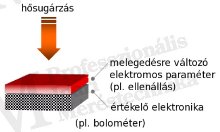 |
| Figure 5: operation of thermal detectors [source: PIM] |
 |
| Figure 3: schematic structure of microbolometer [source: Honeywell Technology Center] |
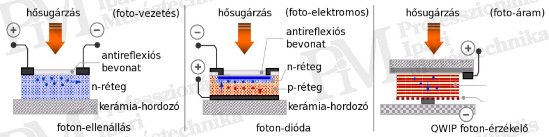 |
| Figure: Structure and Operation of Photon Detectors [source: PIM] |
Spectral Sensitivity of Infrared Sensors
Across all sensor technologies, sensors are available for various wavelength ranges depending on the material used. Thermal detectors - including bolometers and microbolometers - can only be made for the long wavelength spectral range due to their weak thermal sensitivity. (Sufficient radiation intensity can only be expected in this range.) Figure 6 provides an overview of the technical possibilities.
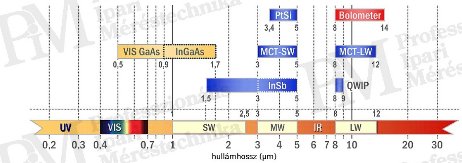 |
| Figure: Wavelength Ranges of Infrared Sensors According to Sensor Materials [source: Infratec] |
It is important to note that not only the sensor's wavelength range (spectral sensitivity) significantly influences the application areas of thermal cameras. The further limitation of the wavelength range of thermal cameras is necessary due to the transmission properties of the atmosphere. Thermal cameras with short, mid-, and long wavelength ranges are produced for measurement tasks with suitable transmission, known as atmospheric windows. While low-temperature objects (e.g., -80 °C) cannot be measured with mid-wave, 3-5 μm thermal cameras, it is impossible to detect the thermal radiation of objects behind glass with long-wave, 7.5-14 μm thermal cameras.
There are further application-related limitations concerning large measurement distances (several hundred meters): such tasks can only be solved with long-wave thermal cameras. On the other hand, the detection of flame temperatures in combustion processes is mostly possible with mid-wave thermal cameras, but the reverse task - detecting object temperatures through flames without sensing the flame temperature - can even be achieved with long-wave thermal cameras. For many applications (e.g., sensing the temperature of thin foils, detecting gas leaks, measurements through special measurement windows such as vacuum chamber windows or furnace measurement windows), the appropriate wavelength range thermal camera for the specific material and suitable infrared filters must be selected. This task requires specialized knowledge and experience, so it is advisable to entrust it to a professional to avoid costly mistakes.
Frame Rate of Thermal Cameras
Matrix-based thermal cameras with microbolometers exist with frame rates of 9, 15, 30, 50, 60, 120 Hz, or even 240 Hz - whether it is a stationary or portable (mobile) thermal camera. Significantly higher frame rates of 850, and even 6000 or 9000 Hz are achievable with photon detector thermal cameras. The required frame rate depends on the time constant of the temperature change of the object to be measured, the speed of movement, or the camera's movement speed.
Rahne Eric (PIM Ltd.) pim-kft.hu, gepszakerto.hu
The content of the publication is protected by copyright. Any (even partial) use, electronic or printed republication is only permitted with the indication of the source and the author's name, and with the author's prior written permission. Violation of copyright (Copyright) will have legal consequences.
Copyright © PIM Professzionális Ipari Méréstechnika Kft.
2026 | Minden jog fenntartva
Impresszum | Adatkezelés