


Procedures for Increasing Thermal Image Pixel Resolution
In addition to the geometric resolution, which is the size of a unique sensor surface "pixel," the image quality achievable with a thermal camera, or more precisely, the detail of the measurement, is determined by the number of pixels in the thermal camera.
It is easy to understand that with more pixels, we can represent the object surface with greater detail or the same level of detail over a larger object surface in a single thermal image. If the number of pixels is low, many images need to be taken, and for the evaluation of continuous objects and the preparation of reports, it often becomes necessary to montage the images, which is a very time-consuming task.
Software-Based Resolution Enhancement
Interpolation Due to the relatively low number of pixels in thermal cameras, creating impressive thermal images and consequently reports - especially with thermal cameras having a lower pixel count sensor matrix - poses serious difficulties. To alleviate this problem, some thermal camera manufacturers apply interpolation commonly used in graphic image processing programs. This procedure generates an additional - mathematically interpolated - pixel between each pixel pair of the captured thermal image, increasing the pixel count fourfold by doubling horizontally and vertically. However, this procedure results in a thermal image that is calculated 75% of the time, meaning it does not contain real, measured pixels. Therefore, enhancing the visual appearance of the thermal image is done at the expense of distorting the data content of the image. Therefore, the application of this procedure is not recommended.
Utilizing Hand Tremors Based on the fact that a sensor matrix is not made up of individual sensors placed seamlessly next to each other, but there is an almost half-pixel gap around each sensor (to avoid thermal cross-talk and due to the electrical connection of individual sensors), the detection of the object also occurs in such a "gappy" manner. To address this, instead of interpolation, another method that software-enhances the thermal image pixel resolution has started to become popular in recent years, known as Super Resolution or UltraMax, for example. These methods are based on the slight horizontal and vertical field of view shifts caused by the hand tremors of the person holding the thermal camera.
The method is very simple: instead of one thermal image, the data of 16 thermal images (typically) are stored, and then, using software, we select the four recordings among them that, due to hand tremors, align precisely with a half-pixel horizontal and vertical shift, and then we merge the thermal images pixel by pixel next to and below each other. With this method, even the empty space between the original two elementary sensors (pixels) generates data, and the number of pixels doubles both horizontally and vertically compared to the original detector matrix pixel count - our thermal image becomes four times more detailed. Moreover, since the field of view detection is now seamless, the thermal camera's geometric resolution also improves (by exactly 34%).
There Are Pitfalls!
As simple (and inexpensive) as the latter method is, it also comes with many pitfalls. It is completely unusable with a tripod-mounted thermal camera, and even the hand tremors of a person are rarely regular enough for the software to find four of the stored 16 thermal images that can be aligned as described earlier. (Consider that the whole process takes nearly 0.2 - 0.4 seconds: if our hand tilts or continuously moves during this time, there is no way to obtain the four alignable thermal images.) Furthermore, the software's image selection algorithm is also unable to select thermal images in cases where the image lacks sufficiently large and sharp contrasts (sufficiently steep temperature gradients) or when there is displacement within a part of the field of view.
In these cases, the software - unfortunately without any warning - applies the resolution enhancement described during interpolation to achieve the desired pixel count. This results in the creation of non-existent pixel data, and the promised improvement in geometric resolution does not materialize. Therefore, from a measurement perspective, we never know which thermal image created in this way actually contains only real pixels, and thus when we can expect a real improvement in geometric resolution. Therefore, the application of this method is not recommended.
Hardware Resolution Enhancement with Micro-Scan
The fourfold pixel count of the sensor matrix built into matrix thermal cameras can reliably be achieved only through hardware means. By microscopically moving the sensor or changing the optical path of the incoming radiation (within the thermal camera!), we alter the position of the radiation beam projected onto the sensor matrix horizontally and vertically one after the other. This way, the radiation projected onto the empty space between the original two elementary sensors (pixels) is also detected, and thus, the image formation can utilize it, while the thermal camera's geometric resolution always increases by 34%, without exception. Since this method does not rely on hand tremors, it can naturally be applied even with a tripod-mounted thermal camera.
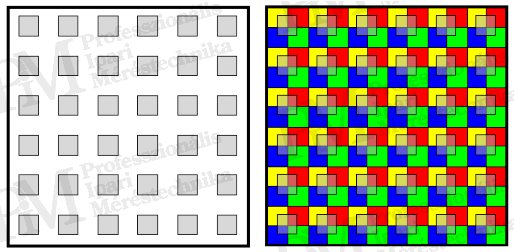 |
| Figure 1: Matrix Detector and Micro-Scan* Pixel Resolution [source: PIM] * A 4-times higher resolution thermal image created by aligning 4 consecutive thermal images |
Although the microscan procedure cannot be considered fast (it takes 0.5–1 s to create a high-resolution thermal image), it is currently the only method to create real pixel extra-large thermal images with maximum geometric resolution. Examples of thermal cameras with this capability are the Jenoptik VarioCAM device family, which offer this optional function under the name Resolution Enhancement. With VarioCAM cameras equipped with a 640×480 pixel detector in microscan mode, 1.23 million pixel thermal images can be created, and with VarioCAM HD devices with a 1024×768 pixel detector, 3.15 million pixel – exclusively real measurement data containing – thermal images can be produced. This allows you to make the most detailed measurements of very large object surfaces without any subsequent montage.
Rahne Eric (PIM Ltd.) pim-kft.hu, termokamera.hu
The content of the publication is protected by copyright, and its (even partial) use, electronic or printed re-publication is only permitted with the indication of the source and the author's name, as well as with the author's prior written permission. Violation of copyright (Copyright) will have legal consequences.
Copyright © PIM Professzionális Ipari Méréstechnika Kft.
2026 | Minden jog fenntartva
Impresszum | Adatkezelés