


Displaying extensive objects on a single thermal image
With appropriate software, instead of hours of manual thermal image correction and alignment, dozens of thermal images can be perfectly and automatically montaged into a single, unlimitedly evaluable data file in just 5 minutes.
The thermographic representation of large objects (such as industrial facilities, public buildings, large machinery, furnaces) often comes with the requirement that the entire object can be viewed on a single thermographic image to recognize the relationships between the object's temperatures. Naturally, achieving this with just one thermal image – even when using the microscan method – is rarely possible because often even 3.15 megapixels are not enough alongside the mandatory geometric resolution, and more so, on-site conditions often do not allow capturing a large object in its entirety from a single location.
Panoramic image, post-thermal image montaging
Panoramic image If the object in question is a horizontally elongated item, the panorama image function available in multiple thermal camera types provides a solution. By using this function, multiple (overlapping) thermal images can be taken consecutively by rotating or moving the thermal camera horizontally, then the camera's software (or the associated PC software) automatically aligns these thermal images into a coherent, elongated thermal image. Of course, the software's capability determines whether the alignment result is just a coherent graphical representation (which is only a nice colorful image, thus not correctable or further evaluable) or even a new (larger) thermal image data file that can be corrected, processed, and evaluated with a thermography evaluation software just like the original individual data files. Naturally, the latter is the real solution. The limitation of the process is that it can only process a series of horizontal images at a time.
Two-dimensional (automatic) thermal image montaging Aligning (montaging) stored thermal images is often necessary, especially for large objects, but typically, horizontal (panoramic) image creation is not sufficient. And if multiple thermal images need to be montaged not only horizontally but also vertically, the total number of images to be processed increases exponentially – along with the required time for the workflow. It's self-explanatory how much assistance software that performs automatic thermal image montaging can provide in such cases. Especially considering that the result of aligning stored thermal images is a larger pixel-sized thermal image data file that can be evaluated without limitations (thus not just a graphical image).
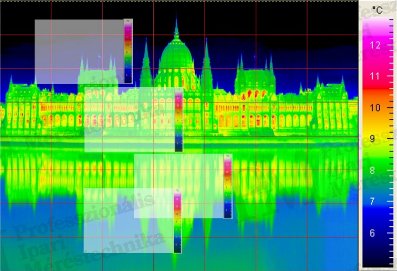 |
| Figure 1: A2 (wall calendar) sized thermal image assembled from 7 x 8 (total of 56!) individual 1.23 Mpixel thermal images [source: PIM] (the grid indicates the arrangement of thermal images, the light areas show the dimensions of the original thermal images /applied overlap >40%/) |
Naturally, such automatic alignment is subject to several conditions: the thermal images must have a large coverage, they must be captured from the same observation angle and distance. Additionally, uniform measurement conditions and identical thermal camera settings are mandatory. This requires great discipline and precise on-site work, but adhering to these conditions pays off multiple times. For example, with Infratec's IRBIS3 mosaic software, instead of hours of manual thermal image correction and alignment, dozens of thermal images can be perfectly and automatically montaged into a single, unlimitedly evaluable data file in just 5 minutes.
Among the special capabilities of the mentioned software, it is worth highlighting the alignment of thermal images' temperature scales, correction of the images' optical (perspective) deformations, and the various (selectable) mathematical methods for aligning thermal image data.
Thermographic lenses, attachments
The most important aspect: thermographic lenses cannot be made of glass but only of materials suitable for the wavelength range of thermal cameras. Therefore, it's not possible to purchase a thermal camera and attach an optical microscope lens just because we want to measure very small objects at the moment. Similarly, a long-wave thermal camera lens cannot be mounted in front of a mid-wave thermal camera (and vice versa, as in both cases, we would find that we cannot measure any radiation.) For long-wave thermal cameras, the lens material is typically germanium, which is often coated with a special anti-reflection layer, achieving transmission factors of over 99 percent. (So, do not remove dirt from the optics with chemicals or abrasive cleaners!)
However, when discussing thermal camera lenses, we cannot avoid making a fundamental distinction between low-cost and professional devices. While the former are characterized by the smallest possible size (and thus the cheapest), generally permanently built-in – and despite their long-wave range, perhaps not even germanium-based – lenses, professional devices offer large-sized lenses and mostly the possibility to exchange the lens as needed. It is worth noting that there have been low-cost devices with interchangeable lenses for a few years now. Why are large lenses and interchangeability beneficial?
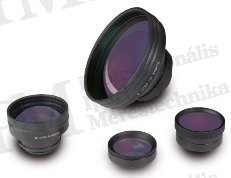 |
| Figure 2: Thermographic lenses [source: Infratec] |
The effect of lens diameter on measurement capabilities
The larger the diameter of a thermal camera's optical lens (more precisely its aperture), the more radiant energy reaches the surface of the thermal sensor. The measure of the optical system's brightness (specifically the intensity of transmitted infrared radiation) is the f-number, which is the ratio of the focal length to the aperture lens diameter. Naturally, the smaller the f-number, the larger the lens diameter, resulting in greater energy input to the sensor, which of course leads to higher sensitivity and accuracy. But beware: the larger the lens diameter, the more it deviates from the ideal optical system model, the Gaussian optics. As a result, imaging errors (such as image distortion) increase, which can only be counteracted with increasingly sophisticated lens designs.
If we want to support the above with some numerical data, let's compare the most common category of microbolometer thermal cameras. The small-sized lenses of low-cost thermal cameras allow for a sensitivity of up to 100 mK at a 50 Hz frame rate; to achieve better thermal resolution (e.g., 80 or 60 mK), the integration time needs to be increased – meaning the frame rate needs to be reduced to 30, 25, or even just 9 Hz. The large lenses of professional thermal cameras, depending on the camera's capabilities, enable thermal resolutions of 50 or even 30 mK at frame rates of 50 Hz or even 240 Hz. Of course, it's not just that the lens of a low-cost thermal camera costs at most a few hundred thousand forints; in the case of professional devices, the price of thermographic optics moves above the one million forint level.
Necessity and Variety of Exchange Lenses
In thermographic measurements, besides the observation field size appropriate for evaluation, the most important aspect is ensuring the necessary geometric resolution for accurate temperature detection. For example, with a "standard" lens providing a 2 mrad geometric resolution, only objects (or object details) with a minimum size of 30 mm can be reliably detected from a distance of 5 m. For measuring smaller objects, either a shorter measurement distance or different optics must be chosen. (By the way, a thermographic image wouldn't be able to detect the temperature of small objects we are interested in.) So, we exchange the aforementioned "standard" lens for a telephoto lens, then with a 1 mrad geometric resolution, we can also measure the temperature of 15 mm objects from a distance of 5 m. (Note: The zoom built into thermal cameras is only digital zoom, which does not solve the above problem – in fact, it even excludes a significant portion of the expensive thermal pixels from our measurement. Therefore, never use it!)
Primarily for professional thermal cameras, there is a wide range of exchange lenses available, which, for easy interchangeability, often connect to the thermal camera not with threads but with a bayonet mount. Ideally, these lenses also have electronic coding so that the thermal camera can automatically detect which lens is being used and load the corresponding calibration data file. The latter is necessary because the calibration of any thermal camera is always done together with the lens installed to determine and correct the characteristics of both the lens and the thermal camera. So, if we change the lens, different calibration data is needed for radiation detection correction. (From this, it naturally follows that purchasing a lens later requires a manufacturer's recalibration of the thermal camera. Also, among identical thermal cameras, lenses cannot be swapped "without consequences.")
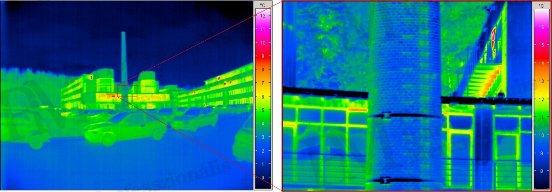 |
| Figure 3: Thermal image resolution achievable with telephoto lens [source: InfraTec] |
Additional Note: Unfortunately, zoom lenses do not exist for thermal cameras used for temperature measurement purposes. The reason for this is, on one hand, the considerable cost of such lenses, but the main reason is the calibration requirement of the thermal camera: since with a zoom lens, the virtual aperture size varies with each magnification setting, a separate calibration would be needed for each possible (continuous zoom=infinite many) setting.
Rahne Eric (PIM Ltd.) pim-kft.hu, termokamera.hu
The content of this publication is protected by copyright. Any (even partial) use, electronic or printed republication, is permitted only with the indication of the source and the author's name, and with the author's prior written permission. Violation of copyright (Copyright) entails legal consequences.
Copyright © PIM Professzionális Ipari Méréstechnika Kft.
2026 | Minden jog fenntartva
Impresszum | Adatkezelés