


Special Thermographic Filters for Thermal Cameras
There are many measurement tasks where it is not enough to select a thermal camera with the appropriate spectral sensitivity (wavelength range), but special infrared wavelength filters are also required to detect the object temperature or physical phenomenon to be measured.
Depending on the type and design of the thermal camera, the filters need to be placed externally (in front of the lens) (such as CO2 laser protection filters) or integrated into a filter wheel inside the thermal camera, allowing for software-based filter selection (very important, for example, when inspecting internal components of incandescent and arc plasma light sources and glass or ceramic enclosures with glass surface and through-glass filters).
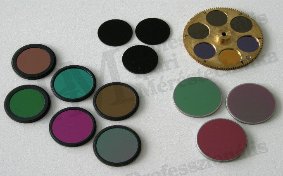 |
| Figure 1: thermographic filters [source: InfraTec] |
Examples of Applications Requiring Infrared Filters
Measurements Related to Glass
Measurement tasks related to glass can be considered almost "classic." Whether determining the exact temperature of a glass surface or the temperature of an object (at high temperature) behind the glass, a mid-wavelength thermal camera is needed. Suitable filters are also required because without them, the radiation passing through the glass and the radiation emitted from the glass surface due to its own temperature will add up. By excluding radiation shorter than 3.5 µm with an appropriate filter, only the radiation representing the glass temperature is detected, and with another filter allowing transmission up to 3.5 µm, only the radiation passing through the glass can be detected, which is proportional to the temperature of the object behind the glass.
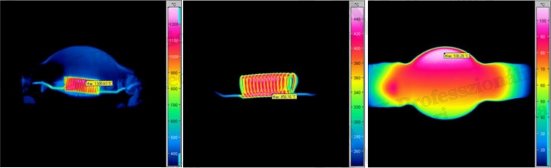 |
| Figure 2: measurement without filter on the left, through-glass filter in the middle, glass surface filter on the right [source: InfraTec] |
Measurements Related to Burning Gases
Almost all measurement tasks related to burning gases require filters. Whether determining the temperature of burning gases or the temperature of objects heated by combustion processes (in the latter case, preferably without the influence of radiation emitted by flames), a mid-wave thermal camera along with a 4.25 µm narrowband filter is needed for the first case, while the latter task can be solved with the same thermal camera and a 3.7–4 µm bandpass filter, or a long-wave thermal camera (practically without a filter).
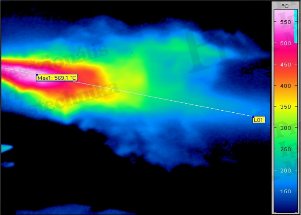 |
| Figure 3: flame temperature measurement [source: InfraTec] |
Measurements of Thin Plastic Films
Among other measurement tasks that are inaccurate or impossible without filters, determining the temperature of very thin plastic films (foils) is highlighted. Knowing which wavelengths the film can absorb, according to Kirchhoff's law, it is possible to determine that it can emit radiation related to its own temperature at these wavelengths. By narrowing down to a specific wavelength – for example, 3.4 µm for polyethylene – with a pinhole filter, the temperature of the film can be determined regardless of the temperature of objects behind it.
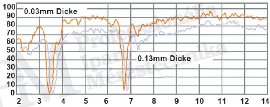 |
| Figure 4: transmittance properties of polyethylene film [source: InfraTec] |
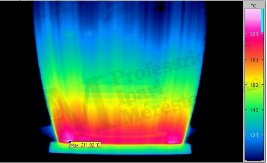 |
| Figure 5: temperature of a 50 µm thick polyethylene film [source: InfraTec] |
Measurements of Solar Panels
It is also advisable to use filters when performing in-operation inspections of solar cells. Since these cells operate only in sunlight, measurements should be taken during sunlight. During this, the reflection of solar radiation on their surface will be very strong, significantly affecting our measurements compared to the temperature of the solar cells. To counteract this, special solar reflection-reducing filters are offered for both mid-wave and long-wave thermal cameras.
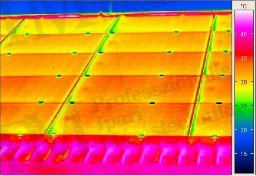 |
| Figure 6: inspection of solar cell roof surface [source: PIM] |
Measurements of Laser Technologies
Caution with laser technologies - e.g. laser cutting, welding, or soldering! Some thermal camera manufacturers already have a collection of thermal camera detectors with "I love You" inscriptions and decorative designs - even though most lasers do not operate at the wavelengths detected by thermal cameras. However, they can damage the sensors of thermal cameras because they work with incredibly high energy density. The input lens and the cover (coating) of the sensor of thermal cameras ideally have close to 100% transmittance to the wavelength range corresponding to the atmospheric window of the thermal camera type, with minimal transmission for wavelengths outside of this range - but not zero! Consequently, the "residual" radiation intensity of high-power density lasers reaching the sensor of the thermal camera will still be sufficient to irreversibly damage the affected pixels of the sensor. And this applies not only to the direct laser beam but also to laser beams reflected by the object being measured. Therefore, it is advisable to use so-called laser protective filters (protective windows). This is especially true for CO2 lasers (10.6 µm) operating at the wavelength detected by long-wave thermal cameras.
Detection of gas leaks
Special filters are also required for gas leak detection, always tuned to the wavelength of the gas we want to detect. However, this also means that gases whose absorption band does not fall within any of the wavelengths of the atmospheric window cannot be detected. Those gases whose spectral lines are only found in the mid-wave atmospheric window can only be detected with ideal (laboratory conditions), very high-sensitivity photon detector thermal cameras. In addition, there are a few gases that can be detected in the long-wave range, but despite the best filters, their measurement promises success only at high gas concentrations. Detecting gas leaks with ultrasonic detection is orders of magnitude cheaper and thousands of times more reliable - even in bright sunlight. This also works on compressed air systems, which is of course theoretically excluded with thermography.
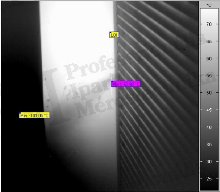 |
| Figure 7: CO2 leak [source: InfraTec] |
Rahne Eric (PIM Ltd.) pim-kft.hu, termokamera.hu
The content of the publication is protected by copyright, and its (even partial) use, electronic or printed re-publication, is permitted only with the indication of the source and the author's name, and with the prior written permission of the author. Violation of copyright will have legal consequences.
Copyright © PIM Professzionális Ipari Méréstechnika Kft.
2026 | Minden jog fenntartva
Impresszum | Adatkezelés