


Thermal resolution, measurement ranges, special thermographic filters
Thermographic devices suitable for non-contact temperature measurement (infrared cameras with thermography capability) have undergone rapid development in recent years. Considering that these devices appeared just 50 years ago, but have now grown into one of the most well-known and versatile inspection tools, it's no surprise to see a wide variety in the market offerings (manufacturers, types). For a client planning to purchase a thermal camera, the issue is no longer the lack of a suitable type according to their needs, but rather the overwhelming variety of options available. Therefore, it is time to review the development and types of these instruments from a professional perspective, and organize the current offerings based on some important technical parameters. Because: The measurement technology implemented in the cameras and the accessories available determine the device's application area, as well as the expected measurement accuracy and the achievable thermal image quality.
Thermal resolution of Thermal Cameras
Especially when the temperatures to be measured are close to the lower limit of the camera's current measurement range, the image quality is predominantly determined by the temperature resolution. "NETD" (noise equivalent temperature difference) is the effective value of the camera's own noise, expressed in the temperature difference of the object that results in the same electrical signal. This parameter, which qualifies the camera's temperature resolution capability, is usually determined at 30°C. However, it is important to note that this value increases almost exponentially as the object's temperature decreases.
Example:
| A lower-quality thermal camera with a valid ±120 mK (+/-0.12°C) temperature resolution at 30°C will practically have a "smooth" ±0.25°C noise at 0°C. Since this value is per pixel, the total thermal image resolution is only 0.5°C (as pixels can deviate oppositely from their placement independently up to the maximum value). However, for a visually coherent surface on the thermal image, the surface temperature must differ by at least twice the above value from the surrounding thermal image pixels - thus, the minimal temperature difference defining recognizability in this example is nearly 1°C! |
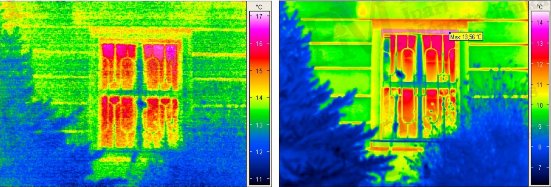 |
| Figure: left inadequate thermal resolution, right adequate thermal resolution thermal image [source: PIM] |
Based on the above, it is easy to recognize that there are application areas for thermal cameras where the camera's thermal resolution is one of the most essential quality (measurement technology) factors, while in others, its significance is not significant. The thermal resolution is considered a critical parameter in the following applications:
- biological (medical, physiological, research, environmental monitoring) measurements - environmental protection, disaster management (e.g., flood surveys, levee saturation) - building thermography (residential buildings, industrial facilities, cold stores) - determining cable locations, moisture and leak detection - supervision of heat-sensitive technologies - non-destructive material testing, active thermographic measurements - sensing extremely low temperatures Temperature measurement range(s) There is often a need for thermal cameras to be able to measure "higher" temperatures. As if this were a difficult task! But it is not. Most (even the cheapest) thermal cameras can measure up to a minimum of 120°C, but there are also a good number of LowCost and "standard" thermal cameras with extended measurement ranges up to 200, 250, or 350°C. A more interesting question is at what temperature their measurement capability starts, in what resolution (with how many bits of digitization), and how many selectable measurement ranges cover their entire measurement capability. Only with all the listed data known can we determine the capability and measurement accuracy (quality) of a given thermal camera. The first quality parameter to mention relates to the digitalization of temperature values. There are devices with 12, 14, or even 16 bits, which cover temperatures of 160, 200, 240, or even 360°C within their critical lowest (or only) measurement range. The expected accuracy varies widely: a 12-bit LowCost thermal camera with a single -10°C ... 350°C measurement range has a digitalization resolution of just 360K/4096 = ±87.9 mK, while a professional thermal camera (with multiple selectable measurement ranges) has 160K/65536 = ±2.4 mK. This is a significant difference! The second important technical characteristic is the lower limit of the camera's measurement range. Since measuring low temperatures is the most challenging according to the Planck radiation law (as bodies emit only minimal radiation), this task is the most critical due to the camera's own noise, known as NETD. Accordingly, most LowCost thermal cameras can barely perform calibrated measurements from 0°C, some types boast a -10°C lower limit, and a -20°C lower limit is very rare. In contrast, long-wave professional instruments can accurately (and calibrated) measure from -40°C. For many tasks (e.g., external building thermography, biological or environmental measurements), this is a decisive parameter for the camera's applicability, as there are guaranteed measurement points with temperatures below 0°C. The upper limit of the thermal cameras' measurement range is much simpler from a measurement technology perspective because, thanks to the aforementioned radiation physics law, there is abundant detectable radiation from high-temperature objects. Only by using appropriately shortened integration times and (in higher ranges) applying suitable filters can we ensure that the sensor remains in the linear detection range (and of course, not "overcook" it).
LowCost thermal cameras use filters with appropriate damping (sufficiently low transmittance) instead of internal diaphragms - to be screwed in front of the lens - to expand the measurement range. This is a specifically cheap solution, but of course not very useful in terms of measurement accuracy. However, there is a practical technical limit to calibrating at really high temperatures. Currently, the highest temperature for calibration is max. 2000°C or 2500°C, which are the temperatures of the highest temperature, hollow reference radiators that can approach the ideal radiator (black body) up to 99.9999%. Calibration for even higher temperatures can only be achieved with mathematical tools (extrapolation), which unfortunately have serious uncertainties. However, we will provide some additional information about the calibration of thermal cameras and calibration ranges, as these terms are often misleading.On-site evaluation functions of mobile thermal cameras
In thermography - as a "visual" non-contact temperature measurement method - the first step is to collect measurement data (digitalized radiation intensity values from each pixel). These values need to be processed appropriately, mathematically corrected (converted to temperature), and then displayed either immediately during the measurement (in the thermal camera) or during subsequent evaluation. Depending on the specific measurement task, the requirements for evaluating thermal images can vary greatly. While in some cases, determining the specific temperature of each pixel (measurement point) is sufficient, in other cases, it is necessary to correct the emissivity value of each pixel in the entire thermal image or even to capture and evaluate complete image sequences for the desired temperature relationships or processes (in the form of temperature-time diagrams). Often, data evaluation and display as "processed" temperature values are required during the measurement (even in real-time). Live evaluation practically means part of the operator software in the thermal cameras, so its operation is integrated into the process of operating the thermal camera. The following table lists the "automatic" auxiliary functions and real-time evaluation possibilities built into or that can be built into modern (professional) thermal cameras (without claiming completeness):
| Function | Explanation |
| Autofocus | focusing of the thermal image based on the steepest temperature gradient |
| Automatic measurement range | setting the measurement (calibration) range according to the current measurement |
| Automatic thermal image scaling | scaling of display based on the currently measured min/max values |
| Temperature color scale | display with multiple selectable color and/or grayscale scales |
| Pixel temperature display | live display of the temperature of the central pixel of the thermal image |
| Cursor temperature display | live display of the temperature of one or more movable cursors |
| Min/Max temperature display | display of the coldest/hottest pixel location and value |
| Multi-surface temperature display | display of average, peak, or minimum values for defined surfaces |
| Display of isotherms | highlighting pixels within a defined temperature range in a single color |
| Differential image display | depiction of temperature differences compared to a reference thermal image |
| Thermal image averaging | formation of an average of multiple thermal images (noise reduction, sensitivity enhancement) |
| Temperature alarm | visual/acoustic alarm in case of minimum or maximum exceedance |
| Automatic storage | Automatic measurement and storage triggered depending on temperature value |
| Composite image display | Continuous projection of visual image (photo) and thermal image (live) on each other |
| Storage of thermal image series | Series storage of thermal image data in the thermal camera (without PC connection) |
| Digital sound recording | Adding acoustic commentary to the stored thermal image data |
| Management of GPS data | Geospatial assignment of ground and aerial thermal images |
| Remote control capability | Remote control capability of thermal camera functions (with or without cable) |
Table: Evaluation / management functions integrated into the thermal camera control software
The more of these functions we find in our thermal camera, the more versatile its applicability and the more convenient and efficient on-site work becomes. Among the mentioned evaluation possibilities, we would highlight the temperature-dependent initiation of measurement storage, which often greatly assists in recording thermal events that occur unexpectedly. In the case of fast processes, the thermal image series recording function provides the solution, utilizing the unparalleled advantage of thermography: the ability to record thermal processes that occur in fractions of seconds. Thanks to the built-in composite image display in the thermal camera (referred to as "fusion" by some companies), there is no longer a need to take separate photos for documentation and insert them, which represents a significant time-saving opportunity. Furthermore, through the projection of thermal and photographic images, the relationships between object temperatures can be graphically documented in the most recognizable and easy-to-understand manner.
Special thermographic filters for thermal cameras
There are numerous measurement tasks that require not only selecting a thermal camera with the appropriate spectral sensitivity (wavelength range), but also the need for special infrared wavelength filters to detect the target temperature or physical phenomena. Depending on the type and design of the thermal camera, the filters need to be placed externally (in front of the lens), such as CO2 laser protection filters, or integrated into a filter wheel inside the thermal camera, enabling the software-based selection of filters (particularly important for examining internal components of incandescent and arc plasma light sources and glass or ceramic enclosures with glass and through-glass filters). The following list includes only a few (most commonly occurring) filters:
| MWIR (2 - 5 µm) | |
| BP: 3.6 - 4 µm | reduces atmospheric effects |
| HP: 3.6 µm | reduces solar reflection |
| NBP: 2.3 µm | measurement through glass |
| NBP: 5.0 µm | measurement on glass surfaces |
| BP: 3.7 - 4 µm | measurement through flames |
| BO: 3.9 µm | range extension for measurements |
| NBP: 4.25 µm | detection of flame temperature |
| NBP: 4.25 µm | polyethylene spectral line |
| LWIR (7.5 - 14 µm) | |
| NBP: 8.3 µm | teflon spectral line |
| HP: 7.5 µm | excludes shorter wavelengths |
| NBP: 10.6 µm | CO2 laser protection filter |
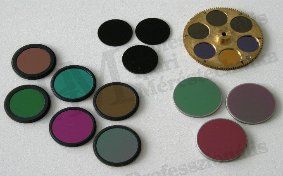 |
| Figure: thermographic filters [source: InfraTec] |
Applications requiring infrared filters Classic examples include measurement tasks related to glass. Whether determining the precise temperature of a glass surface or the temperature of an object (with high temperature) behind the glass, a mid-wave thermal camera is required. Additionally, appropriate filters are necessary because without them, the radiation passing through the glass and the radiation emitted from the glass surface due to its temperature "add up." By excluding radiation shorter than 3.5 µm with a suitable filter, only the radiation representing the glass temperature is detected. With another filter allowing transmission up to 3.5 µm, only the radiation passing through the glass, proportional to the temperature of the object behind the glass, would be detected.
 |
| Figure: measurement without filter on the left, through-glass filter in the middle, surface glass filter on the right [source: InfraTec] |
Many measurement tasks require filters for determining the temperature of burning gases or objects heated by combustion processes (preferably without the influence of radiation emitted by flames). While in the former case, in addition to a mid-wave thermal camera, a 4.25 µm narrowband filter is needed, the latter can be achieved with the same thermal camera and a 3.7 - 4 µm bandpass filter or a long-wave thermal camera (practically without a filter).
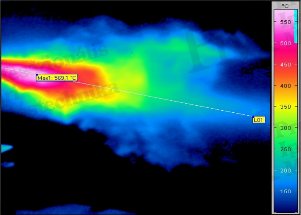 |
| Figure: Measuring flame temperature [source: InfraTec] |
Among further measurement tasks that cannot be solved accurately or at all without filters, determining the temperature of very thin plastics (films) stands out. If we know which wavelengths the film can absorb, we also know that according to Kirchhoff's law, it can emit radiation related to its own temperature at these wavelengths. By using a pinhole filter narrowed down to this specific wavelength - e.g. 3.4 µm for polyethylene - it becomes possible to determine the temperature of the film independently of the temperature of objects in the background.
 |
| Figure: Transmission properties of polyethylene film [source: InfraTec] |
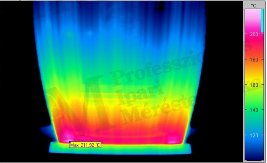 |
| Figure: Temperature of 50 µm thick polyethylene film [source: InfraTec] |
It is also advisable to use filters when performing in-service inspections of solar cells. Since these cells operate only under sunlight, the measurements naturally need to be conducted during sunshine. During this time, their surfaces will strongly reflect solar radiation, which, compared to the cells' own temperature, will have a significantly higher energy content and thus affect our measurements accordingly. To mitigate this, both medium-wave and long-wave thermal cameras offer special filters to reduce solar reflection.
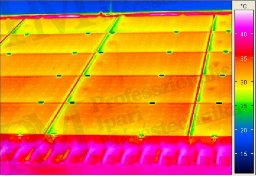 |
| Figure: Inspection of solar cell roof surface [source: PIM] |
Caution with laser technologies! Several manufacturers already have a collection of thermal camera detectors with "I love You" inscriptions and lovely decorations - even though most lasers do not operate in the wavelengths detected by thermal cameras. Yet, they can still damage the thermal camera detectors due to their incredibly high energy density! The input lens and the cover layer of the thermal sensor of a thermal camera ideally have close to 100% transmittance for the wavelength range corresponding to the atmospheric window of the thermal camera type, with minimal - but not zero - transmission for wavelengths outside of this range. Consequently, the residual radiation intensity of high-power lasers reaching the detector can still be sufficient to damage the thermal camera detector. This applies not only to direct laser beams but also to laser beams reflected by the object being measured. Therefore, it is advisable to use so-called laser protective filters (protective windows). This is especially true for CO2 (10.6 µm) lasers operating in the wavelength range detected by long-wave thermal cameras. Special filters are also required for gas leak detection, always tuned to the wavelength of the gas to be detected. However, gases whose absorption bands do not fall within any atmospheric window wavelengths cannot be detected. Gases whose spectral lines are only found in the mid-wave atmospheric window can only be detected with very high sensitivity photon detector thermal cameras under ideal (laboratory) conditions. There are only a few gases detectable in the long-wave range, even with the best filters, but this is only promising for high gas concentrations. It is much cheaper and more reliable to detect gas leaks using ultrasonic detection - even in bright sunlight. This method works even on compressed air systems, which are theoretically excluded from thermography.
 |
| Figure: CO2 leak detection [source: InfraTec] |
Rahne Eric (PIM Ltd.) pim-kft.hu, gepszakerto.hu
The content of this publication is protected by copyright. Any (even partial) use, electronic or printed republication is permitted only with the indication of the source and author's name, and with the author's prior written permission. Violation of copyright will result in legal consequences.
Copyright © PIM Professzionális Ipari Méréstechnika Kft.
2026 | Minden jog fenntartva
Impresszum | Adatkezelés