


Primarily, the rotating parts of electric motors are prone to electrostatic charging during normal operation. Despite the fact that this phenomenon has been known for a long time, it is often not given enough attention. Bearing damage caused by electric discharge or transient/creeping currents is also known as haziness, electrical pitting, groove formation, or surface damage due to arcing.
In order for current flow to occur, the presence of a voltage potential difference is necessary (e.g., induced voltage and ground). By nature, current flows through the path of least resistance, which is usually through the bearings of the electric motor. However, it is also possible for current flow to pass through one of the connected machines or equipment. For example, in the case of electric motors equipped with directly coupled tachometer generators, it is very common for the flowing current to first damage the tachometer generator bearings, as they are smaller in size and therefore offer lower transient resistance.
 |
| Figure: Possible Paths of Current Flowing through Electric Motor and Attached Equipment [source: CSI] |
The lubrication of the bearings also plays a crucial role. Due to its insulating effect, a static charge potential can develop on the shaft. When this voltage exceeds the breakdown voltage of the bearing lubrication, sparking occurs, leading to damage to the metal components' surfaces and oxidation of the lubricating material. This process repeats periodically in the form of new arcing discharges. The breakdown voltage level depends on the type, condition, contamination, environmental moisture, temperature of the lubricating material, and the bearing clearance.
Every electrically driven machine's shaft voltage contains some alternating and/or direct current components, which only become problematic when they exceed a certain level. Once electric damage has started, mechanical bearing wear accelerates significantly due to the recurring arcing discharges. The lifespan can range from one to several years, depending on the shaft voltage, bearing types, transient resistance, clearances, and lubrication. It is essential to emphasize that the lifespan is significantly shortened compared to bearings exposed only to mechanical wear.
Circumstances Facilitating the Generation and Flow of Creeping Currents
The source of shaft voltage or current generation can be:
Electromagnetic voltages and currents occur when there is
Due to voltage induction, circulating current is generated, which starts from the motor shaft, passes through one bearing, through the motor housing, and then returns through the other bearing. Electrostatic voltages and currents result from the accumulation of charges, which can be observed in steam turbines, wet gas compressors, belt-driven machines, and paper machines. Here, the discharge of voltage from the motor shaft leads through one of the bearings to the ground potential.
External voltages are generally caused by the excitation or control devices of electric motors, often resulting in groove formation. The generation of current has a significant role in:
Groove formation caused by external voltages is often observed in:
Detecting Current Passage on Bearings
Visual inspection is the most important tool for determining the presence of current passage. Often, the bearing damage is so severe that the bearing components are welded together. Nevertheless, it is worth inspecting every removed bearing.
Typical signs of damage due to current passage include:
These phenomena can be found on the outer and inner rings of the bearing, but also on the rollers. However, the outer ring is most commonly affected.
The dull surfaces resemble symmetrical sandblasting or machining. One image shows an outer bearing ring with such damage. Under a microscope, the surface is seen to be full of small craters, indicating melting due to electric discharge. Sometimes this phenomenon is mistakenly recognized as chemical damage; in such cases, the craters would be smaller and have a dull surface. Radial bearings often show traces of sparks, which appear as scratches on the bearing surface. In contrast to the fault pattern of insufficient lubrication, these damages occur irregularly and obliquely to the direction of rotation. Under a microscope, melting traces can also be seen at the bottom of the scratches.
The groove formation seen in the following images resembles machining impressions, making it easily recognizable as damage caused by current passage. The affected surfaces are very narrow and clearly delineated.
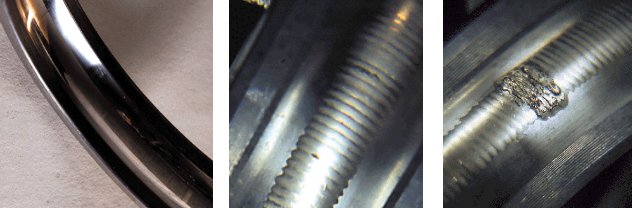 |
| Figure: outer bearing ring with a matte surface (left image), strong grooves (middle image), spalling (right image) [source: CSI] |
Identification of groove formation through vibration analysis
Damages to bearings due to current transitions can be identified with high-resolution spectrum. This type of fault appears as high-frequency modulated vibrations in the form of vibration amplitudes "peaks" in the spectrum in the frequency range of 2000 ... 4000 Hz.
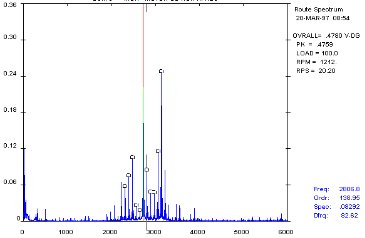 |
| Figure: vibration spectrum of an electric motor with groove formation in the bearing [source: CSI] |
In the amplitude peak, sidebands with modulation frequencies originating from the outer and/or inner ring or a combination of both can be found. Mostly, modulation of the outer ring frequency is present.
As visible in the above figure, the usual bearing fault frequencies are not yet visible in the low-frequency range of the spectrum in the early stage of this fault. Only in deteriorating bearing conditions - when general wear of the bearing intensifies - the bearing fault frequencies appear. It is expected that incipient damages can be detected very early in the envelope demodulation spectra. Therefore, vibration analysis can only confirm bearing damage caused by current transitions, but is not suitable for detecting critical voltage potentials or the occurrence of stray currents damage beforehand. Other electromagnetic phenomena that can lead to stray currents - e.g., asymmetric field strength, problems caused by harmonics - can be identified through vibration analysis.
Identification of current transitions through current and voltage measurements
Prior to the formation of grooves due to current transitions - more effectively in vibration diagnostics - a method that can be applied is the measurement of the current axis and the occurring stray current. This should preferably be done close to the bearings directly with a brush or other sliding contact. To assess the probability of groove formation as safely as possible, the following currents and voltages need to be measured:
These data together provide an insight into the processes taking place in the system.
Generally, the measurement is carried out between the shaft and ground (motor housing, base screw, etc.). Some companies specializing in machine diagnostics also offer measuring probes suitable for measuring shaft voltages and stray currents with their vibration diagnostic handheld devices. The measurement consists of two steps: First, measure the voltage drop across a resistance of R = 1 Ohm. Then repeat the measurement across a resistance connected in series of R = 10 Ohms. However, it should be noted that as long as there are other current paths through the bearing, the value measured with the probe does not represent the entire current flowing through the shaft! In theory, the transient resistance of the bearing - assuming an average lubricating film - should not be less than 1 Ohm. However, if lubrication has collapsed due to current transitions, more current can flow through the bearing. Therefore, the values measured with the probe are usually smaller than the actual currents. If the ratio of measured current values is greater than 10:1 (when using the mentioned 1 and 10 Ohm resistances), then - at constant speed and load - indicative data of a fault have been recorded. Since every electric motor has some - even very small - shaft voltage and stray current, the question arises where the critical limit lies. However, there are different data in the literature, which are likely attributable to different measurement methods, equipment, types of bearings, types of lubrication, bearing clearances, speeds, air humidity, and many other factors. Until new and more accurate empirical data are available, the threshold values regarding acceptable currents and voltages summarized in the table below can be considered as a guideline.
| Measurement | Amplitudes | ||
| low | to be examined | high | |
| Effective value or direct voltage [V] | < 1 | 1 - 3 | >3 |
| Effective value or direct current [mA] | No data | No data | No data |
| Peak voltage [V] | < 3 | 3 - 10 | > 10 |
Interpretation of the symbols used in the table: low: low probability of damage to be examined: corrective measures are necessary if the machine in question has already suffered damage caused by stray currents high: the data should be considered extraordinary, with a very high probability of damage (However, there have been cases where current transition damages were found on a machine where currents or voltages greater than the low level were never measurable.) Where a limit value cannot currently be specified, the value must be defined from numerous measurements, typically less than 1mA for an asynchronous motor running at a constant speed based on initial experiences. The trend of voltage and current values provides more assistance than the reference values given in the table: Increase and decrease can indicate deterioration of the condition or some damage leading to the generation of shaft voltages and stray currents. Changes can also indicate poor grounding. The higher the data, the higher the likelihood of bearing damage due to current transitions. After a certain damage to the bearing, the voltage level may decrease again. Periodic monitoring of voltage and current values is recommended on the following - considered critical - machines:
Prevention of bearing damage due to current transitions
It is highly recommended to take preventive measures if the values of shaft voltage and leakage currents suggest the likelihood of bearing damage occurring at some point. If eliminating the direct cause is not possible, then either the current must be dissipated by installing a grounding system or the current path must be interrupted by insulating the shaft coupling or the bearings electrically. When grounding, ensure that all elements in the system through which current can flow (e.g. pipes, sensors, etc.) are also insulated.
Rahne Eric (PIM Ltd.) pim-kft.hu, gepszakerto.hu
The content of this publication is protected by copyright, and its (even partial) use, electronic or printed re-publication is only permitted with the indication of the source and author's name, and with the author's prior written permission. Violation of copyright will have legal consequences.
Copyright © PIM Professzionális Ipari Méréstechnika Kft.
2026 | Minden jog fenntartva
Impresszum | Adatkezelés