


Efficient, competitive production requires increased operational safety of production processes and manufacturing machinery. Additionally, environmental and safety engineering aspects are playing an increasingly significant role in providing protection for equipment representing significant or critical production or intrinsic value. When it comes to rotating and reciprocating machinery, one effective method of protection is monitoring the vibrations generated by the equipment. The simplest and most reliable way to prevent the development of excessive vibration levels - which endanger the machine, its associated equipment, and its environment - is through the use of so-called vibration switches.
Application of Vibration Switches
Most production equipment (motors, fans, pumps, compressors, etc.) generates vibrations during operation. The level of vibration measurable on the equipment is (with rare exceptions) proportional to the machine's condition. Therefore, implementing vibration monitoring is advisable for basic protection of production, the machine, and its environment to prevent major damages. One of the simplest and most cost-effective solutions for this purpose is the application of vibration switches.
Operation and Design of Vibration Switches
According to their function, vibration switches measure the vibration of the equipment to be protected and classify it based on a set threshold value. Depending on the exceedance of the threshold value, the vibration switch provides a two-state output signal, which can initiate the machine protection function. What may seem like a simple task at first can be realized using mechanical or electronic components. (But neither is simple!) Mechanical vibration switches are generally less tunable to a specific application due to their simple structure. The sensitivity of the mechanical structure strongly depends on frequency and may not always match the characteristics of the vibrations generated by the machine to be protected. As a result, false alarms may occur in the best case scenario, and the protective function may fail in the worst case. Due to their design, mechanical switches do not allow for remote acknowledgment/arming, start-up and alarm delay, or threshold value adjustment without external devices. Therefore, they can only be applied with numerous limitations, especially for the protection of variable or automatic operation equipment. Electronic vibration switches aim to eliminate the disadvantages arising from mechanical structures. The sensor element in these devices is generally a piezoelectric vibration sensor, which allows for well-specified frequency range and transmission characteristics. With the decrease in size and cost of electronic signal processors, these elements are now part of vibration switches, offering numerous adjustable parameters. Setting the threshold value for vibration level is a fundamental function, and a significant difference compared to mechanical devices is the accuracy and range of adjustment. Electronic devices easily allow for various timing and delay functions, which are useful during machine start-up or load-changing phases to prevent false alarms and shutdowns.
 |
| Figure 1: PCB 685B series electronic vibration switch with numerous adjustment options, explosion-proof housing |
The New Generation of Vibration Switches
With the advancement of electronic processing levels, special features such as hysteresis, flexible threshold switching, or the formation, storage, and evaluation of a moving reference level can be easily implemented. The quality of the vibration signal provided by built-in vibration sensors ensures comparability with standard evaluation, enabling precise, calibrated device settings. Some vibration switches allow for the output of buffered vibration signals - in the form of current or voltage signals. These outputs can serve calibration or operation verification purposes, as well as enable connection to external vibration analysis tools or condition monitoring systems. Certain variants of electronic vibration switches feature visible on-site LED indicators and provide numerous acknowledgment and arming options. Among the "intelligent," microprocessor-controlled vibration switches, there are models that allow programming via electronic means, such as serial communication ports (RS-485, USB). Electronic configuration offers several advantages: vibration switches can be quickly set up, potentially remotely, with precise values due to digital data transmission. The complete configuration of a specific vibration switch can be saved in electronic memory, allowing detailed documentation of settings and independent verification. With digital signal processing, wiring and application of vibration switches remain simple: devices with "normal" relay outputs can be easily replaced with minimal modifications.
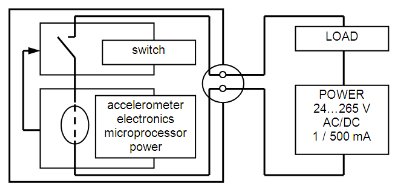 |
| Figure 2: Block diagram of PCB 686Bxx vibration switch (two-wire connection) |
Electronic vibration switches can perform reliably under various conditions, can be applied in potentially explosive environments with appropriate housing, operate in a wide temperature range, and practically require no maintenance.
Comparing electronic vibration switches with sensor+signal processor configurations, the former can be considered more reliable due to fewer wiring and connection errors. Additionally, there is a lower chance of configuration errors resulting from interfacing (e.g., incorrect sensitivity settings), and due to their compact design, they are more resistant to mechanical and electrical influences. Moreover, the overall cost is generally more favorable in most cases.
PCB 686B - the "intelligent" vibration switches
The PCB 686B electronic vibration switch family has a wide range of configurable parameters, yet their setup is simple, thanks to the USB interface and configuration program. In PCB 686B vibration switches, adjustable parameters include warning and alarm levels, switch-on and alarm delay, hysteresis, startup level or blocking, alarm output mode, and even alarm level referencing. The program allows convenient modification of individual characteristics, saving and documenting configurations.
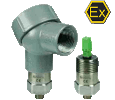 |
| Figure 3: PCB 686B series, USB programmable vibration switch (left: explosion-proof housing) |
The PCB 686B family offers multiple options against environmental influences, from armored cabling to explosion-proof housing. Despite the numerous functions and options, the PCB 686B family is cost-effective.
In summary, the application of electronic vibration switches - with few rare exceptions - not only represents a technically but also economically advantageous alternative to both mechanical switches and sensor+signal processing assemblies.
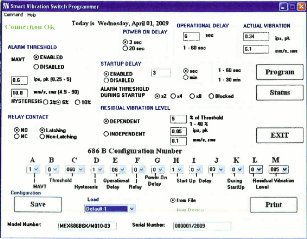 |
| Figure 4: Interface of the PCB 686B series vibration switch configuration program |
Rahne Eric (PIM Ltd.) www.pim-kft.hu, www.gepszakerto.hu
The content of this publication is protected by copyright. Any (partial) use, electronic or printed republication is only permitted with the indication of the source and author's name, and with the author's prior written consent. Violation of copyright (Copyright) will have legal consequences.
Copyright © PIM Professzionális Ipari Méréstechnika Kft.
2026 | Minden jog fenntartva
Impresszum | Adatkezelés