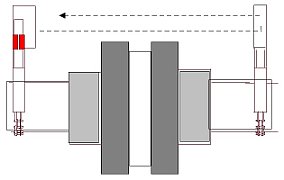
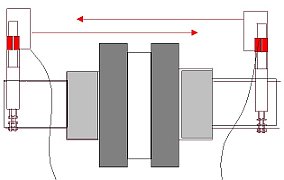
In the case of machine groups where the driving and driven machines are connected by a shaft coupling, the most common cause of vibration after imbalance is the improper alignment of the shaft centerline. Proper alignment of the shaft coupling and centerline is a very important task for reducing the load on bearings and increasing their lifespan.
Consequences of Shaft Alignment Errors (Inaccurate Alignments)
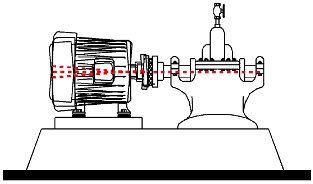
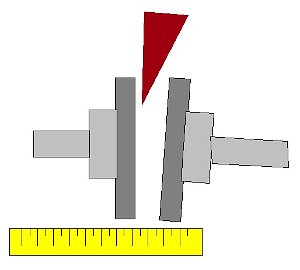
The typical errors of the centerline (or single axis) are parallelism error and angular error.
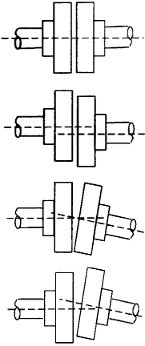
In this case, correct alignment means the shafts are not offset from each other and do not form an angle relative to each other.
Parallelism Error
We speak of parallelism error when the axes of machines connected by a shaft coupling are offset in parallel to each other. Angular Error We speak of angular error when the axes of machines connected by a shaft coupling form an angle with each other. Combined Error In this case, the shafts may even be misaligned.
In practice - almost without exception - we encounter a combination of these two errors. However, during our measurements, it is advisable to separate and treat the two basic cases of errors separately. The tolerance limits of alignment are also separately defined in standards.
Historical Overview
Alignment of shaft centerline with straightedge and feeler gauge This well-known (ancient) method's most outstanding advantage is its moderate equipment requirement. However, its disadvantage is its strong sensitivity to the manufacturing accuracy of the shaft coupling, the condition of the tools used, and the qualification of the personnel. Another issue is that the "quality" of the alignment is difficult to quantify. For more important equipment, it is definitely worth switching to one of the procedures listed below.
Alignment of Single Axis with Mechanical Dial Indicator
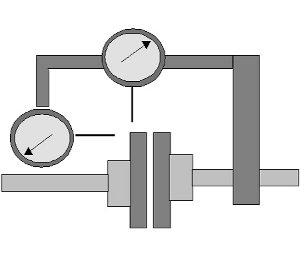
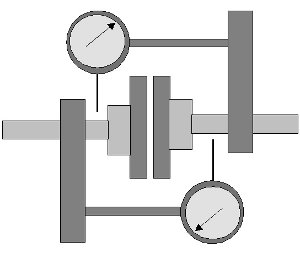
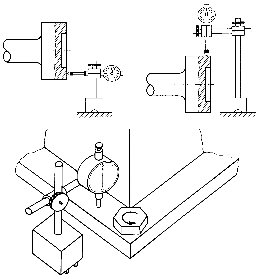
By using dial indicators, adequate accuracy can be achieved, measured values can be quantified well, and thus the "quality" of the alignment can be assessed. The downside of the procedure lies in the complex installation of the devices, the extremely careful reading, and the manual calculations required. Two dial indicators are needed for the measurement, which can be mounted radially and axially, or radially on both sides. The measurement is done by rotating both sides of the shaft coupling.
Radial and axial measurements with dial indicators Two fixed indicator gauges measure the parallel displacement of the coupling (top gauge) and the angular error (side gauge). The readings of the dial indicators are taken in positions corresponding to 6–12–9–3 o'clock.
Two-sided radial measurement With this method, the effect of the serious deflection of the fixing arm due to its length and two gauges on the measurement is eliminated. Indicator gauges fixed to the shaft on both sides of the coupling measure the displacement of the shaft rotation centers relative to each other and the angular error. The readings of the dial indicators are also taken in positions corresponding to 6–12–9–3 o'clock. One dial indicator shows the displacement between the centers, and the difference in values shown by the two indicators indicates the angular error.
During the recording of dial indicator data, it is advisable to perform credibility checks, as reading (or interpretation) errors can easily occur, resulting in complete failure of the shaft alignment.
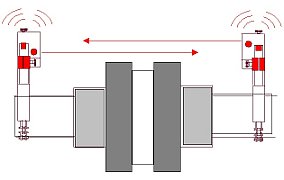
Before the introduction of laser systems, systems equipped with "data collection-evaluation" units were able to record the data of electromechanical dial indicators based on the above principles. After verifying the acceptability of the data, the shaft alignment error and the necessary corrective movements were immediately calculated. The use of these systems eliminated reading and manual calculation inaccuracies. However, the cumbersome mechanical installation, the relatively large space requirement, measurement errors caused by mechanical play, and the inability to bridge large distances remain disadvantages. Laser Shaft Alignment Laser single-axis alignment devices are based on the two-sided radial method. Instead of indicator gauges, one or two combined laser transmitter-detector units are used, fixed on the shafts on both sides of the coupling. These units measure the displacement between the rotation centers of the shafts and the angular error of the shafts. Shaft alignment with such systems is based on trigonometric calculation principles. The measurement values are recorded by the evaluation unit, which immediately calculates the extent of the shaft alignment error and the necessary corrections. Laser systems have rapidly evolved in recent years. The characteristics of each developmental stage are presented below.
|
Single-axis alignment with invisible laser Compared to dial indicator systems, installation is simple, there is no mechanical play, and it is capable of bridging larger distances. The inaccuracies due to mechanical play in dial indicator methods, as well as reading and manual calculation errors, cannot occur with this method. In most cases, these systems work with a combined laser transmitter-detector unit and a reflective target.
|
|
Single-axis alignment with visible laser - 1st generation Devices equipped with visible lasers are easier to handle compared to systems using invisible laser beams. The maximum measurement distance can reach up to 10 m, and these systems almost without exception use two combined laser transmitter-detector units. A new service feature is the automatic verification of "soft foot" (or "tripodness"), as well as continuous live display during correction movements.
|
Single-axis alignment with visible laser - 2nd generation This category includes the best tools currently available: their measuring heads contain electronic angular position sensors (inclination sensors), suitable for wired or even wireless communication. The systems offer several new features to facilitate alignment work:
 |
The most important advantages:
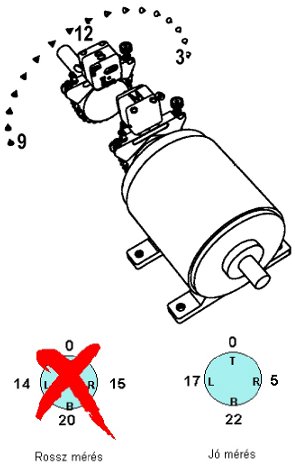
The practical importance of calculation from less than 180° of rotation does not need much explanation: everyone has probably been frustrated that traditional measurements were not possible due to installation conditions (at 9-12-3 o'clock angular positions). With the new systems, this is not a problem: even from a small rotation angle - starting from any position - the axis alignment error and the required corrections can be determined.
However, the direction of rotation should not be changed between the three measurements. By rotating "backwards," the natural mechanical play of the shaft coupling is included in the data, leading to incorrect calculations.
Practical advice for shaft alignment work
The use of modern instruments alone is not a guarantee that the alignments will be perfect, as they do not eliminate the misalignment of the shaft coupling (its skew, runout), the runout of the shaft ends, and the errors in the machine base (tripodness).
Before starting shaft alignment, it is advisable to check the following:
One more important advice: even if we measure the required correction values with micrometer precision using modern instruments, if we do not have suitable shimming washers for executing the correction, it is futile. The shim must have uniform thickness, should not rust, break, or flatten over time. It is most practical to use pre-manufactured quality stainless steel shimming washers (such as the PIM Ltd. EasyLaser washers), as they allow for quick and precise alignment: simply assemble the shimming washer corresponding to the correction value indicated by the instrument under the movable machine feet, and the correct vertical alignment is done.
Rahne Eric (PIM Ltd.) pim-kft.hu, gepszakerto.hu
The content of this publication is protected by copyright. Any (even partial) use, electronic or printed re-publication is permitted only with the indication of the source and the author's name, and with the author's prior written permission. Violation of copyright will result in legal consequences.
Copyright © PIM Professzionális Ipari Méréstechnika Kft.
2026 | Minden jog fenntartva
Impresszum | Adatkezelés