


In recent years, we hear more and more about the application of thermography in various professions. Mostly, it has become well-known for detecting energy problems in buildings, assessing the condition of electrical and mechanical equipment, and for human-biological applications. It is likely that thermal cameras are used in the thousands in Hungary, but there is no way to ensure the professional preparation and knowledge of those handling this measurement technology and evaluating the results (through examination): there is no profession or official training for THERMOGRAPHERS in Hungary, there is no recognized or required exam, thus the professional "self"-regulation of the market does not work. Currently, anyone can provide thermography services (they don't even need to finish elementary school), just having a thermal camera is sufficient!!! With the following article, I would like to prove that this approach is not only incorrect but also causes immeasurable (national) economic damage.
Moreover: What should even a simple infrared thermometer (incorrectly: laser thermometer) user know?
We are talking about contactless temperature measurement based on infrared radiation, so it is not a photographic (image-forming) procedure.
Practical aspects of contactless temperature measurement
Since we have already explained in several articles the theoretical background of temperature measurement based on infrared radiation and the meaning of technical parameters characteristic of thermal cameras, we will now focus on the practical aspects of measurements carried out with this technology. Material dependence of measurement accuracy, measurable surfaces The measurement accuracy of thermographic (thermal camera) or infrared thermometry (incorrectly called laser thermometer) temperature detection primarily depends on the radiation emission capacity (emissivity) of the measured surface. The better this capacity is, the less transmitted and reflected radiation occurs, and the detected radiation by the measuring device increasingly consists only of radiation related to the temperature of the object. Based on the detection of infrared radiation, the temperature of the object surface can only be calculated with the precise knowledge of the emissivity factor, the reflecting temperature (temperature of surrounding objects), and (in the case of transparent bodies in terms of heat radiation) the exact background temperature (based on the basic thermographic equation). The lower the emissivity factor of the object (its radiation emission capacity), the more corrections need to be made, therefore all parameters must be provided more accurately.

| Left image: thermal image of a hot air fan - the polished aluminum cover of the insulation has a very low emissivity value - the real temperature of the hot air fan is visible through the rusty inspection hole (>160°C), the rest reflects the temperature of the environment - the temperature of the insulation (>90°C) is not visible | Right image: new - polished surface - copper strip - the bottom of the copper strip appears warmer than the rest, although due to the good thermal conductivity of copper, there are certainly no differences - the visible heat effect is due to the reflection of the warm equipment located under the copper strip |
Above images: Examples of objects with low emissivity - difficult to measure - [source: PIM Ltd.] It follows from the mentioned relationship that the temperature of the object cannot be measured in any way:
As an explanation, in both cases, the emissivity value is close to "0", so the radiation related to the temperature of the object - and usable for temperature calculation based on detection - is almost non-existent. In practice, this fact is of great importance: we must acknowledge that, for example, insulation with a new - nicely polished - aluminum or stainless steel cover cannot be checked with thermographic tools. It doesn't matter what temperature (even extremely hot) the measured surface is, we will always only see ( "measure") the temperature of the surrounding objects reflected on it. We face a similar fact when we need to inspect brand-new electrical fixtures, switchgear cabinets: the temperature of the metallic (polished) rails, connections, joints cannot be determined contactlessly.
If a thermal image contains various material surfaces, it may be necessary to correct the emissivity factor per pixel for accurate temperature calculation. As a classic example, the assessment of the thermal load of electronic circuits can be mentioned: there are non-metallic surfaces (ceramic, plastic, lacquer) and metallic (copper, tin, nickel, and gold) surfaces. Without material-specific emissivity correction, we would be "measuring" cold circuit legs, and with correction, it turns out that these are actually the hottest.
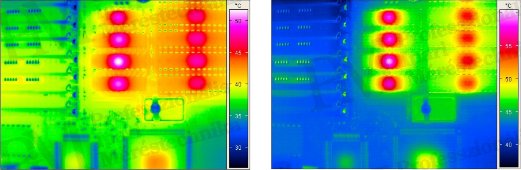
| Left image: PCB without emissivity correction - the hot circuit legs appear cold in reality - the reason for the incorrect data is the different emissivity values | Right image: PCB thermal image with emissivity value correction - pixel-by-pixel correction based on the left image - the hot circuit legs are hotter in the thermal image as well |
Above images: Example of pixel-by-pixel correction of different emissivity factors [source: Infratec]
Since the emissivity factor unfortunately depends on the viewing angle as well, we must take into account that the more the viewing angle deviates from the right angle, the more increasing reflection is observed. This effect is most noticeable when measuring objects with curved surfaces, but it also poses a challenge when measuring the upper floors of tall buildings: seemingly, the upper floors appear cooler (although in reality they are getting warmer). The explanation is that the sky (without clouds -273°C) reflects more strongly on the outer surface of the building, despite the emissivity factor of approximately 95% for surfaces made of silicate-based building materials.
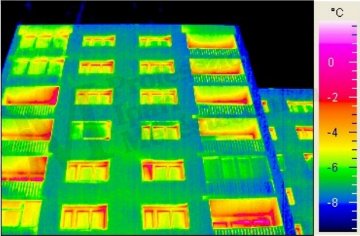 |
| Above figure: Example of the effect of emissivity factor dependency on viewing angle [PIM] |
Geometric Resolution
Geometric resolution significantly influences not only the achievable image quality but also the accuracy of the image's temperature data. The IFOV parameter describing this (typically given in mrad) indicates the viewing angle that corresponds to an individual sensor (pixel) in the image. To ensure good reproduction of details, it is important for this value to be as small as possible. For example, a 1.5 mrad IFOV means that each unique measurement point assigned to each pixel (projected measurement spot) has a diameter of 1.5 mm at a distance of 1m.
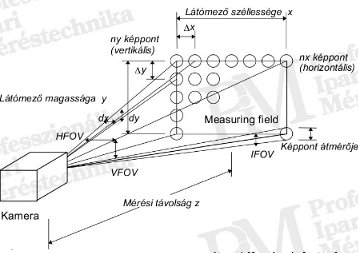 |
| Above figure: Geometric parameters of the image field [source: Infratec] |
Since the "projected" position of the image point on the object is unknown and the sensor matrix itself (necessarily due to manufacturing technology) has gaps, the above pixel size must be multiplied by 3 to determine the smallest measurable object size. Failure to comply with this can result in the measurement spot containing not only the radiation from the object's surface but also from its background (averaging within the measurement spot). Therefore, the measurement result can be either lower or higher than the actual temperature of the object, and the greater the difference in temperature between the object and the background, the greater the measurement error!
Naturally, the above rule applies not only to small objects (e.g., thin wires, filaments, etc.) but also to large objects (e.g., large cross-section cables, doors, etc.) when measuring. Obviously, different dimensions are involved: for small objects, we are talking about measurement surfaces of the order of millimeters, which can be measured from distances of up to several tens of centimeters based on the geometric resolution capability of the applied thermal camera and optics; for large objects, we are talking about measurement surfaces of centimeters in size that can be sensed from distances of several meters (up to 10 meters). In all cases, the use of equipment that allows compliance with the rule is necessary! Concrete example: If we want to measure a ten-story panel building, then to measure the upper floors (approximately 30 meters high), we must work from a distance of about 60 meters to minimize geometric distortion of the image (to avoid perspective effects). According to Pythagoras, the distance between the thermal camera and the object is 67 meters, so with a thermal camera resolution of 1.3 mrad, the elementary measurement point has a diameter of 87 mm, meaning the smallest measurable object must be larger than 261 mm! (As a reminder: a window frame is rarely wider than 70 mm). Therefore, the use of a telephoto lens is necessary!
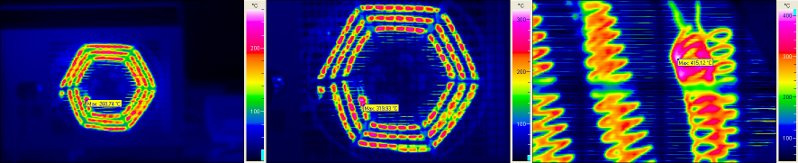 |
| Thermal radiation capture with a value of 1.5 mrad: left from a distance of 2 m (maximum value 261 °C), center from a distance of 1 m (maximum value 320 °C), right from 0.2 m (maximum value 415°C) |
Above figures: Example of the effect of thermal camera geometric resolution [source: PIM Kft.]
Measurement Conditions Given the nature of non-contact temperature measurement and the measurement procedure, we must also carefully consider the measurement conditions. The following examples illustrate the measurement conditions.
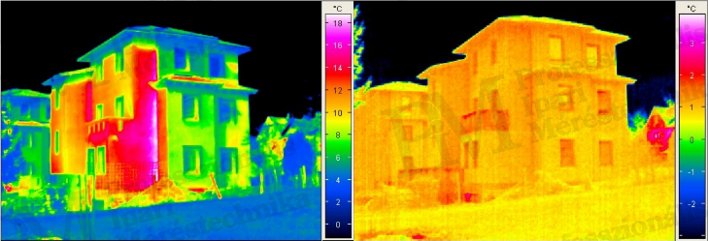
| Left image: daytime building survey (construction) - the sun's radiation is reflected on the building walls - the walls appear warm, although there is no heating!!! | Right image: building survey three hours after sunset - the heating effect of the daytime sunlight is barely noticeable, so measurements can now be taken |
Above figures: Example of the effect of sunlight [source: PIM]
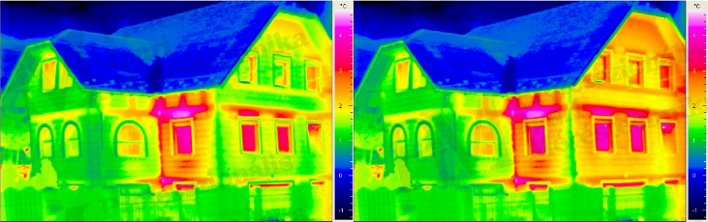
| Left image: thermographic survey conducted in strong wind - the wind carries heat away from the right-hand wall, making it cooler - it seems as if the wall in the middle of the thermal image has better insulation! | Right image: the same survey in calm weather - it is evident that the insulation of the right-hand wall is as poor as that of the wall in the middle of the thermal image (and has equally strong thermal bridges) |
Note for both thermal images: the left side of the building is not heated (staircase) Above figures: Example of the effect of wind [source: PIM]
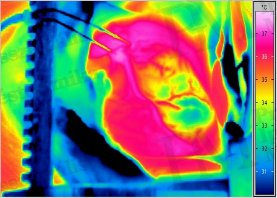 |
| Above figure: Artery occlusion (heart) [source: Infratec] |
(However, there is no detection of "internal organ infrared signals" or insight into the body with a thermal camera, as this requires prior surgical intervention!) Additional internet examples
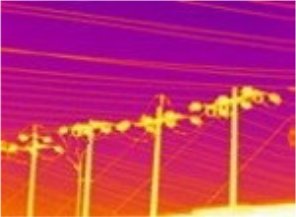
Above figure: thermal image of air ducts (160 x 120 pixels, 2.3 mrad, 50 m measurement distance) no error?! (or rather: not visible!)
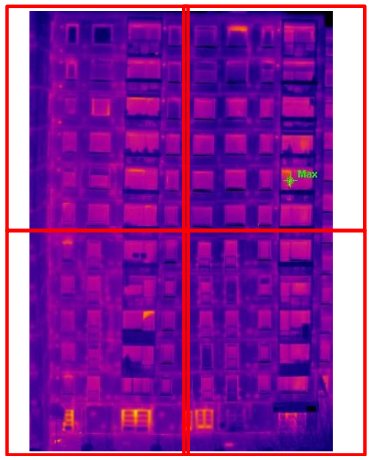
Above figure: thermal image of an apartment building from 4 pcs. 320 x 240 pixel images Pixel size: 6 ... 10 cm --> Object size: >18 ... 30 cm (the images are not from the same building or side!)
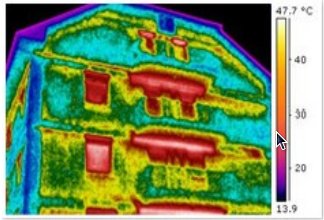
Above figure: thermal image of a condominium from 1 pc. 160 x 120 pixel image Pixel size: 5 ... 7 cm --> Object size: >15 ... 21 cm (it is easy to recognize that the image was taken under the influence of sunlight!)
Necessity of training: not a (debate) topic?!?
Why would training be necessary? Modern thermal cameras are so easy to use! Everyone can use them, just like a digital video camera ... These opinions were presented against the previous examples, which of course only point to the tip of the iceberg. Besides the numerous thermal images containing measurement errors, completely erroneous evaluations and conclusions "spiced up" reports or so-called "expert opinions" are not to be forgotten! What can be expected from a "thermal map" creator without training:
Practically, temperature measurement will never be accurate! Conclusion: Accurate and evaluable temperature measurement through the detection of infrared radiation can only be carried out with precise theoretical knowledge and practical application. We have discussed the accuracy of measurements and reports containing incorrect information due to lack of theoretical knowledge. We have not yet talked about the economic consequences of these! Just a few examples:
These examples can lead not only to incorrect investment consequences but also to huge production losses, fire hazards, and accidents !!! The person (or company) performing thermographic measurements and evaluations has a huge responsibility! The error rate can be reduced to a fraction - preferably through mandatory professional training!
The current training situation in Hungary
Thermography - as a profession - does not exist in Hungary. Thermography is not included in training programs, engineering chamber branches, or various professional classifications maintained by different ministries in Hungary. Accordingly, there is no national qualification framework training or other state-coordinated training that is mandatory for certain measurements and evaluations. The primary reason for this is the reduction of the coordinating role of the state (or its appropriate bodies and institutions) and the lack of new - replacing this - institutions. A secondary reason is that the legal background has also changed unfavorably due to the rise of market economy based on economic decision-making: many activities do not require a separate permit, so without professional requirements, anyone can perform them. It is a widely held - mistaken - belief that an energy auditor issuing the "green card" for buildings has thermographic training. This is not the case, as the use of a thermal camera is not required for their activities (such as for energy audits), nor is detailed knowledge of this measurement technology. The level of professional training of companies conducting thermographic activities in Hungary is very low. Specifically:
Out of the thousands of companies in Hungary using thermography - and even offering services in this field - only 2-300 have undergone more substantial basic training (which unfortunately does not end with a recognized certification) in Hungary or abroad. Therefore, the vast majority of companies continue to carry out service activities supporting decisions worth tens of millions without adequate expertise!
International situation
Thermography - as an inspection method - belongs to non-destructive testing methods. Accordingly, it is logical to link it to the existing (or under construction) non-destructive technology training and examination systems. In Europe, the EN473 training standard was established and introduced in 1987 through the work of CEN (European Committee for Standardization), defining a three-level training and examination system for non-destructive testing practitioners.
Essential organizational elements:
The three levels of training and examination:
Appropriate professional practice is required to reach each training level, participation in training organized by the aforementioned educational institutions, and passing the corresponding level of theoretical and practical examinations. Additionally, good health (good vision) must be medically certified.
Specializations in thermography:
Examination content:
The examination is considered successful if at least a 70% result is achieved in each sub-examination. If any sub-examination is unsuccessful, a re-examination can be taken after a minimum of 30 days (up to twice). If that is also unsuccessful, the entire examination must be repeated. To obtain a higher qualification, possession of a lower qualification, completion of training, and proof of professional practice are necessary.
In Germany, several organizations currently offer training in line with the above (in alphabetical order):
Certificates issued by these companies are internationally recognized (at least in Europe), allowing professionals with such qualifications to perform thermographic services according to their specialization. However, an additional examination is required beyond the EN 473 standard 2nd level qualification for surveys of industrial electrical equipment, making successful participants recognized as electrical equipment thermography experts by VdS (based on VdS Directive 2859).
In Germany, there is also no legal requirement specifying which qualifications and equipment are necessary for providing services. However, the significant responsibility on service providers compels them to obtain liability insurance and reduce their risks by ensuring appropriate training. In an increasing number of industrial segments and public service (urban, county) contracts (or state-supported services), possession of EN 473 qualifications is a requirement.
Professional Recommendation: The current - disastrous - training situation in Hungary can be rapidly improved by not only localizing the EN 473 training system but also allowing only service providers with the appropriate training to participate in tenders, state announcements, or municipal commissions. Furthermore, it is necessary for professional organizations (MATE, GTE ...) to engage in some professional lobbying activities against the widespread poor-quality service providers. It is essential to improve the Hungarian economy not only financially but also professionally! Note: The thermography basic training previously accredited by the Hungarian Engineering Camera and conducted by the only Level 3 Hungarian thermographer can be taken at PIM Professzionális Ipari Méréstechnika Kft. It provides the necessary knowledge for the correct execution of practical thermographic measurements, even if it does not confer a profession. Perhaps one day it will become an officially recognized training ...
Rahne Eric (PIM Kft.) pim-kft.hu, gepszakerto.hu
The content of this publication is protected by copyright. Any (even partial) use, electronic or printed re-publication is only permitted with the indication of the source and author's name, and with the prior written permission of the author. Violation of copyright (Copyright) entails legal consequences.
Copyright © PIM Professzionális Ipari Méréstechnika Kft.
2026 | Minden jog fenntartva
Impresszum | Adatkezelés