


(condition monitoring of electric faults during operation of asynchronous electric motors without disassembly)
As a mechanical system, electric rotating machines can be examined using the same methods as any other rotating machine. However, due to the structure and operation of electric rotating machines, not only mechanical forces and resulting vibrations occurring in the driven rotating machines are present. The electromechanical energy conversion in electric rotating machines takes place through the mediation of electromagnetic fields. The resulting forces not only result in the desired torque but also cause the time-varying and directional loading - and mechanical deformation - of individual machine elements. If an electrical element of an electric rotating machine is damaged from an electrical perspective, this leads to the formation of an unevenly distributed electromagnetic field. As a consequence, one must expect greater, asymmetric, or time-varying mechanical loads on individual machine elements. In such cases, in motors, greater electrical energy consumption can result in lower mechanical power output, while in generators, the supplied electrical energy decreases while being driven by mechanical energy at the same time. The decrease in efficiency is accompanied by increased losses that convert to heat, thus increasing the thermal load on components.
Causes of mechanically induced vibrations in electric machines
Magnetization frequency (magnetostriction effect) The torque of electric rotating machines is generated through the interaction of the stationary and rotating parts' electromagnetic fields. For example, if the stationary part of an asynchronous motor is connected to a 50 Hz power grid, the poles of the stationary part magnetize twice during one period of the grid (see diagram below). This means that the poles of the stationary part and all components in their electromagnetic fields are subject to a sinusoidal force pulsating at twice the grid frequency (magnetostriction effect).

Figure: magnetostriction effect
Generation of periodic forces
The poles of asynchronous motor's stationary part are always arranged in pairs to allow the magnetic field lines to pass through the rotating part. Otherwise, there would be no induction, hence no force, and ultimately no torque. Incidentally, thanks to the paired arrangement - assuming a cylindrically symmetric stationary and rotating part, and perfect positioning of the rotating part in the center of the stationary part - the radial (vibration-inducing) forces cancel each other out. Since the magnetic field strength strongly depends on the air gap between the rotating and stationary parts, it is evident that an uneven distribution of radial forces occurs when the rotating part is not positioned in the center of the magnetic field. The same vibration-inducing phenomenon occurs when an inherently asymmetric electromagnetic field is created, e.g., due to unequal currents flowing in the coils of the stationary part or coils generating different magnetic fields. This can also occur due to manufacturing (design) errors, loose cable connections, or coil short circuits. The resulting forces always occur at twice the grid frequency. Note: In the case of single-phase asynchronous motors, the ideal - symmetric - magnetic field does not develop, but a so-called rotating elliptical electromagnetic field is formed. This elliptical electromagnetic field can be decomposed into a high-amplitude rotating frequency (50 Hz) and a counter-rotating, lower-amplitude 100 Hz frequency magnetic rotating field. Therefore, these motors always exhibit the 100 Hz vibration peak and its slip frequency sidebands. Rotor bar and slot frequency vibration The rotor of an electric motor is usually not a homogeneous body. For example, the induction motors discussed below (asynchronous motors) are equipped with built-in conductive bars (rotor bars). These are crucial for the desired electromagnetic interaction to occur: during the rotation of the rotor, the rotor bars pass in front of the poles of the stationary part. During this process, voltage is induced in the bars, causing current to flow in them, creating an electromagnetic field around them. The force induced by the interaction of the field around each rotor bar and the rotating electromagnetic field of the stationary part generates the torque of the electric motor. The force induced by the interaction of the two fields reaches its momentary maximum with each pass of a rotor bar in front of a pole, hence vibrations at a frequency equal to the product of the rotation frequency and the number of rotor bars - the so-called bar frequency - occur. The same phenomenon occurs if unequal currents flow in the coils of the stationary part, or if the coils themselves generate different magnetic fields. This can occur, for example, due to loose cable connections or coil short circuits. The resulting force always acts on the electric motor components at twice (and multiples of) the grid frequency. Practical advice: method to determine the electrical or mechanical origin of vibrations Disconnect the power supply to the electric motor! Electrically induced vibrations cease immediately, while mechanically induced vibrations decrease proportionally with the speed, as described in our previous article on resonance testing. Vibrations due to electrical problems Vibrations caused by electrical problems can be divided into two main groups: vibrations due to rotor faults and vibrations due to stator faults. Initially, we will detail the vibrations resulting from rotor faults.
Vibrations due to rotor faults
Breakage of rotor bars (-rods) Electrically induced vibrations often occur at the grid frequency and its multiples. If one of the conductor rods (bars) of the rotor is broken, the inductive current can only flow through the adjacent rods (see diagram below). Therefore, in the case of broken rotor bars, the formation of magnetic fields and the resulting force are not uniform. This leads to torsional vibrations, which are generally visible in the mechanical vibration spectrum in the form illustrated on the next page.
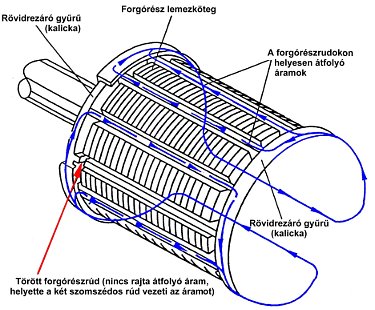
Figure: currents flowing through the rotor of an asynchronous electric motor in case of broken bars [source: J. E. Berry: Predictive Maintenance and Vibration Signature Analysis III]
The uneven force caused by fractures in the rotor bars leads to torsional vibrations, which typically manifest in the mechanical vibration spectrum as follows:
(Note: In the case of broken rotor bars, the amplitude modulation of machine vibrations is load-dependent; in the case of an eccentric rotor, there is no load-dependent change. In normal operation of electric motors, it is also observed that the mechanical performance and torque of the motor decrease proportionally with the number of broken rotor bars, and thus - under constant mechanical load - its speed decreases.)
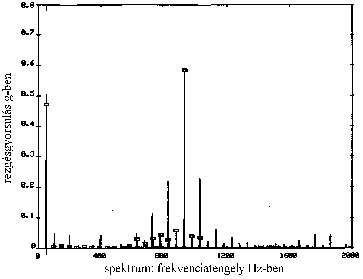
Figure: typical frequency spectrum with bar frequencies [source: CSi]


Figure: examples of rotor bar breakages [source: CSi, DDC]
The details related to vibrations caused by rotor faults according to the German VDI 3839 standard: The rotor's asymmetry leads to the modulation of bearing and housing vibrations at twice the slip frequency of the rotational speed. This is mostly audible as machine noise. Floating is also present in the stator current consumption, with a frequency equal to the slip frequency multiplied by twice the line frequency. This can be recognized from the periodic displacement of the indicator on an analog current meter and can be well displayed on an oscilloscope. Modulation due to stator asymmetry or malfunction caused by stator current increase strengthens with the motor's performance, thus rising together. This is usually clearly observable and measurable in two-pole machines. If sudden amplitude modulation of bearing vibrations occurs during operation and this modulation depends on the performance, a rotor fault can be reliably inferred. If the amplitude modulation has always been present or is not performance-dependent, rotor eccentricity is likely present.
Rotor eccentricity
The cause of the rotor's electromagnetic field eccentricity is the rotor's eccentric geometry or the fracture of bars or laminations. Here, we only address phenomena resulting from rotor geometric errors (broken bars or laminations have been discussed earlier). Rotor geometric eccentricity results from manufacturing inaccuracies or - mostly thermal - effects during operation. Since rotor balancing usually occurs at the end of the manufacturing process, the mechanical (static and dynamic) unbalance caused by geometric errors is usually imperceptible (as it has been balanced out). However, operational deformations - such as thermal deformations - cause noticeable unbalance, which immediately manifests in vibration peaks at the rotational frequency. Geometric eccentricity of the rotor always results in varying clearances (the smallest and largest clearance revolves around the stator with the rotor). This leads to periodic changes in the electromagnetic field strength and naturally induces vibrations.
The German standard VDI 3839 on the electromagnetic eccentricity of the rotating part: A concentric (centered) rotating part eccentrically placed in the stator does not induce vibrations. A rotating part constructed eccentrically causes vibrations typical of unbalance even with centered placement, as well as amplitude modulation at a frequency corresponding to the slip frequency and twice the network frequency. If the motor's vibrations show amplitude modulation, and its extent is independent of the load, there is likely a presence of rotating part eccentricity. (If this modulation depends on the load, broken rotating part rods can be inferred with high certainty.)
The CSI Pocket Vibration Troubleshooter’s Guide on the causes of vibrations: Signals showing low-frequency modulation indicate problems with the rotating part causing eccentric electromagnetic fields. Vibrations at the network frequency are characteristic of a bent or eccentric rotating part. Low-amplitude axial vibrations occur in slightly bent rotating parts. High-amplitude axial vibrations indicate a rotating part shifted from the ideal electromagnetic field or eccentric deformation of the rotating part.
Vibrations in case of stator faults
The stator of asynchronous electric motors essentially consists of coils placed around the poles (at least one per phase), stator teeth, and laminated core. Depending on the application requirements, the design solutions vary significantly. The most common faults include coil short circuits (insulation problems), stator eccentricity, coil breaks, as well as loose laminated cores or core segments. Short circuits between coils and other components, as well as coil breaks (ruptures), mainly occur due to aging, operational vibration loads, dynamic stress, or electrical or thermal overload. Short circuits can be observed within a pole pair, between different pole pairs, and between poles and the laminated core. The eccentricity of the stator's electromagnetic field may arise from geometric errors in the stator coils and their spatial arrangement, material quality issues (inhomogeneities), as well as mechanical or thermal deformation of the stator (resulting in varying air gap sizes along the circumference). The electromagnetic eccentricity of the stator can be a result of manufacturing inaccuracies or operational failures (such as thermal effects, vibration loads). General characteristics of vibrations in case of stator faults:
Notes: It is also worth noting that in the case of bent bases or motors set up with "soft" feet, different air gap sizes can often be found along the circumference. Thus, fault phenomena arising from stator eccentricity also develop. On the other hand, in the case of incorrectly aligned shafts or motors set up with a labile ("soft") base, vibrations with outstanding values at twice the network frequency can also occur.
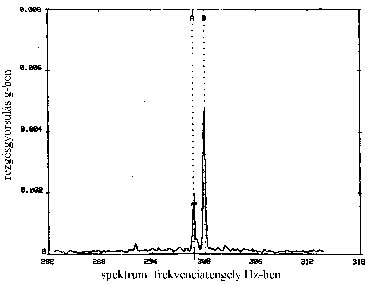
Figure: typical frequency spectrum with network harmonics [source: CSi]
Diagnosing rod fractures based on electrical phenomena
The most commonly used method for detecting fractures in the rotating part's rods, rings, or collars is the phase-by-phase examination of current intake in the low-frequency range. For this, the current of each phase must be measured separately using current clamp meters. A frequency analysis with high resolution should be performed around the network frequency range. The amplitude ratio observed between the network frequency and its sidebands at the pole modulation frequency provides information for fault detection. This ratio characterizes the extent of pulsation of the electromagnetic field per revolution. The American company CSI recommends evaluating magnetic field strength spectra recorded using a portable flux coil in addition to current spectrum recording with clamp meters. In cases where current measurement is impossible or dangerous, spectrum analysis based on flux measurement is the only solution for recording electromagnetic phenomena. Various threshold values for the amplitude ratio observed between the network frequency and its sidebands at the pole modulation frequency can be found in the literature.
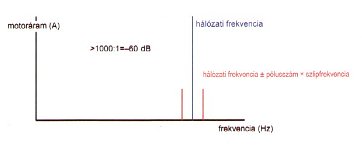
Figure: identification of rotating part rod fracture in the motor current spectrum and low-frequency electromagnetic field spectrum [source: PIM]
In the literature, the following threshold values for the amplitude ratio observed between the network frequency and the sidebands at the pole modulation frequency can be found: Technical Associates of Charlotte (current)
| Evaluation | Ratio | Comments |
| excellent | >60 dB | |
| good | 54–60 dB | |
| acceptable | 48–54 dB | trend monitoring recommended |
| warning | 42–48 dB | damaged rotating part rod or high-resistance contact |
| alert I. | 36–2 dB | broken rotor bar or multiple high-resistance contacts |
| alert II. | 30–36 dB | multiple broken rotor bars, end ring, or contactor faults |
| malfunction | severe faults (multiple types at once) |
| CSI (current, or flux) | Mitchell (current) | |
| ok | >54 dB | >45 dB |
| warning | 54–45 dB | |
| alert | 45–40 dB | 35–45 dB |
| malfunction |
Explanation of Common Technical Terms
Slip Frequency
In induction motors, slip frequency is the difference between the mechanical rotation frequency and the synchronous electromagnetic field rotation frequency. Slip increases with increasing load, making motor problems best examined under full load. The slip is denoted dimensionless by "s" and can be calculated as follows:
s = 1 – ( Ff / Fsyn ), where Ff is the motor rotation frequency in Hz, or the speed in revolutions per minute divided by 60 Fsyn is the synchronous electromagnetic field rotation frequency in Hz, i.e., 2×Fh/P Pole Frequency
The pole frequency is the product of the number of conductor rods on the rotor and the rotation frequency. Electrically induced mechanical (vibration) frequency.
Frúd = Ff × R, where Ff is the motor rotation frequency in Hz, or the speed in revolutions per minute divided by 60 R is the number of rods on the rotor Pole Modulation Frequency
The pole modulation frequency is the product of the number of poles and the slip frequency. The electrically induced frequency occurring in the electromagnetic field (or in the supply current), causing mechanical vibrations, only present in asynchronous motors.
Fpolm = Fs × P, where Fs is the motor slip frequency in Hz, i.e., 2×Fh/P-Ff Ff is the motor rotation frequency in Hz, or the speed in revolutions per minute divided by 60 Fsyn is the synchronous electromagnetic field rotation frequency in Hz, i.e., 2×Fh/P P is the number of poles on the motor stator
Rahne Eric (PIM Ltd.) pim-kft.hu, gepszakerto.hu
The content of this publication is protected by copyright. Any (even partial) use, electronic or printed re-publication is only permitted with the indication of the source and author's name, and with the author's prior written consent. Violation of copyright (Copyright) will have legal consequences.
Copyright © PIM Professzionális Ipari Méréstechnika Kft.
2026 | Minden jog fenntartva
Impresszum | Adatkezelés