Anti-aliasing filters are often recommended as accessories for modern measuring instruments. But what exactly is an anti-aliasing filter? Why and when is it necessary and when is it not? What is the effect of such a filter, what are its advantages and disadvantages? These questions are answered in the following article, which, due to the breadth and versatility of the topic, of course cannot cover everything. However, it aims to provide practical assistance to professionals dealing with digital measurements.An anti-aliasing filter is an active or passive low-pass filter placed directly before the A/D converter in digital signal acquisition with the aim of reducing or eliminating the so-called Aliasing effect (signal distortion due to undersampling).
Practically, the anti-aliasing filter performs band limiting of the analog signal before its digitalization (sampling and amplitude quantization). In addition to reducing or eliminating signal distortion due to undersampling (Aliasing), it also improves the signal-to-noise ratio.
Based on the above, one might think that an anti-aliasing filter only has advantages. However, this is not the case: the decrease in bandwidth increases the rise and settling time for transients occurring at the analog input. In practice, for example, the modified time law of telecommunications must be followed, which can be defined as follows: input bandwidth * settling time = 1.2 Additionally, depending on the type of higher-order low-pass filters, they may cause smaller or larger phase and amplitude errors, which in turn degrade the accuracy of the entire measurement channel. Let's summarize briefly once again: An anti-aliasing filter...
We have not yet focused on the first aspect - the Aliasing effect. Therefore, in the following, we will delve more into the reasons necessitating the application of band-limiting filters as anti-aliasing filters.
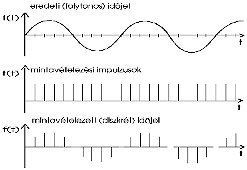 |
| Figure 1 (source: PCB) |
The analog signal - for example, a sinusoidal signal - sampled at time points tn = n * Tsample. When choosing the sampling frequency fsample = 1 / Tsample >> the frequency of the sinusoid, the sinusoidal signal, when reconstructed from the sample sequence, is easily recognizable. The first figure illustrates this.
However, the recognizability of the digitized signal is not always guaranteed. The most important condition for the digital recording of analog signals is to adhere to the Shannon theorem (= sampling theorem), which states that the sampling frequency (fsample) should be at least twice the frequency of the highest frequency component in the signal (fsignal-max). Expressed with the Shannon theorem equation: fsample > 2 * fsignal-max When this theorem is disregarded, Aliasing effects occur, which is nothing but signal distortion due to undersampling: a high-frequency signal appears as a lower-frequency signal after digitization.
Cause of the Aliasing Effect
Based on distribution theory and the properties of Fourier transformation, it can be derived that the spectral function of a discrete (originally continuous signal obtained by sampling) signal is cyclic (periodic). The frequency domain (the combined bandwidth of analog components before A/D conversion) is not only symmetric around the f = 0 Hz frequency - the so-called base spectrum, but also symmetrically mirrored around the sampling frequency and its harmonics (multiples). In cases where the continuous signal has components with frequencies higher than fsample / 2 (or the base frequency of the signal is greater than twice the sampling frequency), the spectral function shown in figure 3 is formed. The overlap between the base spectrum and the spectrum mappings around the sampling frequency and its harmonics is clearly visible. As a result, the mapping of higher-frequency components of the signal at the sampling frequency and its multiples occurs in the base spectrum or even transitions to other spectrum mappings associated with this base spectrum.
The result of digital signal recording - the sequence of digitized discrete signal samples - is nothing but the information content of the base spectrum. Therefore, when reconstructing the signal (graphical representation, mathematical evaluation, frequency domain analysis), the higher-frequency components of spectrum mappings at multiples of the sampling frequency also play a role if their mapping falls within the base frequency band. In other words: The mapping of signal components with frequencies higher than fsample / 2 occurs at lower frequency locations of components and therefore non-existent low-frequency signal components appear during signal reconstruction. This signal distortion problem is called the Aliasing effect, and the errors resulting from it after digital signal recording are not correctable and occur in both time domain and frequency domain analyses.
A typical error attributable to Aliasing problems is shown in figure 4.
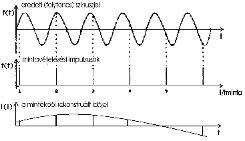 |
| Figure 4 (source: PCB) |
To eliminate the mentioned errors, the following solutions are possible:
Applying the Antialiasing filter results in frequency band limitation and improvement of the signal-to-noise ratio, as higher frequency interferences are not digitized.
Selecting the type of filter against Aliasing effect
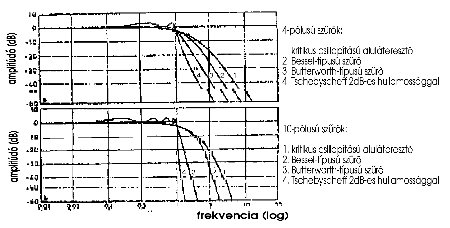
Filters of different types have characteristic transfer functions that describe how the filtered signal will be compared to the input signal. This transfer characteristic can be broken down into the filter's amplitude response and phase response as a function of frequency. Since each time signal can be described by its amplitude spectrum and phase angle spectrum, we can calculate the signal appearing at the filter output: the resulting time signal is obtained by multiplying the original time signal's amplitude values with the filter's amplitude response and adding the resulting phase angle of the original time signal to the phase shift described in the filter's phase response. Of course, the change in amplitude and phase spectrum caused by the filter also represents a change in the resulting time signal. It is in our interest that the time signal (apart from attenuating signal components higher than fsample / 2) changes as little as possible. Accordingly, we need a low-pass filter that causes the least amount of signal distortion. For low-pass filters, the degree of signal distortion is greater:
|
|
| Figure 5 (source: PCB) |
The filter frequency characteristics shown in Figure 5 reveal the favorable amplitude response of the Bessel-type filter: a flat transition at the -3dB cutoff frequency between the passband and cutoff frequency range and a not too steep frequency response in the cutoff range. Looking at the phase responses depicted in Figure 6, the Bessel-type low-pass filter also proves to be favorable, as its phase response is approximately linear in the passband and the phase shift is minimal. (In the case of signal jumps, overshoot is lower compared to other low-pass filter types with the same number of poles.)
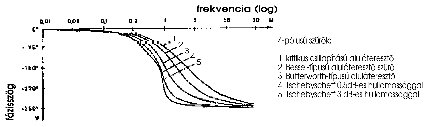 |
| Figure 6 (source: PCB) |
The only drawback of the Bessel-type low-pass filter is that due to the flat -3dB transition, the filter's cutoff steepness (and hence its attenuation effect) is fully effective only at higher frequencies. However, this is more acceptable than greater signal distortion, as our primary goal is to reduce the Aliasing effect while preserving the original signal.
Application of Bessel-type filter as Antialiasing filter
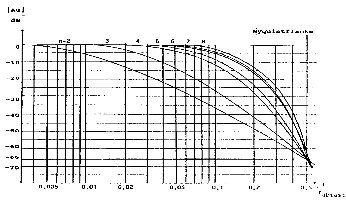
As an optional accessory for our devices, we chose the Bessel-type low-pass filter due to its low signal distortion and other favorable properties for Antialiasing filter applications. Since this filter can be constructed using resistors, capacitors, and operational amplifiers, we opted for the 8-pole filter. Filters with more poles would have required more active and passive components, which due to their tolerances would have strongly affected reproducibility and long-term stability. (This can be proven with simple error calculations.) On the other hand, filters with too low pole numbers would result in a significant reduction in the available baseband width if we demand that a noise signal be attenuated by at least -66dB = 1/2048 at the Nyquist frequency (fnyq = fsample / 2).
 |
| Figure 7 (source: PCB) |
Figure 7 shows the relationship between the -3dB cutoff frequency (fc) of an n-pole Bessel filter and the sampling frequency when aiming for a -66dB attenuation at the Nyquist frequency. The cutoff steepness of an n-pole Bessel filter is otherwise
-n * 20dB / decade or -n * 6dB / octave. An 8-pole Bessel-type filter with fc = fsample / 10 cutoff frequency at the Nyquist frequency (fnyq = fsample / 2) has a -66dB attenuation. The settling time of the filter is tset = 12 / fsample. Minimal - at least -80dB - attenuations can be maintained up to ten times the maximum possible channel sampling frequency. The mentioned attenuations strongly depend on the gain reserves of the operational amplifiers and the resonant frequencies of the capacitors. Bessel-type low-pass filters with -66dB attenuation at the Nyquist frequency show the evolution of the -3dB cutoff frequency based on the filter pole number in the following table. It is easy to see that for utilizing the frequency range of the measurement channels, 8-pole Bessel filters are most suitable for creating band-limited 12-bit measurement channels. Filters with fewer poles would result in excessive narrowing of the available frequency band, and filters with more poles are not favorable due to the reasons mentioned above. Therefore, the 8-pole Bessel-type filter is the optimal compromise between cost-effectiveness and operation.
| Number of poles | -3dB cutoff frequency |
| 2 | fsample / 120 |
| 3 | fsample / 37 |
| 4 | fsample / 20.8 |
| 5 | fsample / 15 |
| 6 | fsample / 12.2 |
| 7 | fsample / 10.8 |
| 8 | fsample / 10 |
Rahne Eric (PIM Ltd.) pim-kft.hu, gepszakerto.hu
The content of the publication is protected by copyright. Any (even partial) use, electronic or printed re-publication is permitted only with the indication of the source and the author's name, and with the author's prior written permission. Violation of copyright (Copyright) will have legal consequences.
Copyright © PIM Professzionális Ipari Méréstechnika Kft.
2026 | Minden jog fenntartva
Impresszum | Adatkezelés